
50 Things a Writer Shouldn't Do & Three Guys One Book. Ten Obvious Truths About Fiction. The following essay was previewed in the class that Stephen Graham Jones taught for LitReactor, Your Life Story Is Five Pages Long. 1.
The reader should never have to work to figure out the basics of your story. Who’s whose wife or husband, what the time period is if that matters, why these people have broken into this house, and on and on, just the basic, ground-level facts about your story. If you don’t relay that stuff up-front, as quickly and efficiently as possible (and please don’t be fancy), then your story becomes a game of three-card-monty, with you hiding information under this or that shell, trying to keep everything moving fast enough that nobody knows what’s going on. Which is to say your story becomes about the reading of the story, not the experience the story is trying to get the reader to engage. 2.
Meaning you don’t have to lay every last detail of every last thing out. The best writers are the ones who can cover the most distance with the fewest words. 3. 4. 5. You Are A Short Story, He Was A Novel. You are a short story.
You start in the middle maybe, and you don’t have a long word count. A few pages. A short arc. A gimmick. Some terse resolution.
How to Write Better: 7 Instant Fixes. Does your writing stand out?
Do you worry whether your writing is good enough? I can see you nodding your head. You are not alone. Ink - Quotes about writing by writers presented by The Fontayne Group. Writing "I put a piece of paper under my pillow, and when I could not sleep I wrote in the dark.
" Seven great writing quotes from seven great American writers. Ernest Hemingway once said “All American literature comes from one book by Mark Twain called Huckleberry Finn.
There was nothing before. There has been nothing as good since.” As much as we love our Ernest, we beg to differ. It’s not just the amazing books Americans have written, which cause us to contradict Papa’s viewpoint. It’s the words of wisdom these masters have shared about their craft. CALLIHOO Writing Helps.
Character Feelings You can describe your character's feelings in more exact terms than just "happy" or "sad.
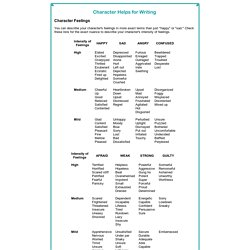
" Check these lists for the exact nuance to describe your character's intensity of feelings. 36 Writing Essays by Chuck Palahniuk. 1: Establishing Your Authority Chuck teaches two principal methods for building a narrative voice your readers will believe in.

Discover the Heart Method and the Head Method and how to employ each to greatest effect. 2: Developing a Theme At the core of Minimalism is focusing any piece of writing to support one or two major themes. Learn harvesting, listing, and other methods, after a fun excursion into the spooky side of Chuck's childhood.
Random Name Generator - StumbleUpon. Funny random pictures. Bukowski's letter to a library that banned his books. In 1985, a library in Holland banned one of Charles Bukowski's books: Tales of Ordinary Madness.
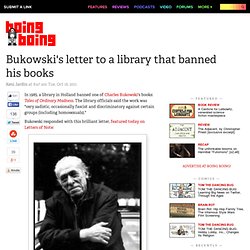
The library officials said the work was "very sadistic, occasionally fascist and discriminatory against certain groups (including homosexuals). " Bukowski responded with this brilliant letter, featured today on Letters of Note: In my work, as a writer, I only photograph, in words, what I see. If I write of "sadism" it is because it exists, I didn't invent it, and if some terrible act occurs in my work it is because such things happen in our lives. I am not on the side of evil, if such a thing as evil abounds. I love that he signed this letter (and others) with little drawings. English 50 - StumbleUpon. Thirty Question Character Survey. 25 Free writing sites for prompts, exercises, lesson plans and more -...
Exercises for Fiction Writers - Page 2 - StumbleUpon. The Online Literature Library. Cliche Finder. Short stories at east of the web - StumbleUpon. A game of Scrabble has serious consequences.
One Sentence - True stories, told in one sentence. English 50 Exercises for Story Writers - StumbleUpon. English 50 – Intro to Creative Writing: Exercises for Story Writers Basic Theory: What is a short story?
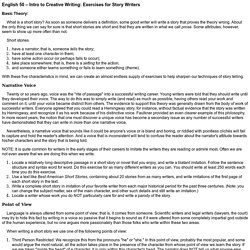
As soon as someone delivers a definition, some good writer will write a story that proves the theory wrong. About the only thing we can say for sure is that short stories are short and that they are written in what we call prose. Some attributes, however, seem to show up more often than not. Short stories have a narrator; that is, someone tells the story; have at least one character in them; have some action occur (or perhaps fails to occur); take place somewhere; that is, there is a setting for the action; and someone either learns something or fails to learn something (theme).With these five characteristics in mind, we can create an almost endless supply of exercises to help sharpen our techniques of story telling. Narrative Voice Twenty or so years ago, voice was the "rite of passage" into a successful writing career.
Eight Secrets Which Writers Won't Tell You. Image from Flickr by Lazurite This is not particularly relevant to the post, but I’m getting an awful lot of comments telling me, often a little snarkily, “it’s ‘THAT’ not ‘WHICH’”. The “don’t use which for restrictive clauses” rule comes (as far as I can tell) from Strunk and White. Plenty of authors, including Austen, have used “which” exactly as I use it in the title.
It’s very commonly used like this here in England, so I’m guessing my comments are coming from US readers. There was never a period in the history of English when “which” at the beginning of a restrictive relative clause was an error. BookMooch: trade your books with other people.
Mayer-Bernadette_Experiments.html from upenn.edu. Sheet-for-Emotions.jpg from psychcentral.com - StumbleUpon.