
Personal Learning Environment & PL Network. Ecritures et arts numériques. Edition / Présentation / Création. How to be an effective digital curator. GoodUI. Curation as Digital Literacy Practice. I have been writing my PhD so haven’t updated this blog for a while.
Thesis writing is taking up a lot of my mental space as I get the ideas, storyline and contentions to ‘coalesce’ and cohere in a manner suitable for such a piece of work. I’ve been mulling over a series of ideas in my analysis of digital literacies, and one of them is the concept and practice of ‘curation’ as a digital literacy, and what the implications are for curation practices to be better understood, theorised, and subsequently harnessed for educational purposes. My PhD thesis (Bhatt, forthcoming) is not fully completed yet, but some ideas are worth throwing out to collide with others as part of what I believe is a public conversation (#impact #engagement).
[Aside: see this brief lecture by Steven Johnson on the ‘collision’ of ideas and the sharing of half-baked hunches] Back to the topic: Source: Students’ previous, even non-academic, work gets linked to assignments where relevant. References: Bhatt, I. Tufte, E. XXI CENTURY ARCHIVING. Digital curation tools. How to be an effective digital curator. Digital curation tools. Interesting Search Engines.
Semantic Web. Ranganathan. Application of Ranganathan's Laws to the Web: the Five Laws of the Web. Alireza Noruzi Department of Information Science, University of Paul Cezanne, Marseille, France Received November 5, 2004; Accepted December 3, 2004.

Ranganathan Killed the Library Theorist. I have been thinking a lot about the philosophical underpinnings of librarianship lately and recently reread Andre Cossette’s essay: Humanism and Libraries: An Essay on the Philosophy of Librarianship, (1976) which was recently translated from French by Rory Litwin, and is available from Litwin’s Library Juice Press.

This essay illustrates the lack of philosophical and theoretical thinking in librarianship that has been troubling me as of late, and lays out a “philosophy of librarianship” grounded in the humanist/realist schools of thought that I feel could bring about a renaissance to our profession and pull us out of the malaise that we are currently mired in professionally. I’ll write more about this in a later post, but I want to focus for a moment on why we are currently in this state in the profession. There is no doubt that S. R. Ranganathan is one of the greats in the field of library science and in the profession of librarianship.
Cossette, A. (2009). Hunt, S. Ranganathan, S. Folksonomy tagging: "crowdsourcing" metadata for Library 2.0? Folksonomies et communautés de partage de signets. Tag Literacy. Introduction: Part of the allure of classifying things by assigning tags to them is that the user can give free reign to sloppiness.
There is no authority —human or computational— passing judgment on the appropriateness or validity of tags, because tags have to make sense first and foremost to the individual who assigns and uses them. And yet, the whole point of distributed classification systems (DCSs) such as del.icio.us and flickr is that the aggregation of inherently private goods (tags and what they describe) has public value: When people use the same tag to point to different resources they are organizing knowledge in a manner, commonly referred to as a folksonomy, that makes sense to them and to others like them.
We can say, then, that DCSs function at the intersection of individual choices and the shared linguistic/semantic norms of a social group (the folks in folksonomy). Homme ou machine ? Qu’est-ce que la cultu. L’opposition homme-machine est un leurre.
Il s’agit plus d’ailleurs d’une association même si elle peut être parfois néfaste, c’est-à-dire relevant davantage d’une dissociation voire d’une prolétarisation qui se manifeste au moins par une perte de savoirs et de savoir-faire. Je reviens ici sur ces aspects en utilisant quelques passages de mon travail de recherche doctoral. La technique est part constitutive de la culture ce que plusieurs chercheurs dans diverses disciplines ont déjà entrepris de démontrer.
Folksonomies. Le terme de folksonomie est apparu récemment sur le web pour désigner le phénomène d’indexation des documents numériques par l’usager.
On rencontre également fréquemment le mot tag qui désigne en quelque sorte un mot-clé. Le terme de folknologie est aussi employé, mais plus rarement. L’usage du mot folksonomie semble donc plus opportun. Culture documentaire et folksonomies. Article "de commande", pour la revue "Documentaliste, sciences de l'information", à paraître fin Février 2010.
La version ci-dessous est celle de soumission, non encore revue et corrigée pour publication définitive. La version définitive sera déposée en archives ouvertes au moment de sa parution. Culture documentaire et folksonomies. Outils 2.0. Hashtags. Hashtags Introduction Hashtags are a community-driven convention for adding additional context and metadata to your tweets.
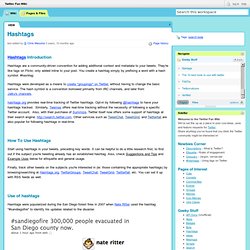
They're like tags on Flickr, only added inline to your post. You create a hashtag simply by prefixing a word with a hash symbol: #hashtag. Hashtags were developed as a means to create "groupings" on Twitter, without having to change the basic service. The hash symbol is a convention borrowed primarily from IRC channels, and later from Jaiku's channels. hashtags.org provides real-time tracking of Twitter hashtags. How To Use Hashtags Start using hashtags in your tweets, preceding key words. Finally, track other tweets on the subjects you're interested in (ie: those containing the appropriate hashtags) by browsing/searching at Hashtags.org, TwitterGroups, TweetChat, TweetGrid, Twitterfall, etc.