
Prolotherapy. Prolotherapy is also known as "proliferation therapy," "regenerative injection therapy,"[1] or "proliferative injection therapy".

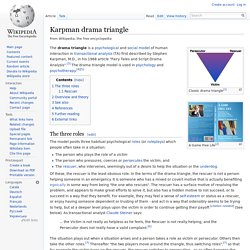
It involves injecting an otherwise non-pharmacological and non-active irritant solution into the body, generally in the region of tendons or ligaments for the purpose of strengthening weakened connective tissue and alleviating musculoskeletal pain.[2][3][4][5] The precise mechanism of action for prolotherapy is currently unclear.[6] History[edit] Karpman drama triangle. Classic drama triangle[1] The drama triangle is a psychological and social model of human interaction in transactional analysis (TA) first described by Stephen Karpman, M.D., in his 1968 article "Fairy Tales and Script Drama Analysis".[3] The drama triangle model is used in psychology and psychotherapy.[4][5] The three roles[edit]
Welcome to Less Wrong. FMS: Feature [Part I: Igor Stravinsky on Film Music] Editor's note: We are pleased to present a fascinating three-part Da Capo series.
![FMS: Feature [Part I: Igor Stravinsky on Film Music]](http://cdn.pearltrees.com/s/pic/th/feature-part-stravinsky-music-24774924)
The following article by Igor Stravinsky first appeared in the September 1946 issue of The Musical Digest, a monthly publication which proclaimed itself as "an independent magazine to intensify your enjoyment of good music" and was financed by Henry H. Reichhold, a chemical corporation mogul. The magazine ran from 1920 to 1949. Because of its length, Stravinsky's article is offered in two parts.
Below we feature Part I; Part II will appear on Friday, October 17. Transformation of “The Psycho Theme” – in Bernard Herrmann’s Music for Psycho – The Bernard Herrmann Society. Originally published in Interdisciplinary Humanities, "Music in Context", 2009.

Published here October 2010. Alfred Hitchcock’s Psycho has become one of the most celebrated American films in its genre and Bernard Herrmann’s music for the film contains an equally celebrated musical icon—the slasher music—that has become a universal motif for all slasher films. The roots of this slasher music are found in a tune called “The Psycho Theme” (a label given to it in the cue sheets) that has been largely ignored over the years.
Advanced Music Theory Lesson 7- Atonality and Serialism. Atonality, Serialism, Organized Chaos Ah, the penultimate lesson.
I want to cover a few things during this one. First, a final important theory concept, atonality. Atonality arises when there is no discernible key or tonic to a piece. This style of writing was developed by Arnold Schoenberg, though others like Charles Ives and even Strauss were experimenting with it around the same time. Lady in a Cage (1964) pt.1/9. Arnold Schoenberg's Twelve-Tone Method (English) Planet of the Apes - Soundtrack - Track 1. Jerry Goldsmith. Psycho (film) From Wikipedia, the free encyclopedia Psycho may refer to: Titled works[edit] Literary cycle[edit] Independent of the cycle[edit] Musical works[edit]

Bernard Herrmann. Bernard Herrmann (June 29, 1911 – December 24, 1975) was an American composer known for his work in motion pictures.

Early life and career[edit] Herrmann, the son of a Jewish middle-class family of Russian origin, was born in New York City as Max Herman.[1] He attended high school at DeWitt Clinton High School, at that time on 10th Avenue and 59th Street in New York City.[2] His father encouraged music activity, taking him to the opera, and encouraging him to learn the violin. After winning a composition prize at the age of thirteen, he decided to concentrate on music, and went to New York University where he studied with Percy Grainger and Philip James.
Bernard Herrmann. Bernard Herrmann (June 29, 1911 – December 24, 1975) was an American composer known for his work in motion pictures.
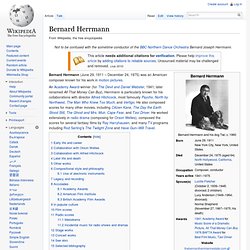
Early life and career[edit] Herrmann, the son of a Jewish middle-class family of Russian origin, was born in New York City as Max Herman.[1] He attended high school at DeWitt Clinton High School, at that time on 10th Avenue and 59th Street in New York City.[2] His father encouraged music activity, taking him to the opera, and encouraging him to learn the violin. After winning a composition prize at the age of thirteen, he decided to concentrate on music, and went to New York University where he studied with Percy Grainger and Philip James.
He also studied at the Juilliard School and, at the age of twenty, formed his own orchestra, the New Chamber Orchestra of New York. Arnold Schoenberg. Arnold Schoenberg, Los Angeles, 1948.

Leonard Rosenman. Leonard Rosenman (September 7, 1924 – March 4, 2008) was an Oscar and Emmy award-winning American film, television and concert composer.

Life and career[edit] Leonard Rosenman was born in Brooklyn, New York. After service in the Pacific with the Army Air Forces in World War II, he earned a bachelor's degree in music from the University of California, Berkeley. Serialism in movie scores - Yahoo! Answers. FSM Board: Serialism in Film Scores. I am researching film music that partly uses Schoenberg-style "serialism" as part of its composition. I'm not entirely sure, but some of Jerry Goldsmith's work sounds like it might use his ideas and other experimental techniques. Thanks. don't want to spoil, but Schoenberg did not compose "serial" music in the accurate sense of the word, but dodecaphonic (another term for twelve-tone-technique) which means the tone pitches are arranged in a tone row determining the order of the pitches as they appear in the composition.
"Serialism" is expanding that principle on the other parameters, rhythmic values, dynamic degrees etc. I know that those terms are confused with each other quite often and obviously Schoenbergs dodecaphonic music ignited the later serialism, but in the exact sense of the words they are not the interchangeable - though even film composers confuse both terms. I think you're confusing things here. I honestly can't think of a single total serial score. Serialism and Just Intonation.
10 Feb 2014 Status: We are currently in an extended Intermission as my brain processes, sorts and curates down to manageability the amazing huge volume of lovely things I wish to share with you all. 4 Feb 2014 3 Feb 2014 Mahmud Nomozov / Махмуд Номозов In the deserts and wastelands, dwelling within ruins and old pottery are jin and jinniyeh spirits, seen by some as entities from another dimension which can project themselves into forms pleasing to those who encounter them. In this video the human momentarily sees past the shapeshifting forms taken on and manages to escape.
Karlheinz Stockhausen By David Paul - Orginally published in SECONDS #44. His father killed in combat, his institutionalized mother put to death by the authorities, he was a stretcher-bearer at sixteen treating casualties in a military hospital right behind the front lines. As the war wound down, the huge red cross painted on the roof of the hospital proved too tempting for Allied air raiders to resist. With no time to bury the dead, his job became piling fresh corpses on top of old ones.