
Jean lurcat - Buscar con Google. Paul klee - Buscar con Google. Gustave singier - Buscar con Google. Alfred manessier - Buscar con Google. Sergei Eisenstein. Life and career[edit] Early years[edit] Young Sergei with his parents Mikhail and Julia Eisenstein.
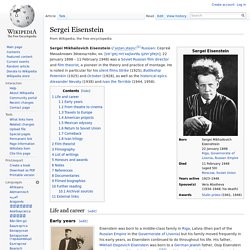
At the Petrograd Institute of Civil Engineering, Sergei studied architecture and engineering, the profession of his father.[11] In 1918 Sergei left school and joined the Red Army to serve the Bolshevik Revolution, although his father Mikhail supported the opposite side.[12] This brought his father to Germany after the defeat of the Tsarist government, and Sergei to Petrograd, Vologda, and Dvinsk.[13] In 1920, Sergei was transferred to a command position in Minsk, after success providing propaganda for the October Revolution. At this time, he was exposed to Kabuki theatre and studied Japanese, learning some 300 kanji characters, which he cited as an influence on his pictorial development.[14][15] These studies would lead him to travel to Japan. From theatre to cinema[edit] With Japanese kabuki actor Sadanji Ichikawa II, Moscow, 1928 Travels to Europe[edit]
David Wark Griffith. David Wark Griffith (La Grange, en la zona rural de Kentucky, 22 de enero de 1875 – Hollywood, 21 de julio de 1948) fue un director cinematográfico estadounidense y considerado el creador del modelo americano de representación cinematográfica (o montaje invisible), por lo que fue llamado «El padre del cine moderno».

Biografía[editar] De ascendencia irlandesa, se educó bajo las influencias dominantes en el Sur de los Estados Unidos de aquella época, con toda la carga de racismo que esto conllevaba, y que le influyeron poderosamente en su carrera. Hay que destacar de este prolífico director que realizó más de 500 filmes y colaboró en la creación de muchos otros.
De joven quiso ser escritor, pero ya en 1897 se hizo actor aficionado, llegando a ser profesional tres años más tarde. Dada la época y la popularidad del incipiente cinematógrafo, sobre todo entre los actores norteamericanos. «El padre del cine moderno»[editar] El discurso de los Lumière. Articoli_files/WASSILY KANDINSKY Y LA MÚSICA VISUAL.pdf. Abstract art. Robert Delaunay, 1912-13, Le Premier Disque, 134 cm (52.7 in.), Private collection.
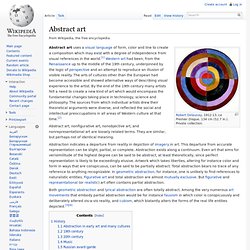
Abstract art, nonfigurative art, nonobjective art, and nonrepresentational art are loosely related terms. They are similar, but perhaps not of identical meaning. Both geometric abstraction and lyrical abstraction are often totally abstract. Among the very numerous art movements that embody partial abstraction would be for instance fauvism in which color is conspicuously and deliberately altered vis-a-vis reality, and cubism, which blatantly alters the forms of the real life entities depicted.[3][4] History[edit] Abstraction in early art and many cultures[edit] Much of the art of earlier cultures – signs and marks on pottery, textiles, and inscriptions and paintings on rock – were simple, geometric and linear forms which might have had a symbolic or decorative purpose.[5] It is at this level of visual meaning that abstract art communicates.
Kazimir Malevich. Kazimir Severinovich Malevich[nb 1] (23 February 1879 – 15 May 1935) was a Russian painter and art theoretician.[1] He was a pioneer of geometric abstract art and the originator of the avant-garde, Suprematist movement.[2][3][4] Early life[edit] Kazimir Malevich was born Kazimierz Malewicz to a Polish family,[5][6] who settled near Kiev in the Kiev Governorate of the Russian Empire (former Polish-Lithuanian Commonwealth, today Ukraine) during the partitions of Poland.[7] His parents, Ludwika and Seweryn Malewicz, were Roman Catholic like most ethnic Poles.[8] They both had fled from the former eastern territories of the Commonwealth (present-day Kopyl Region of Belarus) to Kiev in the aftermath of the failed Polish January Uprising of 1863 against the tsarist army.[9] His native languages were Russian and Polish.[10] Kazimir's father managed a sugar factory.

Kazimir was the first of fourteen children,[7] only nine of whom survived into adulthood. Wassily Kandinsky. Wassily Wassilyevich Kandinsky (/kænˈdɪnski/; Russian: Васи́лий Васи́льевич Канди́нский, Vasiliy Vasil’yevich Kandinskiy, pronounced [vaˈsʲilʲɪj kɐnˈdʲinskʲɪj]; 16 December [O.S. 4 December] 1866 – 13 December 1944) was an influential Russian painter and art theorist.
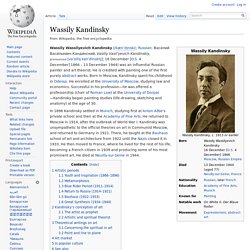
He is credited with painting one of the first purely abstract works. Born in Moscow, Kandinsky spent his childhood in Odessa. He enrolled at the University of Moscow, studying law and economics. Successful in his profession—he was offered a professorship (chair of Roman Law) at the University of Dorpat—Kandinsky began painting studies (life-drawing, sketching and anatomy) at the age of 30. In 1896 Kandinsky settled in Munich, studying first at Anton Ažbe's private school and then at the Academy of Fine Arts. Artistic periods[edit] Kandinsky's creation of abstract work followed a long period of development and maturation of intense thought based on his artistic experiences. Sinestesia: El caso Kandinsky - Vìdeo Dailymotion.