
Groups - Cosm API Documentation. Xively is a Platform as a Service (PaaS) for the Internet of Things.

Xively simplifies the interconnection of devices, data, people and places, accelerating the creation of compelling solutions that transform how people experience their world. Xively Cloud Services™ provide messaging, data archiving, provisioning and directory services which are accessible through the Xively API. Xively ’s web applications leverage the API to provide connected product lifecycle management capabilities through Xively Developer Workbench and Xively Management Console. To help you get up to speed quickly with the Xively Web tools, we have a detailed tutorial. The Xively API makes it quick and easy to create products that connect across the Internet of Things. A hierarchy of data types is used to represent data in the Xively platform: The Xively API documentation is intended to help you understand and utilize the Xively API.
Supporting elements of the API provide security and communications capabilities. Welcome to BeyWatch. Printed Sensors Could Help Save You From Spoiled Food. Ninja Blocks: Connect your world with the web. by Ninja Blocks. Follow us on Facebook or Twitter.
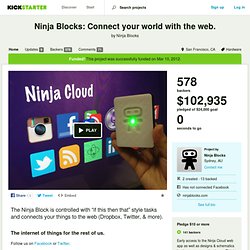
Want to bridge the things in your life with the web? Maybe you want to get an alert when your friends are playing on Xbox Live, or send an SMS to your phone when someone is at your front door. Olly and Molly: the web connected smelly robots. by Benjamin Redford. Thanks for checking out our project.
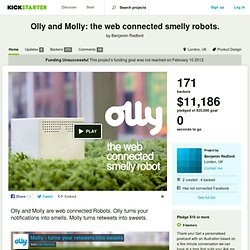
With your help, we hope to get Olly and Molly out in the world! Molly is the latest addition to the Ollyfactory family.She is a module that turns your tweets into sweets by counting how many times you get retweeted, then releasing a tasty candy when a number you've set is reached.You can stack Molly and Olly together to release sweets and smells.You can set Molly to count a number of re-tweets with our simple app.
Olly is a web-connected smelly robot that turns your online notifications into smells. DARPA-Funded Hacker's Tiny $50 Spy Computer Hides In Offices, Drops From Drones. Flying Drone Can Crack Wi-Fi Networks, Snoop On Cell Phones. 'LikeBelt' Prototype Lets You Update Facebook with a Hip Thrust. Wear the LikeBelt to hip-thrust your way to real-world Facebook liking.

Image: Deeplocal Facebook has permeated practically every nook and cranny of the online experience. Our friends’ faces appear in Facebook widgets placed on sites we visit, and “like” buttons are attached to nearly every piece of journalism we read. In fact, one’s attached to the article you’re reading now. Android - a robot or a mobile OS? [shared]] Ovidiu Vermesan: Workshop on Smart Object Security, 23rd March 2012, Paris. Workshop on Smart Object Security, 23rd March 2012, Paris: "Early 2011, the Internet Architecture Board (IAB) solicited position statements for a workshop on 'Interconnecting Smart Objects with the Internet', aiming to get feedback from the wider Internet community on their experience with deploying IETF protocols in constrained environments.

The workshop took place in Prague on March, 25th, 2011. During the workshop a range of topics were discussed, including architecture, routing, energy efficiency, and security. The workshop report summarizes the discussion and suggested several next steps. " "During the months following the workshop indeed a number of IETF initiatives were started, IETF participants submitted Internet drafts, and hands-on code hacking events at IETF 81 and 80 were organized to better facilitate the exchange of ideas. 1. In case of questions please send a mail to <smart-object-security AT lists.i1b.org> Apache Mahout: Scalable machine learning and data mining.
Slope One. Slope One is a family of algorithms used for collaborative filtering, introduced in a 2005 paper by Daniel Lemire and Anna Maclachlan.[1] Arguably, it is the simplest form of non-trivial item-based collaborative filtering based on ratings.
Their simplicity makes it especially easy to implement them efficiently while their accuracy is often on par with more complicated and computationally expensive algorithms.[1][2] They have also been used as building blocks to improve other algorithms.[3][4][5][6][7][8][9] They are part of major open-source libraries such as Apache Mahout and Easyrec. Item-based collaborative filtering of rated resources and overfitting[edit] Nanode and Pachube for the rest of us.
Electronic Product Code. The Electronic Product Code (EPC) is designed as a universal identifier that provides a unique identity for every physical object anywhere in the world, for all time.
Its structure is defined in the EPCglobal Tag Data Standard [1], which is an open standard freely available for download from the website of EPCglobal, Inc.. The canonical representation of an EPC is a URI, namely the 'pure-identity URI' representation that is intended for use when referring to a specific physical object in communications about EPCs among information systems and business application software.
The EPCglobal Tag Data Standard also defines additional representations of an EPC identifier, such as the tag-encoding URI format and a compact binary format suitable for storing an EPC identifier efficiently within RFID tags (for which the low-cost passive RFID tags typically have limited memory capacity available for the EPC/UII memory bank). Auto-ID Labs: Auto-ID Labs. WeMo Home Automation Solutions. WeMo Partnerships New in 2014, we’ve partnered with Jarden Corporation, maker of Crock-Pot®, Mr.
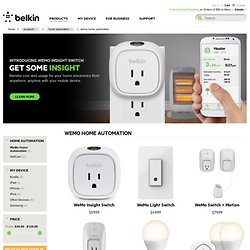
Coffee® and more, to bring home automation to your favorite everyday appliances. The WeMo Story WeMo is a family of simple, ingenious products that make life easier, simpler, better. WeMo uses your Wi-Fi network and mobile internet to control your home electronics right from your smartphone. JOIN THE WeMoVEMENT Discover cool ways people are using WeMo. COMBINE WeMo DEVICES WITH SOCIAL MEDIA. Arduino The Documentary (2010) English HD. Anatomy of a Smart City Full. Best IoT Open Source Project 2011. Nimbits.com.