
Lighthouse of Alexandria. Of the Seven Wonders of the Ancient World, only one had a practical use in addition to its architectural elegance: The Lighthouse of Alexandria.

For sailors, it ensured a safe return to the Great Harbor. For architects, it meant even more: it was the tallest building on Earth. And for scientists, it was the mysterious mirror that fascinated them most... The mirror's reflection could be seen more than 50 km (35 miles) off-shore. Cults of the Gods of Ancient Greece THEOI.COM. Introduction to Ancient Greek History — Open Yale Courses. Syllabus Professor Donald Kagan, Sterling Professor of Classics and History Description This is an introductory course in Greek history tracing the development of Greek civilization as manifested in political, intellectual, and creative achievements from the Bronze Age to the end of the classical period.
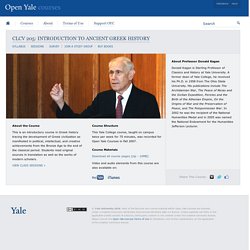
Students read original sources in translation as well as the works of modern scholars. Texts. Sphinx-Henri-Bechard-1887.jpg 581×401 pixels. Mysteries of Egypt - Tutankhamun. Ancient Rome - Ancient History Blog. A Foodie’s Feast in Ancient Pompeii When people think of Pompeii, it’s often to conjure up images of violent destruction, or to ponder the fragility of life as so visibly showcased by the remains of Pompeiians who were caught by the wrath of Mount Vesuvius in 79 A.D. But there was much more to this town than just its end, and for the past ten years, archaeologists from the University of Cincinnati have excavated a row of building plots located in the non-elite district of the city.
Some of these building plots—which represent a total of 20 store fronts near the Portia Stabia—date as far back as the 6th-century B.C. The archaeologists learned that these store fronts were mostly restaurants, and researchers were able to take the finds of preserved, mineralized and charred food contents (found in drains and toilets… don’t think about that too hard) in order to analyze it. The archaeological team also found traces imported, exotic spices from far away regions such as Indonesia. Ancient Roman History Timeline. Provides a chronological index of the history of Ancient Rome with extensive links to internet resources.
Emphasis is placed upon the use of primary source material, numismatics, and a focus upon the roles of women in ancient time. scroll down for the timeline Thank you for visiting! Timeline Menu Ridley Scott's GLADIATOR is a great film. Is it great history? Click here to learn the real story behind the events and characters portrayed in the movie. Kindly report any suggestions, problems, errors, or dead links by emailing david(at)exovedate.com Using info from this site?
For detailed copyright information and bibliographic citation, click here contact the author by emailing david(at)exovedate.com (note: replace (at) with the @ symbol) Copyright © David Neelin: All Rights Reserved. History of Ancient Rome. Notre Dame OpenCourseware (OCW) offers free online educational resources for the course "History of Ancient Rome" in the Department of Classics.
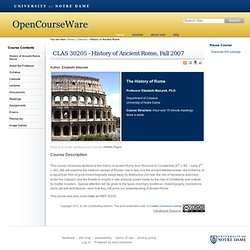
This course introduces students to the history of ancient Rome from Romulus to Constantine (8th c. BC – early 4th c. AD). A surprising discovery about how ancient Romans used lead pipes for food. Sumeria, Ancient Sumeria (Sumer), A history of Ancient Sumer Including its Contributions. Ancient Sumeria Primary Author: Robert A.
Guisepi Portions of this work Contributed By: F. Bronze Age history off by 100 years. Provided Trenchmaster Vronwy Hankey and foreman Antonis Zidianakis excavate storage jars from the Minoan settlement Myrtos-Pyrgos.
The jars were analyzed in the Cornell study using radiocarbon analyses. Separated in history by 100 years, the seafaring Minoans of Crete and the mercantile Canaanites of northern Egypt and the Levant (a large area of the Middle East) at the eastern end of the Mediterranean were never considered trading partners at the start of the Late Bronze Age. Until now. Cultural links between the Aegean and Near Eastern civilizations will have to be reconsidered: A new Cornell University radiocarbon study of tree rings and seeds shows that the Santorini (or Thera) volcanic eruption, a central event in Aegean prehistory, occurred about 100 years earlier than previously thought. Seven Wonders of The Ancient World. 21H.301 The Ancient World: Greece, Fall 2004. 21H.402 The Making of a Roman Emperor, Fall 2005.
World, 500-1000 A.D. Mythology, folklore, and religion. Please enter the award-winning internet encyclopedia of mythology, folklore, and religion.

Here you will find everything from A-gskw to Zveda Vechanyaya, with plenty in between. The mythology section is divided to six geographical regions: Africa, Americas, Asia, Europe, Middle East, and Oceania. Each region has many clearly defined subdivisions that will ease your search. The Folklore section contains general folklore, Arthurian legends, and fascinating folktales from many lands. In addition, we feature special interest areas to enhance and refine your research. To bring our entities to life, we have created an image gallery, where you will find hundreds of images of all kinds of deities, heroes, and strange creatures of every description.
The History Guide. Smarthistory: a multimedia web-book about art and art history. A Comprehensive Outline of World History. MacroHistory : World History.