
Mythology Guide - A dictionary of Greek and Roman Myths - StumbleUpon. A&[Internet Encyclopedia of Philosophy] - StumbleUpon. Philosophy Timeline - StumbleUpon. 40 Belief-Shaking Remarks From a Ruthless Nonconformist.
Philosophy since the Enlightenment, by Roger Jones - StumbleUpon. 7 Lessons From 7 Great Minds - Global One TV - StumbleUpon. Have you ever wished you could go back in time and have a conversation with one of the greatest minds in history?
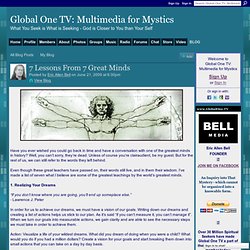
Well, you can’t sorry, they’re dead. Unless of course you’re clairaudient, be my guest. But for the rest of us, we can still refer to the words they left behind. Even though these great teachers have passed on, their words still live, and in them their wisdom. I’ve made a list of seven what I believe are some of the greatest teachings by the world’s greatest minds. 1. “If you don’t know where you are going, you’ll end up someplace else.” - Lawrence J. In order for us to achieve our dreams, we must have a vision of our goals. Action: Visualize a life of your wildest dreams. 2. “It was a high counsel that I once heard given to a young person, “Always do what you are afraid to do.” - Ralph Waldo Emerson The best way to learn something is to dive right in to it. Action: You must define your fears in order to conquer them. 3. “All that we are is the result of what we have thought.
An Essay by Einstein. "How strange is the lot of us mortals!

Each of us is here for a brief sojourn; for what purpose he knows not, though he sometimes thinks he senses it. But without deeper reflection one knows from daily life that one exists for other people -- first of all for those upon whose smiles and well-being our own happiness is wholly dependent, and then for the many, unknown to us, to whose destinies we are bound by the ties of sympathy. A hundred times every day I remind myself that my inner and outer life are based on the labors of other men, living and dead, and that I must exert myself in order to give in the same measure as I have received and am still receiving...
"I have never looked upon ease and happiness as ends in themselves -- this critical basis I call the ideal of a pigsty. The ideals that have lighted my way, and time after time have given me new courage to face life cheerfully, have been Kindness, Beauty, and Truth. "My political ideal is democracy. Cognitive Biases. Psychology. Allegory of the Cave. Plato has Socrates describe a gathering of people who have lived chained to the wall of a cave all of their lives, facing a blank wall.
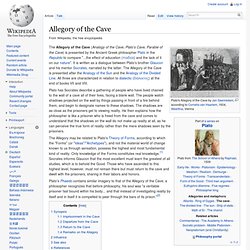
The people watch shadows projected on the wall by things passing in front of a fire behind them, and begin to designate names to these shadows. The shadows are as close as the prisoners get to viewing reality. He then explains how the philosopher is like a prisoner who is freed from the cave and comes to understand that the shadows on the wall do not make up reality at all, as he can perceive the true form of reality rather than the mere shadows seen by the prisoners. The Allegory may be related to Plato's Theory of Forms, according to which the "Forms" (or "Ideas"/"Archetypes"), and not the material world of change known to us through sensation, possess the highest and most fundamental kind of reality. Synopsis[edit] Imprisonment in the Cave[edit] Socrates suggests that, for the prisoners, the shadows of artifacts would constitute reality.
See also[edit]