
Plus nous prenons de décisions, moins elles sont bonnes. Nous avons une capacité psychologique limitée à faire des choix et prendre des décisions explique le New York Times magazine dans une grande enquête intitulée «Decision fatigue» (Fatigué de décider).
Elle révèle un aspect méconnu du cerveau humain qui explique comment un chef de gouvernement, un dirigeant d'entreprise, un général mais aussi nous tous dans notre vie quotidienne prenons parfois des décisions totalement aberrantes ou sommes tout simplement incapables d'en prendre une. Le New York Times cite de nombreux exemples parmi lesquels celui d'un juge qui est systématiquement plus compréhensif et plus à l'écoute le matin qu'en fin de journée et ne rend pas les mêmes verdicts face aux mêmes cas sans en avoir conscience. Peu importe, que vous cherchiez à être extrêmement rationnel et juste, vous ne pouvez prendre des décisions les unes après les autres sans en payer le prix biologique. La deuxième stratégie est tout simplement de ne plus prendre de décisions, de gagner du temps. Super Memory. Dunning–Kruger effect.
Cognitive bias about one's own skill The Dunning–Kruger effect is a hypothetical cognitive bias stating that people with low ability at a task overestimate their own ability, and that people with high ability at a task underestimate their own ability.
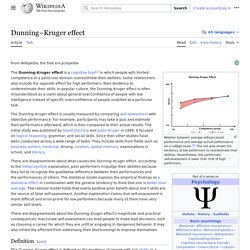
As described by social psychologists David Dunning and Justin Kruger, the bias results from an internal illusion in people of low ability and from an external misperception in people of high ability; that is, "the miscalibration of the incompetent stems from an error about the self, whereas the miscalibration of the highly competent stems from an error about others".[1] It is related to the cognitive bias of illusory superiority and comes from people's inability to recognize their lack of ability.
Without the self-awareness of metacognition, people cannot objectively evaluate their level of competence. Original study[edit] Later studies[edit]