
Drum Machine Online - OneMotion.com. 27) The Con - Tegan And Sara. Www.jpstrings.com/brstring.htm. 80/20 BELL BRONZE Acoustic | PHOSPHOR BRONZE Acoustic | PHOSPHOR BRONZE SILKS ACOUSTRILECTRIC Nickel | NUAGES® Manouche | CLASSICAL | John Pearse®-Thomastik TWELVE STRING GUITAR | ELECTRIC BASS | ARTISTE™ Violin | BANJO | JOHN HARTFORD BANJO| BOUZOUKI | DULCIMER | FIDDLE String gauges are shown in "inches", numbers in bold represent wound strings.

Six & Twelve String Acoustic Guitar Back to Top The New John Pearse® #510L & #610LM SILKS The exciting new SILKS sets mark a departure from orthodox acoustic string design. John Pearse® NUAGES® 'Guitare Manouche' Strings We could try to tell you why these are one of the most exciting additions to our string line...but then, whatever we could say, you would expect it because it is coming from us. While attending the "Django Festival" at Samois, France, I was so fortunate as to meet a wonderful musician and gentle person by the name of Robin Nolan. Classical and Thomastik-Pearse® Strings. Secret Teachings of All Ages: The Pythagorean Theory of Music and Color.
Sacred Texts Esoteric Index Previous Next p. 81 HARMONY is a state recognized by great philosophers as the immediate prerequisite of beauty.

A compound is termed beautiful only when its parts are in harmonious combination. The world is called beautiful and its Creator is designated the Good because good perforce must act in conformity with its own nature; and good acting according to its own nature is harmony, because the good which it accomplishes is harmonious with the good which it is. Beauty, therefore, is harmony manifesting its own intrinsic nature in the world of form. The magical mathematics of music. May 2005 The astronomer Galileo Galilei observed in 1623 that the entire universe "is written in the language of mathematics", and indeed it is remarkable the extent to which science and society are governed by mathematical ideas.
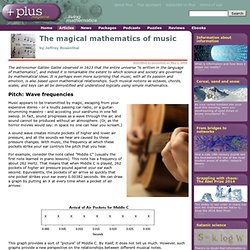
It is perhaps even more surprising that music, with all its passion and emotion, is also based upon mathematical relationships. Such musical notions as octaves, chords, scales, and keys can all be demystified and understood logically using simple mathematics. Pitch: Wave frequencies Music appears to be transmitted by magic, escaping from your expensive stereo - or a loudly passing car radio, or a guitar-strumming maestro - and accosting your eardrums in one fell swoop.
A sound wave creates minute pockets of higher and lower air pressure, and all the sounds we hear are caused by these pressure changes. Diminished Chords - Understanding Diminished Chords. Diminished chords, like major and minor chords, occur naturally in every key, and each key has only one diminished chord.
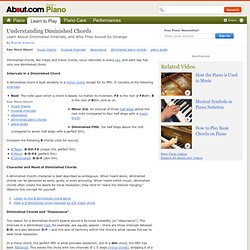
Intervals in a Diminished Chord A diminished chord is built similarly to a minor chord, except for its fifth. Vision Music's "Basic Jazz Chords" Vision Music's "Basic Blues Chords" C O D E O R G A N. 9 of the Weirdest Poems You Will Ever Read. In Hitchhikers Guide to the Galaxy, Douglas Adams outlines the three worst styles of poetry in the universe: 3) that of the Vogons; 2) that of the Azoths of Kria; and 1) that of Paula Nancy Millstone Jennings in Greenbridge, England.
Since Adams has already got bad poetry covered, let’s take a look at some of the weirdest poetry in history. (In Earth’s history, anyway.) While some may associate “weird” with “modern” when it comes to art, you might be surprised to see how many of these were written in the seventeen- and eighteen-hundreds, long before being weird was even cool. In chronological order, here nine of the top contenders. 1. BeatBox - Cuisine. Fingerstyle TAB & MIDI Collection - Page 5. Math and Music. SYMMETRICAL MUSIC. Symmetry is a well-known phenomenon, both in nature, whose existence does not depend on persons, and in culture, the person- and people-made part of reality.
Math Night Module: Mathematics of Music. Elton Johns Improvisation - Cool - Funny Pictures, Funny Videos, Cool... Current News. The Free Music Philosophy (v1.4 - June 17, 1998; v1.0 - February 1, 1994) Downhill Battle presents the Reasons. Music diversity will grow.
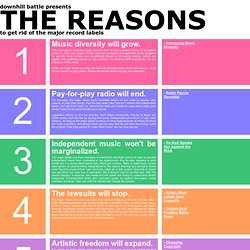
The major labels' business model requires them to have a steady stream of consistent products. The very nature of their operation produces homogenized music designed for specific radio formats and scientifically honed to hit-making models. Artists are signed and promoted based on the opinions of individual A&R executives, not the popularity of the music. When the major labels crumble, the diversity of mainstream music will blossom.
It will be a revolution in pop culture. Pay-for-play radio will end. For decades, the major labels have controlled what's on the radio by paying radio stations to play their songs. Legislative efforts to end the practice have failed consistently. Independent music won't be marginalized. Downhill Battle presents the Reasons. MUSE. Songs for the Dirty Dirty. The Sacred Geometry Of Music. Eccentric Guy is Straight Murder on the Keyboard. Listen to songs online. Musical scale. The frequencies 440Hz and 880Hz both correspond to the musical note A, but one octave apart. The next higher A in the musical scale would have the frequency 1760Hz, twice 880Hz.
In the western musical scale, there are 12 notes in every octave. These notes are evenly distributed (geometrically), so the next note above A, which is B flat, has frequency 440 × β where β is the twelfth root of two, or approximately 1.0595. The next note above B flat, which is B, has frequency 440 × β 2. Pogo: The Coolest DJ Ever. Seaquence.
FREE Online Rhyming Dictionary.