
Garments. Be the first to know about the Purl Bee’s latest projects and Purl Soho’s newest products and most special offers!

Subscribers also receive a FREE Purl Soho Pattern download (up to a $15 value!). Choose from 8 of our exclusive patterns! Learn more > Be sure to also enjoy the new and improved Purl Bee! Sock prØn.: How to weave in ends while knitting (VERY PIC INTENSIVE) Okay!

Here is where I attempt to show you the coolest.thing.ever that I learned from Jennifer "JP" Pett-Ridge during my colorwork class at my LYS Article Pract. The heavy pics are a necessity, and if you want to "get it" I'd suggest starting up a swatch and following along (I know as I look at these pics, they don't make sense... but as you go with needles and yarn in your hand, its a revelation fo sho.) These instructions are written for an English/right hand knitter, since I'm biased that way ;) (Seriously though, I don't know how to knit Continental so I can't show how to do it left handed.)
(edit, 10/07: Jen in KS has unvented the continental answer for those of pickers who want to weave in ends while knitting continental! Stretchy Bind Off Comparison. Here are the results of a quasi-scientific investigation into answering the question: "Which bind off is the stretchiest of all for Stockinette stitch?
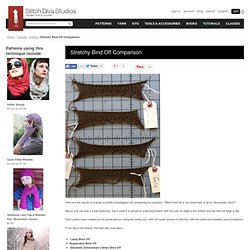
" Above you can see 4 small swatches. Each swatch is pinned to a blocking board, with the cast on edge to the bottom and the bind-off edge at top. Each swatch was created by the same person, using the same yarn, with the same amount of stitches, with the same size needles used throughout. How to improvise a top-down sweater, Prologue: The possibilities are endless. Alpaca Socks, Clothing and Household Textiles by John Arbon Textiles. Shibui - No.13. Chilla Valley 100% Alpaca 4ply - Chilla Valley 100% Alpaca - Yarns - The Little Wool Company.
Chunky Knitting Patterns. Home page. The Island Wool Company- Faroese By Design - Nordic By Nature - 3 Border Jumper. Houndstooth Jumper - Marmalade Cashmere - Independent Boutique. The Invisible Ribbed Bind Off For 1x1 Rib. I’m almost done putting my toe-up socks video e-book together, and I wanted to give you a sneak peek of my favorite technique: The stretchy, hemmed-edge invisible ribbed bind-off.
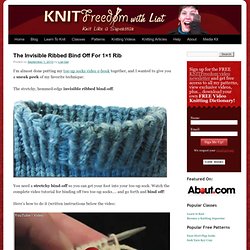
You need a stretchy bind-off so you can get your foot into your toe-up sock. Watch the complete video tutorial for binding off two toe-up socks…. and go forth and bind off! Here’s how to do it (written instructions below the video: To do the invisible ribbed bind-off, cut a long tail of at least 6 times the circumference of the project you want to bind off. Set-Up: - go purlwise into stitch 1 (the stitch closest to the needle-tip) - go knitwise FROM THE BACK into stitch 2. Identify stitches 1, 2, 3, and 4. Repeat: 1) go knitwise into stitch 1, remove stitch from needle 2) go purlwise into stitch 3 3) go purlwise into stitch 2, remove stitch from needle 4) go knitwise FROM THE BACK into stitch 4 An easy mantra to repeat: 1) knit off purl, 2) purl off knit.
Shipwreck Shawl - Knitty, Spring 2009. Regarding the dyes and process used: Shipwreck was worked with undyed yarn and dyed after the knitting was complete in order to achieve a slightly weathered effect.
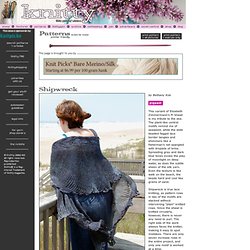
The shawl's color was achieved using approximately 3 tsp of #80332 Sapphire Blue and 1/4 tsp of #80337 Jet Black dissolved in a pot of simmering water on the stove. Next, add a dollop of vinegar to the water. The more vinegar you add now, the more variations in shade will appear in the final shawl. For a shawl with no variations, add the vinegar after the shawl is soaked in the dye, rather than before. Place the completed shawl gently in the pot and submerge it until it is thoroughly soaked. Directions for the Simple Ring cast-on method can be found here. Turtlegirl's Bloggy Thing » Blog Archive » Tutorial: Twister Garter Cuff/Edging. Nov 4th, 2010 by turtlegirl76 When I was putting together the Breaking Hearts Sock pattern, I wanted to find a good reference for knitters to go to for the twisted garter cuff.
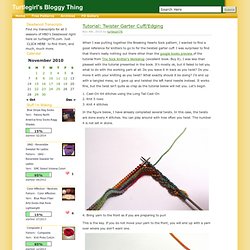
I was surprised to find that there’s really nothing out there other than the google books preview of the tutorial from The Sock Knitter’s Workshop (excellent book. Buy it). I was less than pleased with the tutorial presented in the book. It’s mostly ok, but it failed to tell you what to do with the working yarn at all. 1. In the figure below, I have already completed several twists. Knitting to Stay Sane. A couple of folks asked last week about a blog tutorial on Magic Loop, since it’s a technique I mention every so often and one that I use happily.
So, ta-da! Let’s talk about that, with the aid of some photos. I will start out with a brief proviso – Magic Loop is the popular name given to the technique of working small circumferences in the round by using a single, long circular needle, in place of a short circular, multiple double-pointed needles, or two circular needles. It is by no means my invention, and in fact I learned this technique through a collection of things – friends showed me, Elizabeth Zimmerman mentions the same basic approach in her books, and of course Bev Galeskas and Sarah Hauschka have what is arguably the most popular publication on the subject.
There are likely other resources on the technique. So: you’re interested in working in the round for small items (hats, sleeves, socks, gloves, mittens, toys, booties…snake sweaters? Now, you are ready to knit. Brooklyn Tweed. Outback Yarns - Adriafil Avantgarde - Cream 11 - Avantgarde - Adriafil - The Friendliest Online Yarn Shop. Marion Foale 3 Ply Yarn - MarionFoale.com. Scrumptious Lace 512 Magenta on Fyberspates. How to Cable Without a Cable Needle. November 7th, 2011 by Jess.

BACK to the back join. The back join (subject of a previous post) is a method for working in the tails AS YOU GO in multi-color knitting.
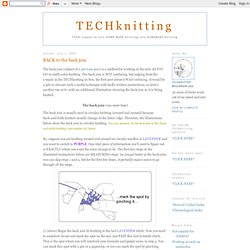
The back join is NOT confusing, but judging from the e-mails in the TECHknitting in-box, the first post about it WAS confusing. It would be a pity to obscure such a useful technique with badly-written instructions, so here's another run at it--with an additional illustration showing the back join as it is being knitted. The back join (one more time) The back join is usually used in circular knitting (around and around) because back-and forth knitters usually change at the fabric edge. Therefore, the illustrations below show the back join in circular knitting. Www.queenkahuna-creations.com/kitchenerstitch_socktoes.pdf. Sideways Edge Cast-On, a knitting unvention! plus, Swerve! So I just released a new pattern (Swerve!)
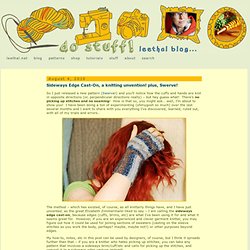
And you’ll notice how the cuffs and hands are knit in opposite directions (or, perpendicular directions really) – but hey guess what! There’s no picking up stitches and no seaming! How is that so, you might ask… well, I’m about to show you! I have been doing a ton of experimenting (ohmygosh so much) over the last several months and I want to share with you everything I’ve discovered, learned, ruled out, with all of my trials and errors… The method – which has existed, of course, as all knitterly things have, and I have just unvented, as the great Elizabeth Zimmermann liked to say – I am calling the sideways edge cast-on, because edges (cuffs, brims, etc) are what I’ve been using it for and what it seems great for.
Below is an example of a version of the method having been worked as a hat brim. Now, what was up with that “ratio of stitches to rows” issue mentioned above? Cast-on 6 stitches.Knit 1 row.Purl 1 row.Kfb, place marker, k to end. Cast On: Provisional. A provisional cast-on keeps cast-on stitches "live" so that they can be knit later. Knittingfool - Guest Desktop. How to Join Yarn: Russian Join Method. Weaving in Ends. I have some good news. And, I have some bad news. Good news first: there is no one right way to weave in your ends. So, chances are, you haven’t been doing it wrong! Now, the bad news: there are so many different ways to weave in your ends, you might not be doing it the best way either. Wool & Tea: Designers. Tzuri Gueta is a innovator in technologies for textiles. Having consulted for Armani, Dior, Mugler, and Gaultier, he has launched his own collection of accessories incorporating lace and silicon, and laser cut textiles.
Staggered%20Cable%20Throw. Tutorials. Kaffe Fassett Studio : Welcome. Ravelry - a knit and crochet community. Knitting Patterns - Chic Knits FALL 2010 - Designed by Bonne Marie Burns. Knitting Supplies & Knitting Patterns from Noble Knits. Knitting Design for Beginners: Designing Knitwear Patterns; Getting Started.
Once you can knit, there is nothing to stop you from designing your own simply shaped garments. This is the first part of a series of articles which will show you how. Knitting is maths; knitwear design even more so. This is a thought that often scares people, but nobody who knits need be afraid of the numbers, as all knitters are already counting and measuring as they go. The mathematical side doesn’t have to be difficult or complex, but it is vital. Designing your own patterns is straightforward and satisfying. Equipment Knitting needles (of course)Yarn – do you have enough? Land of Natural Fiber Yarn and Pattern. Great British Yarns Online Catalogue. Knit Pro Symfonie Wood Interchangeable Circular Needles Starter Set from Hulu. Knit and Crochet 1.
Cables. Pattern Reading. KnitWitches Yarns. PATTERNFISH - the online pattern store. Knitting Accessories - Stash Fine Yarns.