
Learning Space Toolkit. Design Thinking for Educators. Elliot w. eisner: what can education learn from the arts about the practice of education? Designing Spaces for Creativity. Posted by keithsawyer in Enhancing creativity, New research.
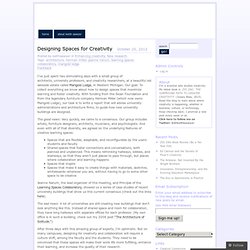
Tags: architecture, herman miller, jeanne narum, learning spaces collaboratory, marigold lodge trackback I’ve just spent two stimulating days with a small group of architects, university professors, and creativity researchers, at a beautiful old lakeside estate called Marigold Lodge, in Western Michigan. Our goal: To collect everything we know about how to design spaces that maximize learning and foster creativity. With funding from the Sloan Foundation and from the legendary furniture company Herman Miller (which now owns Marigold Lodge), our task is to write a report that will advise university administrations and architecture firms, to guide how new university buildings are designed. Arts Involvement Narrows Student Achievement Gap. A new NEA study finds disadvantaged students do better academically if they are intensely involved in the arts.
Students from the lower end of the socioeconomic ladder tend to do less well in school than those from more upscale families. But newly published research identifies one sub-group of these youngsters who tend to exceed expectations: those who participate heavily in the arts. “At-risk teenagers or young adults with a history of intensive arts experiences show achievement levels closer to, and in some cases exceeding, the levels shown by the general population studied,” a team of scholars writes in a new National Endowment for the Arts Research Report. “These findings suggest that in-school or extracurricular programs offering deep arts involvement may help to narrow the gap in achievement levels among youth.” Semester Online. About Semester Online was a pilot program that offered rigorous courses from prestigious colleges and universities - for credit, online during the fall 2013, spring 2014, and summer 2014 semesters.
Designed to match the quality of an on-campus experience, Semester Online gave top students access to the best online college classes available. Courses were of the same rigor and quality as their on-campus counterparts, and were designed by the same world-class professors who teach on campus. Students and professors were connected over a virtual platform in live, face-to-face classes with sections capped at 20 students.
Courses featured dynamic, immersive content designed by university faculty, social networking tools, and the flexibility to access coursework 24/7. Contact For questions and/or general inquiries, please email us at information@semesteronline.org. Contacts at individual schools are as follows. Pixar's tightknit culture is its edge. More on why Pixar’s movies are so much better than the competition: According to “Pixar Rules — Secrets of a Blockbuster Company,” the company has created an incredible work environment that keeps employees happy and fulfilled.
The result: “A tightknit company of long-term collaborators who stick together, learn from one another, and strive to improve with every production.” At the heart of this effort is Pixar University: The operation has more than 110 courses: a complete filmmaking curriculum, classes on painting, drawing, sculpting and creative writing. “We offer the equivalent of an undergraduate education in fine arts and the art of filmmaking,” [Randy Nelson, dean of Pixar University,] said. Marissa Mayer's New Product Development Process by Marissa Mayer. Gee’s vision on game-based learning, affinity spaces and education. This is probably one of the best keynotes I’ve ever attended (virtually in this case): inspirational, well structured and full of content and ideas.
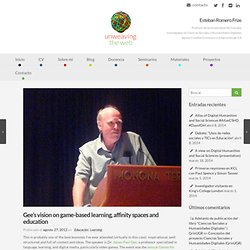
The speaker is Dr. James Paul Gee, a professor specialized in language, learning, and digital media, particularly video games. The event was the annual Games for Change Festival (June 20, 2012). Jobs. We are a small group of people passionate about lifelong learning.
We love tough challenges and crazy characters. Located in Menlo Park, CA, Curious has a tested leadership team, funding and support from great investors and is growing quickly — one terrific new employee at a time. Mapping The Future Of Education Technology. Add this massive infographic to the recent discussion of futuristic dorms and what education will look like in 2020--and beyond.
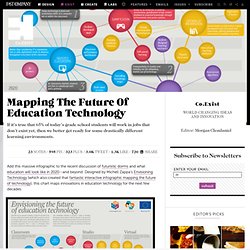
Designed by Michell Zappa’s Envisioning Technology (which also created that fantastic interactive infographic mapping the future of technology), this chart maps innovations in education technology for the next few decades. Click to enlarge. It illustrates a shift from a classroom-centered approach toward an increasingly virtual set of learning environments. Learning Through Connecting. Much of the discussion about educational technology these days focuses on new ways to deliver instruction, through online videos and online courses.
In our Lifelong Kindergarten research group at the Media Lab, we have a very different approach to education and learning, developing technologies not to deliver instruction but to open opportunities for people to create, collaborate, experiment, and express themselves. What will the university of the future look like? In New York City on 12 June, the World Economic Forum brought together senior university administrators, faculty staff and entrepreneurs in online education and university ventures to discuss online learning.
Everyone is talking about this “tsunami”, which could have the same impact on higher education as the Internet has had on printed newspapers. The debate centred on what future universities will look like as a whole, not just their online components. The participants strongly agreed that education is broader than content. UK Qualifications Reform: Looking East and Back Isn't The Answer. Doing by learning. [Note: This is the fourth in a series of posts about the Social Enterprise and the Big Shift.
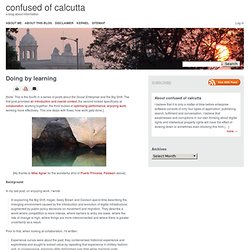
The first post provided an introduction and overall context; the second looked specifically at collaboration, working together; the third looked at optimising performance, enjoying work, working more effectively. This one deals with flows, how work gets done.] [My thanks to Mike Agner for the wonderful shot of Puerto Princesa, Palawan above] Background. Work is learning and learning is the work. We have come to a point where organizations can no longer leave learning to their HR or training departments. Being able to understand emerging situations, see patterns, and co-solve problems are essential business skills.
Learning is the work. I had mentioned that I was talking to a financial advisor at a bank the other day and I asked her what kind of professional development she did. The bank has a central online learning portal where employees can take “courses”, particularly compliance training. Going From One-Size-Fits-All Education, To One-Size-Fits-One. In June of 2009, after Michael Jackson died, I decided it was time to learn how to moonwalk. Move Over Harvard And MIT, Stanford Has The Real “Revolution In Education” Lectures are often the least educational aspect of college; I know, I’ve taught college seniors and witnessed how little students learn during their four years in higher education. D10: How Education Will Change In the Digital Age. An interesting session at the All Things D conference featured Stanford University President John Hennessy and Salman Khan, founder of Khan Academy.
They discussed how the digital era could help lower the exorbitant costs of higher education. Above: Conference host Walt Mossberg, Stanford University President John Hennessy, and Khan Academy founder Salman Khan College tuition can cost nearly $60,000 a year, but is this model sustainable? The Elastic Learning Network Melbourne - Collaborative 21st Century Learning. Curiosity Lab - Sparks for exploration, imagination and creativity. Tech infused excursions and incursions. GPNEcon - The Thiel Fellowship. Self-Learning: The New Master's Degree. Come the Revolution. Imagination: Creating the Future of Education & Work. Khan Academy Competitor? Mike Feerick of Alison.com Talks About The Future of Online Education. By Paul Glader. Transcripts » Show. The Games Companies Play.
8 Principles For Disruptive Learning Environments. University of the People – The world’s first tuition-free online university. Learning through questioning: Gurteen summary of links. Gurteen Knowledge-Letter: Issue 142 - April 2012 Contents 1 Introduction to the April 2012 Knowledge Letter 2 You can forget facts but cannot forget understanding 3 Don't praise the child! 4 Brown Bag Lunches 5 Business is a Conversation - It's Good To Talk 6 Reading PDF and HTML articles on my Kindle 7 Gurteen Knowledge Tweets: April 2012 8 Upcoming Knowledge Events: April 2012 9 Subscribing and Unsubscribing 10 The Gurteen Knowledge Letter Introduction to the April 2012 Knowledge Letter (top | next | prev) Coursera- Solving Open University courses With Big Data peer reviews.
MIT Media Lab &Cognitive Limit of Organizations. Top 10 Things Every Presenter Needs To Know About People: #1 – People learn best in 20 minute chunks. Home - Visual Thinking Strategies. "The Audrey Test": Or, What Should Every Techie Know About Education? Search Results guitar.
The Learning Project. The Biggest Opportunity of 2012? Learning Objective-C - Blog - General Assembly. Map of Alternative Education Initiatives and Institutions. The End of Teaching (as we know it) via @Slideshare — Digital Fingerprint. Skillshare Careers for World builders. The CultureCode Initiative. Where Social Learning Thrives. Limited Memory & Importance of Forgetting. NeuroEducational Research Network (UK) Neuroscience, Games & Learning.
MIT & a Post-Campus America.