
Background Music and Cognition. Lucy Patston and Lynette Tippett, two scientists at the University of Auckland, set out to investigate whether the brains of musicians process music in the same brain areas where language is processed.
CBT for Depression. Brain Training Software Beats Out Crosswords. Though crossword puzzles may give your brain an edge every now and then, research suggests other types of brain training can be more effective in improving cognitive function — for older adults at least.
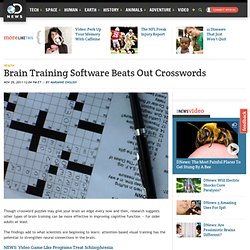
The findings add to what scientists are beginning to learn: attention-based visual training has the potential to strengthen neural connections in the brain. NEWS: Video Game-Like Programs Treat Schizophrenia Researchers plan to finish the project in January, but the first round of results are available in British Medical Journal Open. The team drew data from the Iowa Healthy and Active Minds Study. In the setup, 681 participants 50 years and older were randomly assigned to testing groups. Researchers used participants’ “useful field of view” — basically what’s noticeable out of the corner of the eye — as a means to measure progress.
NEWS: Chess Experts Use Brains Differently The effectiveness of such training is still debated by some researchers, though. Photo by bjohnson/Flickr.com. Cosmic egg illustration Carl Jung's Red Book #Jungian #s. Psychology Team.
Neuropsychology. Podcasts. List of thought processes. Nature of thought[edit] Thought (or thinking) can be described as all of the following: An activity taking place in a: brain – organ that serves as the center of the nervous system in all vertebrate and most invertebrate animals (only a few invertebrates such as sponges, jellyfish, adult sea squirts and starfish do not have a brain).
It is the physical structure associated with the mind. mind – abstract entity with the cognitive faculties of consciousness, perception, thinking, judgement, and memory. Having a mind is a characteristic of humans, but which also may apply to other life forms.[1][2] Activities taking place in a mind are called mental processes or cognitive functions.computer (see automated reasoning, below) – general purpose device that can be programmed to carry out a set of arithmetic or logical operations automatically.
Complete Table of Contents for Online Readings in Psychology and Culture. Online Readings in Psychology and Culture, Unit 2, Chapter 5. David Matsumoto San Francisco State UniversityU.S.A.
In my view, the study of culture provides three main contributions to our understanding of human behavior and mental processes. First there is great knowledge to impart about cultural similarities and differences in behavior, and these form the basis for improving psychological theories. Second the study of culture is a prime example of critical thinking in the field, as cross-cultural research begs the question about whether our notions of truth and psychological principles are applicable to people beyond those whom were studied. Third research on intercultural adjustment provides us with clues about possible psychological constructs that may be universally necessary for adjusting to life well in a pluralistic and diverse environment. I discuss these contributions, and reframe thinking about the goals of education focusing on these skills. My Introduction to Cross-Cultural Psychology Cross-Cultural Research on Emotion Judgments 1.
Love? Or Being In Love? Video Game-Like Programs Treat Schizophrenia. Computer-based brain training looks to be effective for treating some symptoms.

People living with schizophrenia have cognitive deficits that make daily tasks and social interactions difficult. Some video game-like programs can help the brain relearn. With more research, the programs may be used like other FDA-approved medical devices. Though the condition is commonly associated with hearing voices or experiencing hallucinations, the most debilitating effects of schizophrenia are cognitive and social deficits that limit one's abilities to hold jobs or perform daily activities.
Carl Jung: The Red Book. A small introduction to Carl Jung's famous Red Book.

Under the following quotation from The Red Book is a short video about the book as well as the link to a free and complete 200MB download of the original text and art of The Red Book. Written on the back of the painting Untitled work, 1917, within The Red Book, Liber Novus, is the following inscription ( pp 320-1): "The Cabiri: We hauled things up, we built. Depressive realism. Evidence for[edit] Evidence against[edit] When asked to rate both their performance and the performance of another, non-depressed individuals demonstrated positive bias when rating themselves but no bias when rating others.

Criticism of the evidence[edit] Some have argued that the evidence is not more conclusive because there is no standard for "reality," the diagnoses are dubious, and the results may not apply to the real world.[33] Because many studies rely on self-report of depressive symptoms, the diagnosis of depression in these studies may not be valid as self-reports are known to often be biased, necessitating the use of other objective measures.
Due to most of these studies using designs that do not necessarily approximate real-world phenomena, the external validity of the depressive realism hypothesis is unclear. See also[edit] References[edit] Jump up ^ Alloy,L.B., Abramson,L.Y. (1988). Further reading[edit] Rachel Adelson (April 2005).