
Partition Système EFI (ESP) — ArchwikiFR. Attention : Cette page s'adresse uniquement aux possesseurs de carte-mère disposant d'un UEFI, ainsi que d'un disque avec une table de partitionnement GUID (dit GPT).
Elle a pour but de donner les informations relatives à la création de la partition pour le système EFI (appelée ESP). L'ESP, pour EFI System Partition en anglais, est une partition spéciale apparue avec l'UEFI. [Résolu]Conky n'affiche le bon pourcentage d'espace disque utilisé. NetHogs: What program is using that bandwidth? Supercomputer built with Raspberry Pi and Lego – Computer Chips & Hardware Technology. There’s just something about the Raspberry Pi that inspires the most wonderful kinds of geekery.
We’ve seen the tiny, inexpensive, open Linux PC used in all sorts of projects, but this Raspberry Pi supercomputer is one of the best. Why is it the best? Lego. That’s why. Professor Simon Cox from the University of Southampton led the team that assembled 64 Raspberry Pi systems and installed them into a custom rack mount built using Lego. 6 Command Line Tools for Linux Performance Monitoring.
4inShare So you need to monitor a Linux system for performance metrics...
CPU, Memory, Network, Disk, etc. Joyeux anniversaire Linux ! Tiny Core Linux, Micro Core Linux, 10MB Linux GUI Desktop, Live, Frugal, Extendable. Welcome to The Core Project - Tiny Core Linux The Core Project is a highly modular based system with community build extensions.
It starts with a recent Linux kernel, vmlinuz 3.0, and a 5MB core.gz. MicroCore 8MB is simply the kernel + core.gz - this is the foundation for user created desktops, servers, or appliances. TinyCore is simply the kernel + core.gz + Xvesa.tcz|Xorg.tcz + Xprogs +fltk-1.10.tcz + (user's choice of Window Manager) + wbar.tcz TinyCore becomes simply an example of what the Core Project can produce, an 12MB FLTK/FLWM desktop. CorePlus ofers a simple way to get started using the Core philosophy with its included community packaged extensions enabling easy embedded frugal or pendrive installation of the user's choice of supported desktop, while maintaining the Core principal of mounted extensions with full package management. It is not a complete desktop nor is all hardware completely supported. The latest version: 5.3 News. Date Arithmetic In Linux Shell Scripts. How to write a Linux shell scripts that backup previous month data files on monthly basis?
Of course, it involves date time calculation! Unless you’re using GNU Coreutils / GNU date, doing date arithmetic in shell scripts will not be that straight-forward as a novice think! I just can’t recall that SCO Unix and Concurrent Real Time Unix (RTU) have GNU date installed, when I was exposed to Unix for the first time in year 2000. But, I believe that GNU Coreutils is a standard package that available on most Linux distributions as of today. How to do date arithmetic in Linux shell scripts using GNU date command? GNU date is one of the many common Linux programs in GNU Coreutils package. NX - Support: Article. The NX client software gives to users the option of saving the password in the session configuration file.
When the password is stored in the file, NX doesn't prompt the user for the login credentials at the time the session is started, so that it is possible to automate the login by launching the software by clicking on a session configuration saved on the user's desktop or by running the client during the session startup of the host OS. While this feature can be very useful in many scenarios, it must be noted that saving the password in the configuration file makes it possible for any user to have access to the physical computer to steal the password and get access to the NX server with the user's credentials. For this reason the option is turned off by default.
Give the Gift of a Custom Linux Distro. For all of you hackers and geeks who need a last-minute christmas present, we have just the thing for you.
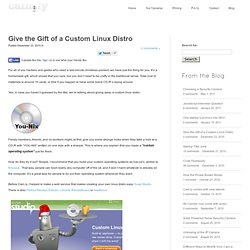
It’s a homemade gift, which shows that you care, but you don’t need to be crafty in the traditional sense. What If All the World Ran Linux? There's a cartoon that made the rounds in the Linux community a few years back that I often think of at this time of year.
In essence, it depicts a Linux aficionado refusing to help convince someone to switch to Linux, explaining, "If everyone's using it, I'm not cool anymore. " It's a joke, of course, made funny by the fact there may just be the tiniest hint of truth underlying it, at least among some people. JDownloader.org - Official Homepage.
Grub. Shape your traffic with trickle. Any user on the system can run Trickle without needing administrative privileges.
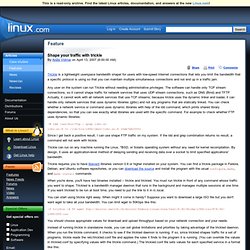
The software can handle only TCP stream connections, so it cannot shape traffic for network services that uses UDP stream connections, such as DNS (Bind) and TFTP. Actually, it cannot work with all network services that use TCP streams; because trickle uses the dynamic linker and loader, it can handle only network services that uses dynamic libraries (glibc) and not any programs that are statically linked. You can check whether a network service or command uses dynamic libraries with help of the ldd command, which prints shared library dependencies, so that you can see exactly what libraries are used with the specific command. For example to check whether FTP uses dynamic libraries: ~# ldd /usr/bin/ftp | grep libc.so libc.so.6 => /lib/tls/i686/cmov/libc.so.6 (0xb7d42000) Set maximum CPU consumption in percentage by any process. Le système d\'exploitation universel.
Office 2010, bient. Quelle est la came des services marketing de chez Microsoft, en ce moment ?
La question est plus compliquée qu'il n'y paraît. Car si la réponse évidente semblerait être « shoot quotidien de Démineur et de Solitaire », il faut croire que la vérité s'approche de quelque chose de plus hardcore. Pour preuve, les bijoux publicitaires dont l'éditeur nous gratifie en ce début d'été. La première série de clips fait la promotion d'Internet Explorer 8, qui en a bien besoin avec la sortie de tous ces navigateurs en ce moment, en particulier Firefox 3.5 .
Et donc, selon Microsoft, un utilisateur d'IE8 pourrait échapper à de nombreux syndromes, comme le fameux FOMS ( Fear Of Missing Something , peur de manquer quelque chose) ou le redouté SHYNESS ( Sharing Heavily Yet Not Enought Sharing Still , partager en masse n'est pas encore partager suffisamment). Toutes les vidéos à voir sur la page YouTube . Et hier, c'est bien une bande-annonce que Microsoft nous a présenté.
Rosetta Stone for Unix - Shiretoko. Footnotes 1. In System V-based Unixes, run level relates to booting, shutdown, and single-user mode. In BSD, it has to do with security. 2. Freeware or separately downloadable; not part of the base OS. 3. Open Source Code Distribution Service. NetHogs: What program is using that bandwidth?
Too many open files. Linux Read CPU Temperature Sensor Chip Data. Q. How do I read CPU core temperature data from a shell prompt under Linux operating system? How do I monitor my cpu hardware? A. You can use Linux hardware monitoring tool such as lm_sensor. This tool provides some essential tools for monitoring the hardware health of Linux systems containing hardware health monitoring hardware such as the LM78, and LM75.