
Khan Academy. Udacity. Videolectures.net. Flooved. Anki - powerful, intelligent flashcards. Free eBooks at bookboon.com. Opening Educational Practices in Scotland. Fundamentally Reforming Math Curriculum with Computer-Based Math. Conrad Wolfram | October 2010 Download I wanted to talk today about math education and then specifically reforming math education in a rather dramatic fashion, so if you've got eggs to throw, this is the time to prepare them!

I think we've got a real problem with math education, particularly in schools right now. Basically, no one's very happy. Most of those trying to learn it think it's boring and irrelevant. To understand what I'm talking about, let's remind ourselves what math looks like in the real world. Why teach math? So to understand why this is, why these things have got so separated, why a chasm has opened up, let's first ask the question, why do we teach math? What is math? So the next question we might ask: what is math? Here's the funny thing.
Calculating is the machine of math The crucial point here is math is not equal to calculating. And the critical thing to understand, this is no small problem. Now I don't think all teaching of hand calculating is wrong. The Learning Myth: Why I'll Never Tell My Son He's Smart. New insight into how children learn maths. 26 March 2014Last updated at 21:29 ET By Helen Briggs BBC News Actions may speak louder than words in learning maths Teaching maths using abstract gestures is a good way to help children learn, research suggests.

Eight-year-olds gained a deeper understanding of mathematical principles by using their hands as well as their brains, say US psychologists. Children were taught to solve formulae such as: "4 + 2 + 6 = _ + 6" by making a V-point beneath the numbers to be added, then pointing at the blank. The actions helped in generalisation, a report in Psychological Science says.
Previous studies have shown that gesture helps learning. Psychologists think that when children move and make gestures, they are able to express ideas physically, which helps the learning process. However, the latest research goes further, suggesting abstract gesture may be a more effective teaching tool than manipulating and touching objects. Abstract gestures can underpin learning Symbolic interpretation. Tick box v check-list. 4 August 2011Last updated at 11:00 By Michael Blastland GO FIGURE - Seeing stats in a different way Should people in all professions be carrying a clipboard?

What's the difference between a tick box and a check-list? And why is one seen as better than the other, asks Michael Blastland in his regular column. Tick one of the following. [ ] Tick box culture - pointless, burdensome, bean-counting bureaucracy gone mad. [ ] Check-list culture - quick, beautifully simple, innovative, life-saving genius.
One bad. Both entail a list of things to do and a tick when they're done. So how is it possible for one to be the most almighty curse of our paranoid, pettifogging times and the other to be inspiringly brilliant? "Tick box culture" took a drubbing the other day from Justice Secretary Ken Clarke, as reported in the Guardian. It was found that probation officers spent only a quarter of their time dealing directly with offenders. Mr Clarke was staggered. Revision techniques - the good, the OK and the useless. 17 May 2013Last updated at 21:34 ET By Deborah Cohen Health Check, BBC World Service It's the time of year where students are poring over their books, trying to ensure they are prepared for their exams.
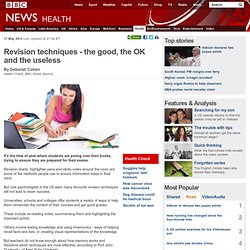
Revision charts, highlighter pens and sticky notes around the room are some of the methods people use to ensure information stays in their mind. But now psychologists in the US warn many favourite revision techniques will not lead to exam success. Universities, schools and colleges offer students a variety of ways to help them remember the content of their courses and get good grades. These include re-reading notes, summarising them and highlighting the important points. Others involve testing knowledge and using mnemonics - ways of helping recall facts and lists, or creating visual representations of the knowledge. But teachers do not know enough about how memory works and therefore which techniques are most effective, according to Prof John Dunlovsky, of Kent State University.
Plan ahead. How To Remember Anything Forever-ish. Also, this interactive comic is PUBLIC DOMAIN meaning you can freely use this thing for educational, personal, or even commercial purposes. You already have my permission! (Download the code) (Translate this comic) However, I'm only able to do this thanks to my 1,000+ Patreon supporters. They let me keep doing what I love. Thank you! Further Reading Something something shoulders of giants. . 🤓 Augmenting Long-Term Memory by Michael Nielsen showed me that Spaced Repetition wasn't just a tool for memorization, it's a tool to build deep understanding. And if you want to learn-by-playing more stuff, check out Explorable Explanations!
More Thanks.