
Broad System of Ordering - BSO website. Bliss Classification Association - Bibliographic Classification - Home page. 中国图书馆分类法查询系统(Chinese Library Classification - CLC) CAMBRIDGE UNIVERSITY LIBRARY CHINESE CLASSIFICATION SYSTEM. Chinese Library Classification. The Chinese Library Classification (中国图书馆分类法 CLC), also known as Classification for Chinese Libraries (CCL), is effectively the national library classification scheme in China.

It is used in almost all primary and secondary schools, universities, academic institutions, as well as public libraries. It is also used by publishers to classify all books published in China. The Book Classification of Chinese Libraries (BCCL) was first published in 1975, under the auspices of China's Administrative Bureau of Cultural Affairs. Its fourth edition (1999) was renamed CLC. In September 2010, the fifth edition was published by National Library of China Publishing House. The CLC System[edit] The 22 top categories and selected sub-categories of CLC (5th Edition) are as follows: A.
B. B-4 Education and dissemination of philosophy B-49 Learners' book und popular literature of philosophyB0 theory of philosophy B0-0 Marxist philosophyB01 Basic problems of philosophy B019.1 Materialism C. D. E. F. G. H. I. J. Harvard–Yenching Classification. Alfred Kaiming Chiu [1] (1898–1977) was a pioneer of establishing a library classification system for Chinese language materials in the United States of America.

The system devised by him was known as Harvard–Yenching Classification System. The system was primarily created for the classification of Chinese language materials in the Harvard-Yenching Library which was founded in 1927 at the Harvard-Yenching Institute.[2] During that early period other systems, such as the early edition of the Library of Congress Classification, did not consist of appropriate subject headings to classify the Chinese language materials, particularly the ancient published materials.
In addition to American libraries, the libraries of other universities in the world including England, Australia, New Zealand, Hong Kong, Singapore etc. also followed Harvard University to adopt the system. The Harvard–Yenching classification system[edit] The key classes of the system are listed as follows: Colon classification. ISKO Italia.

Documenti Notation and examples are taken selectively from: Colon classification. Basic classification : 6th edition / S R Ranganathan -- Sarada Ranganathan endowment for library science : Bangalore : 1960. SRELS has been asked permission of reproducing. A short explanation of CC is given at the end of Eugene Garfield's Tribute to S R Ranganathan [PDF file]. 3 Book science 4 Journalism B Mathematics B1 Arithmetic B11 Lower arithmetic B12 Concept of numbers B13 Theory of numbers [number] , [theory] : [method]B2 Algebra B21 Elementary algebra B23 Algebraic equations [equation] : [problem] B25 Higher algebra [form] , [degree] : [transformation]B3 Analysis B33 Differential equation [equation] , [degree] , [order] : [problem] B37 Real variable [variable] : [problem] B38 Complex variable [variable] : [problem] B39 Special functions B4 Other methods B6 Geometry [space] : [method]B7 Mechanics [matter] : [problem]B8 Physico-mathematics B9 Astronomy [body] : [problem] C Physics Z Law.
Library of Congress Classification Outline - Classification - Cataloging and Acquisitions. Skip navigation Suggestions enabled.
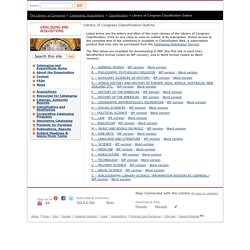
The Library of Congress > Cataloging, Acquisitions > Classification > Library of Congress Classification Outline Library of Congress Classification Outline Listed below are the letters and titles of the main classes of the Library of Congress Classification. Click on any class to view an outline of its subclasses. The files below are available for downloading in PDF (the first link in each line), WordPerfect format (noted as WP version), and in Word format (noted as Word version).
Stay Connected with the Library All ways to connect » Find us on. UDC Consortium: Welcome to the Universal Decimal Classification Consortium.