
Tumbledown Farm. Excerpt: Elevations and floor plan: 12 x 18, eight feet high in front, five feet in rear.
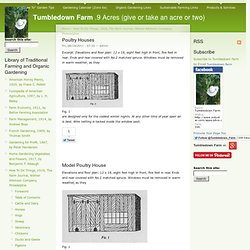
Ends and rear covered with No.2 matched spruce. Windows must be removed in warm weather, as they Fig. 1 are designed only for the coldest winter nights. At any other time of year open air is best. Wire netting is tacked inside the window sash. Model Poultry House Elevations and floor plan: 12 x 18, eight feet high in front, five feet in rear. Fig. 1 are designed only for the coldest winter nights. Drop doors are each three feet wide, five feet four inches long.
Dropping board, two and one-half feet high in front, three feet at rear. Roof is covered with paper roofing. A small room, 4 x 6, can be partitioned off, if desired, for storing sup plies and dressing fowls. Designing a Pasture Shelter. Photo by Deborah Moore The following is the main portion of an article of the same title that I wrote for the August/September 2007 issue of Backyard Poultry Magazine, a great resource for the homestead flock owner.
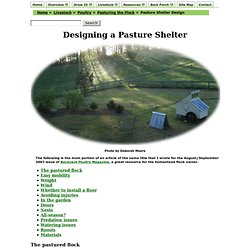
The pastured flock I have numerous times in these pages encouraged readers to keep their flocks on pasture if at all possible. There is no place a chicken (or duck or goose) is happier and healthier than foraging over good pasture, socializing and engaging in interesting natural behaviors, finding best-quality foods on her own, and enjoying the benefits of sunshine, fresh air, and exercise. Unless your pastured flock is “anchored” on the main poultry house, you will need a pasture shelter to provide protection from rain and from predators, a place where they feel secure to roost at night, and (in the case of layers) nests for laying eggs. Waterfowl usually show no interest in a shelter, even when it rains, but they badly need shade when it is hot. Easy mobility Sabot Bolt Wheel Wind. Small Scale Poultry Housing. Authors as Published Phillip J.

Clauer, Poultry Extension Specialist, Animal and Poultry Sciences Small scale poultry coops seem to be built in almost every possible shape and size. Building Chicken Coops and Constructing Chicken House Plans. Your chickens need a warm, sheltered area.

When it comes to giving your backyard chickens a home, it doesn’t matter the style of the housing — examples include a conventional chicken coop, an open range or an off-the-ground kennel — so long as you provide the basic requirements necessary for happy, healthy hens. In this guide, you’ll discover what to look for when building a chicken coop or buying a pre-made chicken house. Characteristics to Consider The best chicken coops or poultry houses have several characteristics in common. Permanent or Portable? Although there are hundreds of chicken coop styles on the market, most of these housing styles can be divided into two types: those that are portable and those that are permanent. Chicken Coop Project page 5. The front elevation plan This is the front elevation plan which gives a perspective of the frame viewed from the front.

The skids (i.e. what the chicken coop sits on) are of 4" x 4" (100mm x 100mm) stock and the joists are of 2" x 4" (100mm x 50mm) stock. The 3/4" (18mm) plywood floor is fixed to the floor joists and then the rest of the frame is built on this. The chicken coop frame (wall and roof) is all of 2" x 4" (100mm x 50mm) stock, except for the corner studs which are 4" x 4" (100mm x 100mm). Note: This complete project (all the pages together in one handy pdf file,ad free) can be purchased online and downloaded immediately to your computer for only $5. To view all available plans in downloadable pdf file click here.
This plan also gives detail of the roof rafters and pattern for cutting out the bird's mouth. Chicken coop design tips - Hen house. Home > Lawn & Garden > Keep Chickens > Coop Design Tips Building a house for your hens must start with the birds.
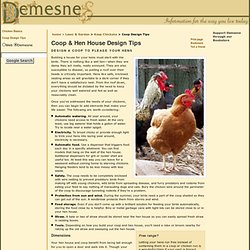
There is nothing like a wet hen—when they are damp they act really, really annoyed. They are also susceptible to disease, so putting a roof over their heads is critically important. Hens like safe, enclosed nesting areas so will gravitate to a dark corner if they don't have a satisfactory nest. From the roof down, everything should be dictated by the need to keep your chickens well watered and fed as well as reasonably clean.
Once you've addressed the needs of your chickens, then you can begin to add elements that make your life easier. Automatic watering. Dimensions Your hen house and coop benefit from being tall enough for you to open a door and walk into it. The size of the hen house, which contains the nests and roosts, needs to accommodate the number of birds you have (or aspire to) and be large enough for you to walk into and turn around. Materials Books.