

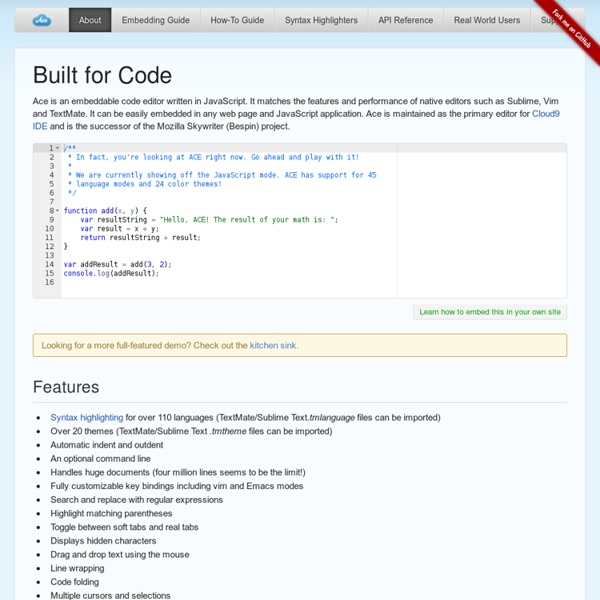
IDE in the cloud: Mozilla Labs' browser-based IDE prototype Mozilla Labs has launched a new project called Bespin that provides a browser-based framework for interactive code editing. The prototype includes a simple IDE with a built-in command system, a basic project management interface, and an editor that supports syntax highlighting and other features. The Bespin framework is distributed under an open source license and can be deployed by users on any server. It uses standards-based Web technologies and doesn’t rely on features that are specific to the Mozilla ecosystem, so you will eventually be able to use it in any standards-compliant Web browser. It does use some cutting-edge standards, however, so you will need Firefox 3 or a WebKit nightly build to test it today. The editor’s internal components are written in JavaScript and are very easy to extend. A technical overview of the prototype and additional details about the Bespin vision are provided in a blog entry at Ajaxian.
LESS « The Dynamic Stylesheet language The GeoJSON Format Specification 1. Introduction GeoJSON is a format for encoding a variety of geographic data structures. A complete GeoJSON data structure is always an object (in JSON terms). 1.1. A GeoJSON feature collection: 1.2. JavaScript Object Notation (JSON), and the terms object, name, value, array, and number, are defined in IETF RTC 4627.The key words "MUST", "MUST NOT", "REQUIRED", "SHALL", "SHALL NOT", "SHOULD", "SHOULD NOT", "RECOMMENDED", "MAY", and "OPTIONAL" in this document are to be interpreted as described in IETF RFC 2119. 2. GeoJSON always consists of a single object. The GeoJSON object may have any number of members (name/value pairs).The GeoJSON object must have a member with the name "type". 2.1 Geometry Objects A geometry is a GeoJSON object where the type member's value is one of the following strings: "Point", "MultiPoint", "LineString", "MultiLineString", "Polygon", "MultiPolygon", or "GeometryCollection". 2.1.1. A position is the fundamental geometry construct. 2.1.2. 2.1.3. 2.1.4. 2.1.5. 3.
Black Duck Software Names Open Source Rookies of 2010 -- WALTHAM, Mass., Jan. 7 Black Duck Software. (PRNewsFoto/Black Duck Software) WALTHAM, Mass., Jan. 7, 2011 /PRNewswire/ -- From a personally-controlled social network to a mobile application that lets aid workers collect, sort and share information about children in emergency situations, open source software is meeting the needs of today's application developers, according to Black Duck Software, which today announced its 2010 open source 'Rookies of the Year' list. (Logo: ) Working from a list of thousands of new projects launched in 2010, Black Duck evaluated a project's popularity using a weighted scoring system that awards points for commit activity within a project, the number of developers involved, and the number of web sites linked to the project. Some key observations from this year's report include: The Black Duck Rookies of the Year for 2010 include: About Black Duck Software SOURCE Black Duck Software RELATED LINKS
Programming in the Cloud. Some remarkable Online IDEs. Cloud computing is said to be the next big thing. We have witnessed the creation of great applications like Office tools, web operating systems and many many more. We still see Google, Yahoo! and Microsoft trying to gain more and more of the user’s share. At the time you read this article, each and everyone of the programs you can find and use on your operating system, it’s online alternative is also there to rival it. Things could not be different for development and designing tools. Flash Creation with Flash Minibuilder This project, currently named ActionScript MiniBuilder, features code assist (code completion) for ActionScript 3 and compilation of one-file AS3 SWF. Image Editing with SplashUp Splashup, formerly Fauxto, is a powerful editing tool and photo manager. PHP Developing with PHPAnywhere PHPAnywhere is an online PHP IDE that will be very familiar to Zend Studio users. PHP, C#, .NET, HTML, Javascript with CodeRun Javascript and HTML with UIzard Java Developing with Wavemaker
CSS3 PIE: CSS3 decorations for IE jQuery Geo autoinst: Wiki: UserGuide Welcome to the Autoinst User Guide. Autoinst is a tool for version controlled, templated, host configuration. This guide describes how to use Autoinst to manage configurations and templates, explains Autoinst concepts, how to use the command line interfaces and the API methods. Autoinst is designed to help its users manage host configurations, with the following features: Version controlled repository of configuration information Ability to reconstruct host configurations at any point in time Ability to write a single template to manage multiple similar configuration files Why another configuration system? Autoinst is limited in scope by design. Host configurations might be centrally managed, but do not have a revision system. Autoinst does not attempt to solve the following problems: Binary packaging. Instead, Autoinst is meant to complement these existing solutions, by providing a version-controlled configuration framework. Autoinst Resources Hosts <? Groups <? Group Naming Conventions <type>.
Eclipse Commands Advanced You can define parameters in commands. Create project "de.vogella.rcp.commands.parameterfirst" using the "Hello RCP" template. Create a command with the id "de.vogella.rcp.commands.parameterfirst.helloName" and a default handler "de.vogella.rcp.commands.parameterfirst.handler.HelloName". Right-click on your command, select New → commandParameter Use the following id for the parameter "de.vogella.rcp.commands.parameterfirst.commandParameter1" In the handler you have to evaluate the parameter. Add this command to the menu. As name enter the name of the parameter, pass as a value the value you want to use in your handler. Add the same command again to the menu and pass another parameter. If you run your application and select the menu entry the value should be used in the message box.
A re-introduction to JavaScript Why a re-introduction? Because JavaScript is notorious for being the world's most misunderstood programming language. It is often derided as being a toy, but beneath its layer of deceptive simplicity, powerful language features await. JavaScript is now used by an incredible number of high-profile applications, showing that deeper knowledge of this technology is an important skill for any web or mobile developer. It's useful to start with an overview of the language's history. Several months later, Microsoft released JScript with Internet Explorer 3. Because it is more familiar, we will refer to ECMAScript as "JavaScript" from this point on. Unlike most programming languages, the JavaScript language has no concept of input or output. Overview JavaScript is a multi-paradigm, dynamic language with types and operators, standard built-in objects, and methods. Let's start off by looking at the building blocks of any language: the types. And there are some built-in Error types as well. Numbers
The 5 types of programmers « Steven Benner's Blog In my code journeys and programming adventures I’ve encountered many strange foes, and even stranger allies. I’ve identified at least five different kinds of code warriors, some make for wonderful comrades in arms, while others seem to foil my every plan. However they all have their place in the pantheon of software development. Without a healthy mix of these different programming styles you’ll probably find your projects either take too long to complete, are not stable enough or are too perfect for humans to look upon. The duct tape programmer The code may not be pretty, but damnit, it works! This guy is the foundation of your company. The OCD perfectionist programmer You want to do what to my code? This guy doesn’t care about your deadlines or budgets, those are insignificant when compared to the art form that is programming. The anti-programming programmer I’m a programmer, damnit. His world has one simple truth; writing code is bad. The half-assed programmer What do you want?
Fabrice Bellard's Home Page Syndie