
Rumi. Jalāl ad-Dīn Muhammad Balkhī (Persian: جلالالدین محمد بلخى), also known as Jalāl ad-Dīn Muhammad Rūmī (Persian: جلالالدین محمد رومی), Mawlānā or Molānā (Persian: مولانا, meaning Our Master), Mawlawī or Molavi (Persian: مولوی, meaning My Master), and more popularly in the English-speaking world simply as Rumi (30 September 1207 – 17 December 1273), was a 13th-century Persian[1][6] poet, jurist, theologian, and Sufi mystic.[7] Iranians, Turks, Afghans, Tajiks, and other Central Asian Muslims as well as the Muslims of South Asia have greatly appreciated his spiritual legacy in the past seven centuries.[8] Rumi's importance is considered to transcend national and ethnic borders.
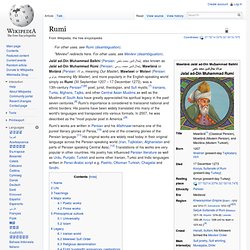
His poems have been widely translated into many of the world's languages and transposed into various formats. In 2007, he was described as the "most popular poet in America. "[9] Name Life Jalal ad-Din Rumi gathers Sufi mystics. Why should I seek? Hussam implored Rumi to write more. Teachings Major works. Avicenna. Pūr Sinɑʼ (Persian ابن سینا or ابو علی سینا or پور سينا Pur-e Sina; [ˈpuːr ˈsiːnɑː] "son of Sina";[full citation needed] August c. 980 – June 1037), commonly known as Ibn Sīnā, or in Arabic writing Abū ʿAlī al-Ḥusayn ibn ʿAbd Allāh ibn Al-Hasan ibn Ali ibn Sīnā[2] (Arabic أبو علي الحسين بن عبد الله بن سينا) or by his Latinized name Avicenna, was a Persian[3][4][5][6] polymath, who wrote almost 450 works on a wide range of subjects, of which around 240 have survived.
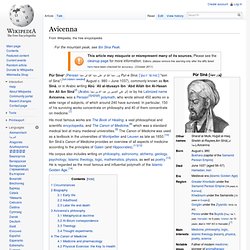
In particular, 150 of his surviving works concentrate on philosophy and 40 of them concentrate on medicine.[7] His corpus also includes writing on philosophy, astronomy, alchemy, geology, psychology, Islamic theology, logic, mathematics, physics, as well as poetry.[13] He is regarded as the most famous and influential polymath of the Islamic Golden Age.[14] Circumstances[edit] The study of the Quran and the Hadith thrived in such a scholarly atmosphere.
Muhammad. Names and appellations in the Quran Sources for Muhammad's life Quran A folio from an early Quran, written in Kufic script (Abbasid period, 8th–9th century). The Quran is the central religious text of Islam and Muslims believe that it represents the words of God revealed to Muhammad through the archangel Gabriel.[25][26][27] Although it mentions Muhammad directly only four times,[28][Quran 3:144][Quran 33:40][Quran 47:2][Quran 48:29] there are verses which can be interpreted as allusions to Muhammad's life.[14][n 4] The Quran however provides little assistance for a chronological biography of Muhammad, and many of the utterances recorded in it lack historical context.[29][30] Early biographies Next in importance are the historic works by writers of the 2nd and 3rd centuries of the Muslim era (AH – 8th and 9th century CE).[31] These include the traditional Muslim biographies of Muhammad (the sira literature), which provide additional information about Muhammad's life.[32] Hadith Life.
Averroes. ʾAbū l-Walīd Muḥammad bin ʾAḥmad bin Rušd (Arabic: أبو الوليد محمد بن احمد بن رشد), commonly known as Ibn Rushd (Arabic: ابن رشد) or by his Latinized name Averroës (/əˈvɛroʊ.iːz/; April 14, 1126 – December 10, 1198), was an Al-Andalus Muslim polymath, a master of Aristotelian philosophy, Islamic philosophy, Islamic theology, Maliki law and jurisprudence, logic, psychology, politics and Andalusian classical music theory, and the sciences of medicine, astronomy, geography, mathematics, physics and celestial mechanics.
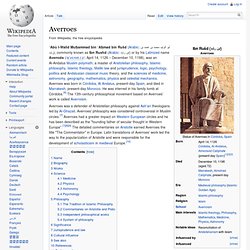
Averroes was born in Córdoba, Al Andalus, present-day Spain, and died in Marrakesh, present-day Morocco. He was interred in his family tomb at Córdoba.[6] The 13th-century philosophical movement based on Averroes' work is called Averroism. Averroes was a defender of Aristotelian philosophy against Ash'ari theologians led by Al-Ghazali. Name[edit] Biography[edit] Averroes was the preeminent philosopher in the history of Al-Andalus.