
1BOG Takes On Residential Solar with Online Brokering Service. The Energy Cost of Food. At the grocery cooperative nearest my home I can buy kale from California, grapes from Argentina, olive oil from Italy, miso from Japan, and apples from New Zealand.

I can enjoy a diet that’s utterly dissociated from Vermont’s Champlain Valley where I live, one that renders my local climate, the character of the local soil and geography, and even the passage of seasons irrelevant to my food choices. Rebuilding the Foodshed: Fields of ENERGY. Over the coming days, we'll be sharing material from Chapter 4 (Energy) of the latest Resilience guide, "Rebuilding the Foodshed: How to Create Local, Sustainable & Secure Food Systems".

This is a heck of a chapter, one that takes a look at the complex relationships between food systems, energy and waste. If you eat food, grow food, use energy, create energy, or make waste, you'll find yourself fascinated. Fast%20Clean%20Cheap. Looking at Trends in District Energy Development. "District Energy" is a term widely known in the energy field, but seldom enters the conversation of city planning.

District energy has been popularized by EcoDistricts, an organization that embodies a paradigm shift in urban planning which includes utility services as a component of community development. District energy is not a new concept; there are hundreds of legacy systems the U.S and thousands worldwide. Advanced Energy Legislation Tracker.
Green Energy’s Big Challenge: The Daunting Task of Scaling Up by David Biello. 20 Jan 2011: Report by david biello From the dust-blown steppes of Inner Mongolia to the waters off Shanghai, China installed more wind turbines in the first half of 2010 than any other country — 7,800 megawatts of potential power production, or more than the United States, the European Union, and India combined.

In fact, in northeast China alone, autumn and winter winds now produce some 17 billion kilowatt-hours of electricity, roughly 5.5 percent of the total power generation in the region. That’s up from 534 million kilowatt hours just five years ago. But despite this rapid progress, wind energy still only generates a tiny fraction of China’s electricity. This is hardly unique to China.
As the world attempts to wean itself from fossil fuels — a result of the converging desires to combat climate change, improve energy security, and ‘We need to replace all of the power-producing infrastructure that we have today within 40 years,’ says one expert. Wikimedia Commons. How to power America with renewables on the cheap: Build a shit ton of wind and solar capacity.
America could be powered almost entirely with wind turbines and solar systems by 2030 at a cost comparable to what we’re spending for dirty power today, a new study finds.

The necessary approach would surprise most people, and it would generate enough economic activity to make any capitalist drool: Build, build, build … and then build some more. From Midwest Energy News: The analysis … challenges the common notion that wind and solar power need to be paired with fossil fuel or nuclear generators, so utilities can meet electricity demand when it’s not windy or sunny.The paper instead proposes building out a “seemingly excessive” amount of wind and solar generation capacity — two to three times the grid’s actual peak load. A Plan to Power 100 Percent of the Planet with Renewables. In December leaders from around the world will meet in Copenhagen to try to agree on cutting back greenhouse gas emissions for decades to come.

The most effective step to implement that goal would be a massive shift away from fossil fuels to clean, renewable energy sources. If leaders can have confidence that such a transformation is possible, they might commit to an historic agreement. We think they can. A year ago former vice president Al Gore threw down a gauntlet: to repower America with 100 percent carbon-free electricity within 10 years. Jevons paradox. The Jevons paradox has been used to argue that energy conservation may be futile, as increased efficiency may increase fuel use.

Nevertheless, increased efficiency can improve material living standards. Further, fuel use declines if increased efficiency is coupled with a green tax or other conservation policies that keep the cost of use the same (or higher).[3] As the Jevons paradox applies only to technological improvements that increase fuel efficiency, policies that impose conservation standards and increase costs do not display the paradox. History[edit] The Jevons paradox was first described by the English economist William Stanley Jevons in his 1865 book The Coal Question. Jevons observed that England's consumption of coal soared after James Watt introduced his coal-fired steam engine, which greatly improved the efficiency of Thomas Newcomen's earlier design.
Cause[edit] Rebound effect[edit] Khazzoom–Brookes postulate[edit] Three Birds - Home.
Discussions about Energy and Our Future. State Revolving Fund. Can Crowdfunding Unlock an Off-Grid Solar Revolution? The poorest people on the planet spend more on energy than we do.
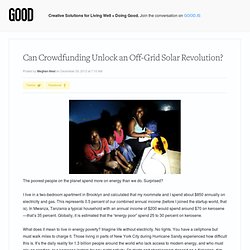
Surprised? I live in a two-bedroom apartment in Brooklyn and calculated that my roommate and I spend about $850 annually on electricity and gas. This represents 0.5 percent of our combined annual income (before I joined the startup world, that is). WEBINAR RECORDING: Community Solar 101. Community Green Energy - Energy Exchange Project.