
Karsten Neuhoff at IDEAS. Share: MyIDEAS: Login Diberdayakan oleh Terjemahan This is information that was supplied by Karsten Neuhoff in registering through RePEc.
If you are Karsten Neuhoff , you may change this information at the RePEc Author Service. Or if you are not registered and would like to be listed as well, register at the RePEc Author Service. Personal Details First Name: Karsten Middle Name: Last Name: Neuhoff Suffix: RePEc Short-ID: pne71 Email: kneuhoff@diw.deHomepage: Postal Address: Phone: Affiliation (95%) DIW Berlin (Deutsches Institut für Wirtschaftsforschung) Energy Information, Data, and other Resources. Energy Analysis Home Page. Negative prices in wholesale electricity markets indicate supply inflexibilities - Today in Energy. February 23, 2012 Source: U.S.
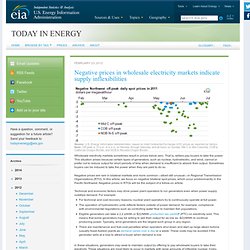
Energy Information Administration, based on InterContinental Exchange (ICE) prices as reported by Ventyx. Note: Off-peak is 10 p.m. to 6 a.m. on Monday through Saturday and all hours on Sunday. Mid C is Mid-Columbia, COB is California-Oregon Border, and NOB is Nevada-Oregon Border. Wholesale electricity markets sometimes result in prices below zero. Negative prices are rare in bilateral markets and more common—albeit still unusual—in Regional Transmission Organizations (RTO). Technical and economic factors may drive power plant operators to run generators even when power supply outstrips demand. In these situations, generators may seek to maintain output by offering to pay wholesale buyers to take their electricity. Today in Energy. April 18, 2014 Eleven states generated electricity from nonhydro renewables at double U.S. average April 15, 2014 Twelve states produced 80% of U.S. wind power in 2013 April 8, 2014 Half of power plant capacity additions in 2013 came from natural gas.
Energy. Microturbine Technology Matures. Microturbine technology has evolved from early systems of 30 kW to 70 kW to today’s systems, which can have individual ratings of 200 kW to 250 kW.

Packages up to 1 MW are now available that can be assembled into multipac units for projects of 5 MW to 10 MW. These modern units are packaged with integrated digital protection, synchronization, and controls; they produce high combined heat and power efficiencies; and they are capable of using multiple fuels. Microturbines are a relatively new technology for the generation of electric power.
So, not surprisingly, questions are often raised by potential customers, engineering firms, original equipment manufacturers, and government agencies about how microturbines perform and how they differ from other more traditional forms of electric power generation. This article addresses those questions, describes the major features of microturbines, and gives examples of how they are used in real-world applications (Figure 1).
Energy Infrastructure Reports - NYSERDA. New York State Energy Assurance Plan The purpose of the Energy Assurance Plan (EAP) [PDF|9.5MB] is to develop a reasonable, effective and actionable Plan that will enhance state government Energy Assurance capabilities, energy reliability and identify new opportunities for enhanced assurance through technology.
The EAP is intended to help State Energy Officials communicate and coordinate with energy stakeholders on energy disruptions and to prepare for potential disturbances. It provides a resource for State Energy Officials and other governmental stakeholders to understand the highly integrated and interdependent nature of the energy industry, the roles and responsibilities of regional organizations and designated State agencies, in the execution of effective pre-emergency mitigation, emergency response and restoration. The NYS EAP is part of the ongoing effort at the federal, state and local levels to enhance energy resiliency in New York. New York Energy Policy Institute Project.
Search Results. Files. Power Generation and Energy Industry News, Magazines, Conferences and Events: PennWell.com. The Association for the Study of Peak Oil and Gas. Yale Environment 360: Opinion, Analysis, Reporting & Debate. Matter Network - Clean Technology, Sustainable Business and Green News. SmartGridElectronics.Net « How the Smart Grid is Changing the Design of Electronic Equipment SmartGridElectronics.Net. Www.pwc.com/en_US/us/technology/assets/pwc-money-tree-q1-2012-cleantech-summary.pdf. This Quarter in Cleantech Venture Capital investing.
The various deal-tracking groups continue to step up their game, doing a better and better job each year.
Looking forward to seeing additional takes from CB Insights, Ernst & Young and others, but just reviewed the Cleantech Group's Q2 media presentation (as reported on by GTM here) and had a few additional thoughts and reactions to lob in: 1. It really feels like 2012 is a shakeout year. Remember that the way these numbers get reported, and given the paucity of exits in the sector, there's a fundamental momentum to see deal counts always go up over time.
Every quarter's new deals will require multiple follow-on rounds, so as new companies are added to VC firms' portfolios (and especially when, as the Cleantech Group's data suggests, existing portfolio companies are not being acquired out very rapidly), you would expect a cascading effect, where over time a lot of follow-on financings would mean more and more deals, even if the industry isn't really attracting a lot of new VC interest.