
Favorites of 2012: On being wrong about business talks. Business talks are boring.
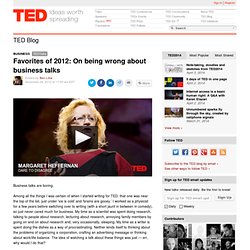
Among all the things I was certain of when I started writing for TED, that one was near the top of the list, just under ‘ice is cold’ and ‘brains are gooey.’ I worked as a physicist for a few years before switching over to writing (with a short jaunt in between in comedy), so just never cared much for business. My time as a scientist was spent doing research, talking to people about research, lecturing about research, annoying family members by going on and on about research and, very occasionally, sleeping. My time as a writer is spent doing the dishes as a way of procrastinating. Neither lends itself to thinking about the problems of organizing a corporation, crafting an advertising message or thinking about work/life balance. At TED, I was hired to write about the science talks, and it was wonderful.
As I watched more talks, though, one theme started to emerge that I fell in love with — the idea of being wrong. A collection of hand selected articles by Steven Kornfeld from Passion for Training. The Power of Concentration.
6 Popular Ideas that Fail. “Nobody ever gets fired for buying IBM” was once a popular belief that seems quaint now.
It’s hard to imagine that people used to buy IBM products simply because they were so dominant. We are all, however, chauvinists for our own age, caught up in our own moment. We take refuge in the safety of numbers. We don’t trust the short line at the store. Quantity has a quality all of its own. 1. One of the things you hear with metronomic regularity in the business world is the importance of performance pay. He draws on decades of studies that show that for problem solving and creative tasks (i.e. most of what professionals do today), incentive pay often decreases productivity. My experience suggests that he’s right. That doesn’t mean that that incentives have no place at all. 2. Another standard practice that is taken on faith is brainstorming. Introduction to Informal Learning. Informal learning accounts for over 75% of the learning taking place in organizations today.[1] Often, the most valuable learning takes place serendipitously, by random chance.

Most companies, however, focus only on formal learning programs, losing valuable opportunities and outcomes. To truly understand the learning in your organization you might want to recognize the informal learning already taking place and put in practices to cultivate and capture more of what people learn.
This includes strategies for improving learning opportunities for everyone and tactics for managing and sharing what you know. This introduction is dedicated to reviewing the informal learning literature, understanding the issues, and pointing you to additional resources. What is informal learning? Most learning doesn’t occur during formal training programs. (click on the image to get a larger version of this graphic you can use in presentations) I also sometimes refer to one more category: Non-formal learning.
Learn More Now. Picture a company cafeteria with overhead projectors, pads of paper, and pencils on all the tables.

Is this the sign of an organization in desperate need of more conference rooms? No, it's the cafeteria at Siemens Power Transmission and Distribution, designed by senior managers to help employees capture what they learn during casual conversations and impromptu knowledge-sharing sessions. Now picture a meeting during which everyone describes the biggest mistakes they've made during the past year. Is this some kind of support group? Sort of: It's a gathering of WD-40 Company's global brand managers, who take the opportunity to share their "learning moments," the times when they mess up and learn something as a result. According to the U.S. Informal learning can support the day-in and day-out culture building and skills development needed in an economy fueled by distinctive information and sparkling innovations.
Brainstorming - Brainstorming Techniques from MindTools. Generating Many Radical, Creative Ideas Brainstorm better with James Manktelow & Amy Carlson.

How often have you used brainstorming to solve a problem? Chances are, you've used it at least once, even if you didn't realize it. For decades, people have used brainstorming to generate ideas, and to come up with creative solutions to problems. However, you need to use brainstorming correctly for it to be fully effective. In this article, we'll look at brainstorming: what it is, why it's useful, and how to get the best from it. What is Brainstorming? Madison Avenue advertising executive Alex Osborn developed the original approach to brainstorming and published it in his 1953 book, "Applied Imagination.
"
HR. Startups: As a startup CEO, what is your favorite productivity hack.