
10 mistakes every programmer makes. When you start programming, you get disillusioned quickly.
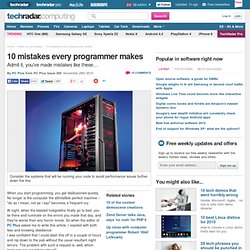
No longer is the computer the allinfallible perfect machine – "do as I mean, not as I say" becomes a frequent cry. At night, when the blasted hobgoblins finally go to bed, you lie there and ruminate on the errors you made that day, and they're worse than any horror movie. So when the editor of PC Plus asked me to write this article, I reacted with both fear and knowing obedience.
I was confident that I could dash this off in a couple of hours and nip down to the pub without the usual resultant night terrors. The problem with such a request is, well, which language are we talking about? Bringing Holistic Awareness to Your Design. Gone, thankfully, are the days when the user experience and the user interface were an afterthought in the website design process, to be added on when programming was nearing completion.
As our profession has increasingly gained importance, it also become increasingly specialized: information design, user experience design, interaction design, user research, persona development, ethnographic user research, usability testing—the list goes on and on. Increased specialization, however, doesn’t always translate to increased user satisfaction. My company conducted a best practice study to examine the development practices of in-house teams designing web applications—across multiple industries, in companies large and small. Some teams were large and highly specialized, while others were small and required a single team member to perform multiple roles. Fig. 1 — Teams tend to organize in similar patterns in response to the information domains they need to explore and understand 1. 2. 3. 4. Agile Ruined My Life. I read the reply to my comment on a popular hacker board with sadness: (disclaimer: Agile consultants ruined the software group I work in.)Making good software is hard, and anyone claiming to have a magical process that guarantees good software is selling snake oil.
I can appreciate your wanting to make a buck, but would also seriously appreciate it if you could find some other industry besides software development to go screw up Reminded me of an email I received back in May: [We] started working on [agile technique X] when [author]‘s [famous book] was just a draft. I was on that project and worked on Agile Projects for a decade.
I’ve had many such conversations over the years.There are some seriously pissed off people about Agile out there. The easy answer — and the answer most agile-lovers would give — is that these folks are simply non-hackers. Throw Away Your Bug Tracking System. From APIDesign Bugzilla is a bug tracking system backed by SQL database.
Many open source projects use Bugzilla. JBehave 3.0 (Behavior-Driven Development) now available! Just a few days ago JBehave released version 3.0. What is Behaviour-Driven Development (BDD)? BDD is an agile software development technique that helps the relationship and communication between developers and experts in different fields. The BDD wiki states: "BDD relies on the use of a very specific (and small) vocabulary to minimise miscommunication and to ensure that everyone – the business, developers, testers, analysts and managers – are not only on the same page but using the same words. " JBehave is a framework for Behaviour-Driven Development.
The ACH Methodology and Its Purpose - The Open Source Analysis of Competing Hypotheses Project. From The Open Source Analysis of Competing Hypotheses Project Analysis of Competing Hypotheses (ACH) is a simple model for how to think about a complex problem. Better Requirements Definition Management. Click here to view the complete list of archived articles This article was originally published in the Summer 2010 issue of Methods & Tools Better Requirements Definition Management is Better for Business Genefa Murphy, HP Software and Solutions, www.hp.com/blogs/requirementsmanagement Why focus on requirements definition management in the application lifecycle?
Increasingly, smart businesses are looking much closer at requirements definition (RD) and requirements management (RM) (sometimes grouped together under the Gartner-coined phrase, requirements definition management (RDM)) to streamline the entire application lifecycle. The Perfect Development Environment. Deadlines Without Downtime: The Curse of Software Development. We Recommend These Resources A common observation of the software development industry is that it's immature.
Explaining Kanban to Scrum Adopters. XPlanner+open source project tracking and planning tool for agile teams. The one file kanban board application. Maîtrise d'ouvrage. Un article de Wikipédia, l'encyclopédie libre.
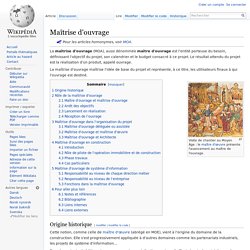
Pour les articles homonymes, voir MOA. La maîtrise d'ouvrage (MOA), aussi dénommée maître d'ouvrage est l'entité porteuse du besoin, définissant l'objectif du projet, son calendrier et le budget consacré à ce projet. Le résultat attendu du projet est la réalisation d'un produit, appelé ouvrage. La maîtrise d'ouvrage maîtrise l'idée de base du projet et représente, à ce titre, les utilisateurs finaux à qui l'ouvrage est destiné.
Maîtrise d'œuvre. Un article de Wikipédia, l'encyclopédie libre.
Pour les articles homonymes, voir Moe. Maîtrise d'ouvrage / Maîtrise d'oeuvre.