
Transhumanism. Transhumanism (abbreviated as H+ or h+) is an international cultural and intellectual movement with an eventual goal of fundamentally transforming the human condition by developing and making widely available technologies to greatly enhance human intellectual, physical, and psychological capacities.[1] Transhumanist thinkers study the potential benefits and dangers of emerging technologies that could overcome fundamental human limitations, as well as the ethics of developing and using such technologies.
They speculate that human beings may eventually be able to transform themselves into beings with such greatly expanded abilities as to merit the label "posthuman".[1] History[edit] According to Nick Bostrom,[1] transcendentalist impulses have been expressed at least as far back as in the quest for immortality in the Epic of Gilgamesh, as well as historical quests for the Fountain of Youth, Elixir of Life, and other efforts to stave off aging and death.
First transhumanist proposals[edit] The Singularity Is Near. The Singularity Is Near: When Humans Transcend Biology is a 2005 non-fiction book about artificial intelligence and the future of humanity by inventor and futurist Ray Kurzweil.
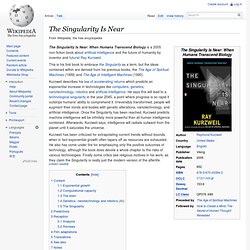
This is his first book to embrace the Singularity as a term, but the ideas contained within are derived from his previous books, the The Age of Spiritual Machines (1999) and The Age of Intelligent Machines (1990). Kurzweil describes his law of accelerating returns which predicts an exponential increase in technologies like computers, genetics, nanotechnology, robotics and artificial intelligence. He says this will lead to a technological singularity in the year 2045, a point where progress is so rapid it outstrips humans' ability to comprehend it. Irreversibly transformed, people will augment their minds and bodies with genetic alterations, nanotechnology, and artificial intelligence.
Content[edit] Exponential growth[edit] Computational capacity[edit] Moore's Law The brain[edit] Exponential Growth of Computing. Ray Kurzweil. Raymond "Ray" Kurzweil (/ˈkɜrzwaɪl/ KURZ-wyl; born February 12, 1948) is an American author, computer scientist, inventor, futurist, and is a director of engineering at Google.
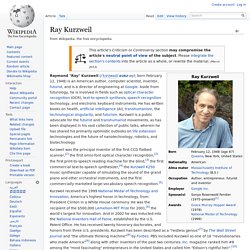
Aside from futurology, he is involved in fields such as optical character recognition (OCR), text-to-speech synthesis, speech recognition technology, and electronic keyboard instruments. He has written books on health, artificial intelligence (AI), transhumanism, the technological singularity, and futurism. Kurzweil is a public advocate for the futurist and transhumanist movements, as has been displayed in his vast collection of public talks, wherein he has shared his primarily optimistic outlooks on life extension technologies and the future of nanotechnology, robotics, and biotechnology. Life, inventions, and business career[edit] Early life[edit] Ray Kurzweil grew up in the New York City borough of Queens. Kurzweil attended Martin Van Buren High School. Mid-life[edit] Later life[edit] Personal life[edit] How to Create a Mind. How to Create a Mind: The Secret of Human Thought Revealed is a non-fiction book about brains, both human and artificial, by inventor and futurist Ray Kurzweil.
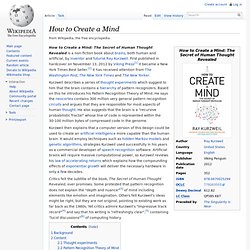
First published in hardcover on November 13, 2012 by Viking Press[1] it became a New York Times Best Seller.[2] It has received attention from The Washington Post, The New York Times and The New Yorker. Kurzweil describes a series of thought experiments which suggest to him that the brain contains a hierarchy of pattern recognizers. Based on this he introduces his Pattern Recognition Theory of Mind. He says the neocortex contains 300 million very general pattern recognition circuits and argues that they are responsible for most aspects of human thought.
He also suggests that the brain is a "recursive probabilistic fractal" whose line of code is represented within the 30-100 million bytes of compressed code in the genome. Critics felt the subtitle of the book, The Secret of Human Thought Revealed, over promises. Background[edit]