
Yangchen. You're a Nobody Unless Your Name Googles Well. Why Social Accountability Will Be the New Currency of the Web. John C.
Havens is the founder of The H(app)athon Project and author of the upcoming book H(app)y -- The Value of Well Being in a Digital Economy (Tarcher/Penguin, 2014). He can be reached @johnchavens. In 1932, a small town in Austria called Worgl created an economic experiment to counter the devastating effects of the Great Depression. The Mayor issued a new currency and encouraged citizens to spend it quickly to put money back in the system. People were motivated to participate in an economy based on action. Within months, the town’s unemployment rate had dropped by over 30%.
DigiCitizen - Some Facts. Discover what your digital footprint says about you. Does your digital footprint convey the message you want?

If you don't know you should spend time figuring this out. In the 21st century our digital footprint conveys an important image and people should know what that is. Below are ideas that will enable you to explore and consider if your digital footprint conveys the message you want to share with the world. It will also give you ideas for activities you can do with your students so they can do the same.
General Internet Footprint Here are some basics to get you started in discovering what your general footprint is on the internet. Google yourself. Six hot trends in social influence marketing. Now that access to the high-speed Internet and free social media publishing tools are widespread, everyone can create their own content and have a voice about topics they love.

The ability to create powerful content that moves through an audience is a legitimate source of influence on the web, and something that just could have happened now. Influence has been democratized! Companies like Klout, Kred, PeerIndex, and Appinions are tapping into this powerful new trend and attempting to quantify this new source of influence — not ALL influence, but a very small, important sliver of it — Can people effectively create content that moves through the Internet and elicit a reaction (like a RT, a comment, or opening a link). This is another way of saying, “Who creates buzz?”
While assigning influence to celebrities and sports stars has been common for decades (E scores and Q scores), assigning some measure of word-of-mouth power to the masses opens up some revolutionary possibilities. NYC's First Chief Digital Officer Speaks Out. To improve communication with residents and businesses, New York City hired its very first Chief Digital Officer, a role that aims to enhance transparency through digital media.
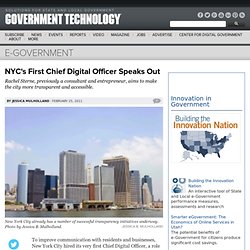
Though only in the position for a few weeks, Rachel Sterne already has started gathering feedback to create a 90-day report that details the city's online strategies. The report ultimately will look at ways the city can enhance its digital footprint, streamline its existing social media mechanisms and explore public-private partnerships. Sterne says her first weeks have been very exciting, noting that New Yorkers are eager to access government services and important information online. "Across the city, many agencies are already active online and have a genuine interest in innovation and connecting digitally with citizens," she said.
In what ways has your background, both education and career-wise, prepared you for this position? We are starting the 90-day report with no preconceptions. TransLattice Releases First Geographically Distributed Database. By Anam Alpenia, Red Herring The future of the database lies in geography.

TransLattice, the provider of distributed database and application platforms, today released the next generation in databases that uses multiple locations to strategic advantage. The company announced the world’s first geographically distributed Relational Database Management System that uses an elastic approach to place nodes in a variety of locations. Those nodes instantly back up the data from across geographies, serving as a safety net in the case of a blackout or data disruption. Instead of the traditional approach of stacking database servers within 200 feet of each other, TransLattice Elastic Database (TED) geographically distributes the data across an organization’s geographic locations. “We allow these mass workloads to operate on the public cloud for the first time,” said Mike Lyle, CTO of TransLattice.
In a traditional database, a power outage or other catastrophe can wipe a company’s data off the map. The End of Theory: The Data Deluge Makes the Scientific Method Obsolete. Database of the Self in Hyperconnectivity.