

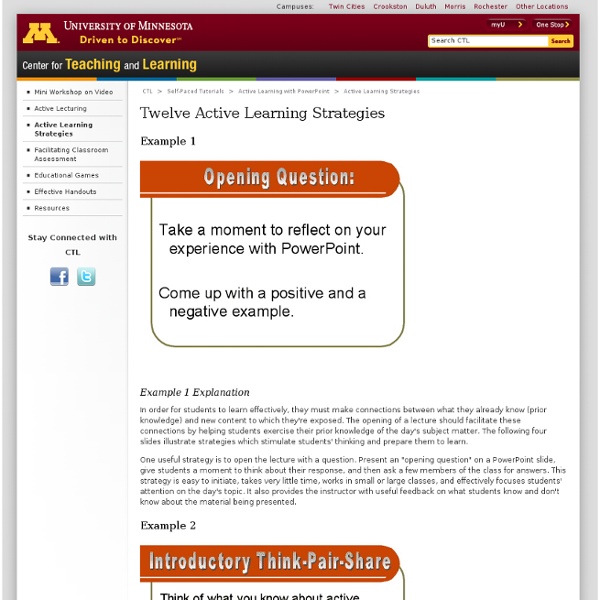
Think-Pair-Share Think-Pair-Share activities pose a question to students that they must consider alone and then discuss with a neighbor before settling on a final answer. This is a great way to motivate students and promote higher-level thinking. Even though the activity is called think-"PAIR"-share, this is the term many instructors use for pairs and small groups (three or four students) alike. Advantages of think-pair-share Instructors find they can have a format change during lecture that only takes a small amount of class time. Steps and tips for using think-pair-share Click above to watch a video of Greg Hancock, College of William and Mary, demonstrate how to use the Think-Pair-Share method at an On the Cutting Edge workshop.Ask a question. Examples of think-pair-share questions include: Describe and interpret the image. Challenges of the think-pair-share technique One of the biggest challenges of the think-pair-share is to get all students to truly be engaged. Examples of think-pair-share activities
Teaching strategies If you have dropped into this Course Design Tutorial from somewhere else, you might wish to start at the introduction, overview, or table of contents. If you are working through the tutorial, you should have completed Part 2.1 before beginning this section. At this stage of the tutorial, you have set overarching goals, organized content, and developed a course plan with ideas for how to give students the practice that will make it possible for them to achieve the course goals. Start by downloading the worksheet (Microsoft Word 22kB Jun16 05) that goes with this part, and use it as you work through the sections below. Student Learning An enormous amount has been written in the last two decades about research on how people learn. Research shows clearly that a person must be engaged to learn. What messages can we take home for course design? Several years ago, one of us was an observer in a large lecture class. Learning Styles Task 2.2a: Learning styles inventory Gen. The jigsaw technique
Some Basic Active Learning Strategies Engaging students in individual or small group activities–pairs or trios especially–is a low-risk strategy that ensures the participation of all. The sampling of basic activities below can be adapted to almost any discussion or lecture setting. Using these strategies, or variations on them, ensures that you'll hold your students' attention in class and throughout the semester. Ice Breakers Those things that get people talking quickly and personally about their goals, fears, expectations for the session before them. top Think/Pair/Share Have attendees turn to someone near them to summarize what they're learning, to answer a question posed during the discussion, or to consider how and why and when they might apply a concept to their own situations. Write/Pair/Share The format for this strategy is identical to the think-pair-share, except that students process the question asked of them by writing about it rather than reflecting. Student Summaries Question and Answer Pairs Focused Listing Corners
Free Visual Dictionary & Thesaurus | Online Dictionary | Associated Words | Synonyms Dictionary at SnappyWords.com Index of Learning Styles The Index of Learning Styles is an on-line survey instrument used to assess preferences on four dimensions (active/reflective, sensing/intuitive, visual/verbal, and sequential/global) of a learning style model formulated by Richard M. Felder and Linda K. Silverman. ILS users should be aware of an important point. To take the questionnaire immediately, click here.To get information about the questionnaire and then take it, click here. Visual Synonyms | English Thesaurus Online Teaching Activity Index : Lesson Template Goals & Objectives: What will the students be able to do after doing what to what level. What are the knowledge, skills, and attitudes gained. Goals are included as a broad learning statement and objectives as specific items to be learned. Students will acquire / demonstrate knowledge of a given topic X ... ... during active participation in a discussion forum, both answering x questions and replying to y other posts on the topics assigned within an 80% achievement level as determined by the discussion rubric. Prerequisites: What must students already know before beginning this lesson? Materials and Resources: What needs to be prepared in advance by the teacher? What does the student need to bring to the lesson? Guiding Questions for this Activity: Is there a main question being answered by the lesson? Activity Outline and Procedure: How will the materials be presented? Teaching Strategies: Discussion questions are there for discussion. Accommodations: Timeline: Back to Top
eTextbook Teachers [licensed for non-commercial use only] / Welcome Mission In 5 weeks (Jan. 11th - Feb. 14th, 2016), collaborate with over 500 teachers worldwide to design the 1st chapter of a digital textbook that meets your students' needs. Receive support from 18 moderators with experience in publishing, editing, and materials design. **REGISTER for this Session: 1. 2. 3. 4. We are thankful for the support of our sponsor CALL-IS! While you wait, complete our pre-tasks to learn more about Google Communities and ebook design! A pbworks wiki which has not been edited in the last 12 months is reclaimed by pbworks
Online Teaching Activity Index : Hypothetical Discussion Activity Goals & Objectives: In general, hypothetical discussions are on the upper end of Bloom's taxonomy. Students usually analyze and/or evaluate a given situation. Action verbs in objectives include appraise, synthesize, evaluate, recommend, interpret, compare, etc. Prerequisites: The answer to this question will vary depending on the needs of the lesson. Materials and Resources: What needs to be prepared in advance by the teacher? What does the student need to bring to the lesson? Guiding Questions for this Activity: Is there a main question being answered by the lesson? Activity Outline and Procedure: Questions or situations are posed to the student. Teaching Strategies: What are some tips to help the lesson run smoothly? Accommodations: What accommodations may be needed for students with disabilities or other special needs? Timeline: Typically, about 3 days should be provided at a minimum between the time a question is posed and the time an answer is required. How was student learning verified?
Six Wonderful Sites to Help you Write, Speak and Sound Better I’m not a native speaker. Even though I read, write, work and I would almost dare say live and dream in English, I haven’t learned the language from birth and sometimes have moments of self-doubt. These websites I am going to share in this post have been an invaluable help. Blog de Cristina is also on Facebook. FOLLOW IT! ♥Howjsay and Forvo: The world’s largest dictionaries of English Pronunciation How often have you come across a proper name you had no clue how to pronounce and you desperately needed to know the correct standard pronunciation of or perhaps a variant pronunciation of this word? ♥Linguee We all know how difficult it is to write, even more in a foreign language. ♥Phraseup Sometimes we know what we want to write, the sentence is phrased in our mind, but we can’t figure out some of the words we need. ♥Ozdic.com I have been using ozdic.com for years and this is a dictionary I cannot live without. ♥Text2Phonetics
Story Arts | Storytelling in the Classroom Why Storytelling? Educators have long known that the arts can contribute to student academic success and emotional well being. The ancient art of storytelling is especially well-suited for student exploration. As a folk art, storytelling is accessible to all ages and abilities. Retelling Folktales Storytelling Lesson Plans and Activities Using Storytelling To Assess Listening and Speaking Skills Story Library Exploring Cultural Roots Through Storytelling Why Storytelling? Gaining Verbal Skills Becoming verbally proficient can contribute to a student's ability to resolve interpersonal conflict nonviolently. Imagination Both telling a story and listening to a well-told tale encourages students to use their imaginations. Passing On Wisdom Storytelling based on traditional folktales is a gentle way to guide young people toward constructive personal values by presenting imaginative situations in which the outcome of both wise and unwise actions and decisions can be seen.
How To Structure A Story: The 8 Point Arc By Ali Hale - 3 minute read One of my favourite “how to write” books is Nigel Watts’ Writing A Novel and Getting Published. My battered, torn and heavily-pencil-marked copy is a testament to how useful I’ve found it over the years. (Even if you’re a short story writer or flash fiction writer rather than a novelist, this structure still applies, so don’t be put off by the title of Watts’ book.) The eight points which Watts lists are, in order: StasisTriggerThe questSurpriseCritical choiceClimaxReversalResolution He explains that every classic plot passes through these stages and that he doesn’t tend to use them to plan a story, but instead uses the points during the writing process: I find [the eight-point arc] most useful as a checklist against which to measure a work in progress. So, what do the eight points mean? Stasis This is the “every day life” in which the story is set. Trigger Something beyond the control of the protagonist (hero/heroine) is the trigger which sparks off the story.
The Golden Rules for a Good Plot Writing a novel can be a daunting task. Here are some helpful tips to ensure you write a good plot. Is it your dream to become a best-selling author? Plot Rule 1: Create a plot skeleton A plot outline will help you choose a complication and the steps to resolve it. Plot Rule 2: Flesh out your plot Fleshing out your plot with colorful characters and a vivid setting will enhance your novel and grab your readers’ attention. Plot Rule 3: Bring your plot to a powerful resolution Have you used each scene and story event to guide readers to a plot resolution? Plot Rule 4: End your story at a natural stopping place After the climax, wrap up the story as quickly as possible. Plot Rule 5: Make sure your characters resolve conflicts on their own Don't rely on an act of nature or an unknown hero to clean things up at the last minute. A final note on creating a good plot… Creating a good plot isn't as easy as it sounds.