

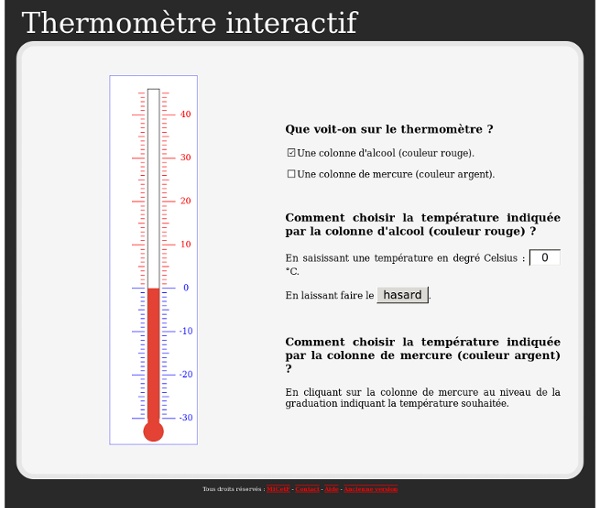
Number Frames Overview Number Frames help students structure numbers to five, ten, twenty, and one hundred. Students use the frames to count, represent, compare, and compute with numbers in a particular range. The frames help students see quantities as equal groups of other quantities and in relation to benchmark quantities. About Us This resource is brought to you by The Math Learning Center, a nonprofit organization dedicated to K-12 education since 1976. This app was crafted by Clarity Innovations. www.clarity-innovations.com © 2015 Math Learning Center | Number Frames version 1.1.2 Apprendre à mesurer la température avec un thermomètre interactif Dans la même veine que l’horloge interactive, je vous propose cette fois une application pour apprendre à mesurer la température, il s’agit du thermomètre interactif.A ma connaissance, il n’existe pas énormément de matériel didactique qui permette de réaliser des manipulations avec cet instrument de mesure et on est vite amené à travailler avec des activités « papier/crayon ». Quand bien même les ordinateurs grand public ne sont pas encore équipés par défaut d’un capteur de température ambiante, cette application conçue en Flash vous permettra de réaliser des manipulations avec les enfants en indiquant les températures de votre choix. Pour l’enseignant, ce programme est avant tout destiné à réaliser des activités de manipulations avec ses élèves. Lire la température indiquée sur le thermomètre.Une température étant donnée, indiquer la position correspondante du liquide sur le thermomètre. – Premier cas de figure: Lire la température indiquée sur le thermomètre. Caractéristiques Save
pour apprendre sa conjugaison Super Teacher Tools jeux ce1 Math : Calcul, Numération, Problèmes, Géométrie. Français : Lecture-sons (révisions), Lecture-compréhension, Conjugaison-Grammaire, Confusions de sons, Orthographe, Vocabulaire. Eveil : B2i, Sciences, Géographie, Mémorisation/spatialisation, Langues étrangères, Pendus, Sudokus, Puzzles. Mathématiques Français Eveil Jeux (Sudokus, Pendus, Logique, Récréation)
ILLUSIONS OPTIQUES …si, si, ces lignes sont bien parallèles… Elles sont droites leurs lignes? Non, non, c'est pas celle d'Herman! Coupe ou têtes? Celui-ci est traître! Regardez deux fois plutôt qu'une! La belle et la sorcière! Celui-ci est pour les pros seulement! Bon allez! Ecco come funziona Mathpix, l'app che fotografa un'equazione e la risolve È un’app gratuita che riconosce le equazioni matematiche (scritte a mano) e le risolve in pochi secondi Pubblicato Più che un’evoluzione di una calcolatrice grafica è una sorta di Shazam del calcolo. Qualche giorno fa è stata lanciata Mathpix, una nuova app iOs (gratuita) che consente di puntare la fotocamera verso un’equazione matematica scritta a mano (con grafia leggibile) e calcolarne le soluzioni in pochi secondi. L’interfaccia di Mathpix si presenta come quella di una qualsiasi app per fotocamera: si trascina il reticolo sullo schermo sopra l’equazione e l’app la risolve e fornisce anche le risposte in termini di grafici del caso. Mathpix è stato concepito da Nico Jimenez, un dottorando di Stanford. Dopo averla provata, dobbiamo in effetti dire che l’applicazione è molto ben fatta, intuitiva e semplice nell’utilizzo, oltre che molto veloce. In sostanza, è uno strumento incredibilmente utile per un qualunque studente di una facoltà tecnico-scientifica. Segui
Grand Prix Multiplication Grand Prix Multiplication Grand Prix Multiplication is a multi-player racing game that allows students from anywhere in the world to race one another while practicing their multiplication facts! Content: Multiplication facts to 12 Standards:3.OA.C.7: Fluently multiply and divide within 100 Players: 4 Arcademics Plus Achievements: Today's Top Scores Grand Prix Multiplication Arcademics provides free online educational games, free math games, free language arts games and more for students K-8.
Gravitational waves – your questions answered The final piece of Einstein's general theory of relativity, which has stubbornly evaded detection since his predictions a century ago, has been detected. Scientists announced today at a press conference they’ve successfully picked up gravitational waves, formed during the cataclysmic collision and fusion of two mammoth black holes 1.3 billion light-years away. Not only does this confirm Einstein’s predictions, it gives astronomers a new method of “seeing” the Universe. Nailing down gravitational waves – ripples through the fabric of space-time – has not been an easy task. Indeed, in 2014 the astrophysics world was elated with the announcement that the Background Imaging of Cosmic Extragalactic Polarisation (BICEP2) telescope at the South Pole had picked up faint echoes of the Big Bang, only to have those hopes dashed when the signal turned out to be dust in our own galaxy. This time, though, it’s different. But to set the scene, we need to turn back the clock 1.3 billion years.