

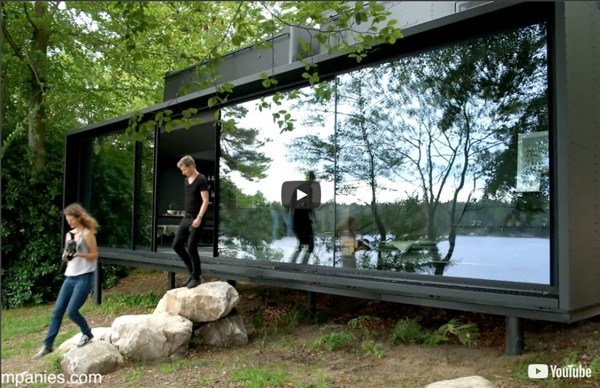
Sell Your Crap, Pay Off Your Debt, And Do What You Love! This Makes It All Possible! There’s something strange happening around the globe… but it’s awesome! Lifestyles and needs are changing, and consequently, our houses are shrinking. The tiny house movement has blown up in the past few years, shifting the traditional North American housing models towards a more practical, finance-friendly blueprint. The movement is garnering attention from people fed up with the current consumerist/utility-based lifestyle which has placed millions of people in debt. The typical American home is around 2600 square feet, while the typical small or tiny house is around 100-400 square feet. “A tiny house is any house in which all the space is being used well,” he says. This means that if two people lived in a 300 square foot pad and could call it a tiny house, then 8 people living in a 2000 square foot house could boast the same title. Let’s face it, who wants to spend the majority of their youthful years paying off such massive debt? A tiny house can cost between $15,000 and $80,000.
The US$55,000 Port-a-bach relocatable home (in a shipping container) - Image 5 of 18 December 1, 2008 The appeal of regularly relocating where we live probably comes from our nomadic origins as a species, and over the years we’ve thrilled at the possibilities of some remarkable constructs designed to enable just that: the Icosa Pod, miniHome, Free Spirit Sphere, Nackros Villa, LoftCube, Trilobis, Kitahaus, and the relocatable sphere house. New Zealand is one of those countries where its near-to-no-one geographic location has created a hotbed of innovation through necessity and the Kiwi-produced Port-a-bach is particularly inventive because it is based around a remanufactured shipping container. As such, the NZD$100,000 (US$55,000) fold-out dwelling is not just rugged due to its natural steel exoskeleton, it’s as easy to transport internationally as it is to transport locally on a standard container truck. It has low environmental impact and can connect to local utilities or be entirely power, water and sewer independent. View all Share
96 Sq. Foot Finnish Micro-Cabin Built Small To Forego Permits © Robin Falck The image of a secluded cabin in the woods recalls the simple, idealistic idyll of Henry David Thoreau's Walden, free of the impositions of society. This beautiful micro-cabin, built beside a lake in Finland, was constructed to go under the radar of Finnish building regulations, which require one to get a permit for anything that is larger than 96 to 128 square feet, depending on the district. Anticipating a one-year stint in the military, owner Robin Falck decided to design a cabin that wouldn't require getting tangled in bureaucratic red tape. On Tiny House Listings, he talks about his cabin, which he has dubbed "Nido" (or "bird's nest" in Italian): A couple years back in 2009 I got this idea of an cabin/small house that would be small enough to be built without the need of a permit. Winter of 2009/2010 I spent designing and planning the house. © Robin Falck
Shipping Container Housing Guide 20+ Tiny Homes That Make The Most Of A Little Space | Bored Panda Small and efficient homes, whether in the city, out in the country or even on the road, are becoming more and more popular. Interior design innovations are helping more and more people realize that, sometimes, less can be more! As more people move into cities (and tiny apartments), efficient interior design has been driven by necessity, but many have been applying these clever and inspiring innovations to create comfortable and tiny homes elsewhere as well. The environmentally-minded love them for their efficiency (low heating and lighting costs). The philosophical or spiritual might appreciate them for the way they encourage us to forgo all but the most necessary worldly possessions. In some cases, like with the story of Jenna and Guillaume, these tiny houses can even be pulled across the country on wheels! Show 14 more Add Image Drag Image Select File Rules: 1) no ugly watermarks 2) no borders 3) no low quality images Ooops!
Mobile Fold-Out Shipping Container Home In this case, the sum is more than the parts – and the building footprint tells only half of the story. Push a button and things begin to unfold, revealing not just a deck but a lofted sleeping area and other pop-out amenities all hiding in the shell of a conventional cargo shipping container. While it has evolved through various concepts and prototypes, the primary features of the Port-a-Bach cargo container home include “a fully enclosed exterior steel shell (when folded up), appointed with large internal storage cupboards and shelves / stainless steel kitchen and fittings / bathroom with open shower, sink, composting toilet. Fabric screen system gives the versatility of creating rooms within the large open living space: includes bunk beds, double bed room, dressing room, kitchen and bathroom.”
7 Prefab Eco-Houses You Can Order Today Ever since the early days of the 20th century, when Americans started buying kit bungalows and farmhouses from the Sears Roebuck catalog, the lure of instant housing has been huge. But in recent decades, “prefab” got a bad name, associated with shoddy construction, cookie-cutter design, and cheap, synthetic, environmentally questionable materials. Now it’s time to forget all that and say hello to the rapidly growing world of prefab and modular green homes, one where you can pick a LEED platinum or zero-energy house off a website and have it installed on your lot of choice in a matter of months. If this sounds appealing, you’re in good company. Market research firm Freedonia reports 15 percent growth in the prefab business, and Global Industry Analysts finds even greater momentum in China, Japan, Europe, and Latin America. RELATED: 3 Tiny Houses That Let You Live Green—and off the Grid (Photo: Blu Homes) 1. Watching a Blu Home being set up is quite something. (Photo: IdeaBox) 2. 3. 4. 5. 6.
Small Homes – Living Off The Grid | Small Home Oregon Back to Small Homes No more utility bills, no power outages, less contribution to global warming, clean, pure rain water and an overwhelming feeling that you are in charge and not dependent on large utilities. If you have property that is far from utilities you may have no choice but to use alternatives, you will be saving money in the long run. Read on and explore the tabs to learn more about the various technologies and their costs. Living off the grid requires upfront expense, but pays back in countless ways. Water Harvesting $1,500 to $3,000 There is nothing better than taking a shower in the soft rain water that you have captured in your system, or drinking fresh, clean water that has nothing added. Big system and PV info: www.solarhaven.orgThe prices listed are estimates (as of November 2007) and include materials only. Gray Water Disposal Gray water is waste water from sinks and bathing (showers & tubs). Ready made systems at good prices: www.thenaturalhome.com Compost Toilet System:
The Q Cabin Kit Process - The Q Cabin Kits Owning a new home can be exciting and overwhelming. Design Horizons aims to ramp up the excitement and remove the obstacles and uncertainty around new home construction. In addition to a superior architectural shell, Design Horizons provides an essential service for the success of your project: a complete set of permit documents. Documents are included with every cabin kit and are amended to reflect your individual design and site parameters. The set includes all architectural and engineering details for the construction of your customized Q Cabin Kit. We include coordination with other agencies and engineers to insure that your permit package will be complete and be successfully awarded a permit for construction. The successful steps to a new Q Cabin home construction are: Secure financing. Decide how you will finance your new home. Buy land. Find that ideal spot. Call Design Horizons. We will work with you to come up with an ideal floor plan and integrate the home into your property.
Where Can You Park A Tiny House? - MiniMotives This is probably the most common question I get, “Where can you park a tiny house?”. I have no idea why I haven’t just done a post on this, I’ve answered it individually at least 300 times… So, here is the answer: You can park it almost anywhere it will fit for at least a little while (ha! Where to live is the one major sticking point (understandably) that prevents a lot of people from choosing tiny. Legalities… So, here is how tiny houses are viewed by the legal entities: There is currently no ‘tiny house’ classification as codes/zoning see it (I would like that to change), generally they are classified as an RV or mobile home (though you can get them classified as other things depending on location. Mobile Home: If you are registered as a mobile home you can live full time in a mobile home park legally or in any zone that allows mobile homes (a lot of downtown districts surprisingly are not anti mobile home). Well, you now fall into the ‘grey area’. Like this: Like Loading...
11 Tiny House Villages Redefining Home Above: Boneyard Studios in Washington, D.C. Please share with Shareable! Click here to support our coverage of the real sharing economy. Tiny house villages are a new part of the tiny house movement, yet they hold a lot of potential to transform lives and communities. Some tiny house villages are still in the planning phase or are demonstration villages, and many are designed to house the homeless. 1. A demonstration tiny house village in the District of Columbia, Boneyard Studios has a mission to demonstrate creative urban infill, promote the benefits of tiny houses, support other tiny house builders, and model what a tiny house community could look like. 2. Community First! 3. Still in the planning stages, this tiny house village in Sonoma, California is the brainchild of Jay Shafer, founder of the Four Lights Tiny House Company. 4. 5. Touted as the first tiny house hotel, Caravan is a model of what a tiny house village could look like. 6. 7. 8. 9. 10. 11.