

How to get film-based lessons right Have you ever shown films to your class, or considered setting up a film club? Daryn Simon, Head of History at Ysgol Bryn Alyn, and Beatrix Clark of Into Film share some advice. Why show films in the classroom? Using film in the classroom is particularly effective in developing children's literacy skills. The Leeds Partnership Project, in which pupils regularly watched and made films, recorded a 96 per cent improvement in reading, compared with the previous term, and a 60 per cent improvement in writing. What do students and teachers get out of establishing a film club? I have seen pupils become far more confident in expressing opinions about films. How can teachers make sure that pupils don't 'zone out' in class when shown a film? Choose the film carefully. What's the best way to structure the lesson to keep things lively? Before the film starts, share discussion points with pupils to help them watch in an active way. In practical terms, how should teachers go about setting up a film club?
The Other Pair This ELT lesson plan is designed around a short film by Sarah Zorik titled The Other Pair and the themes of altruism and empathy. Students watch a short film, write a story, and speak about a story. I would ask all teachers who use Film English to consider buying my book Film in Action as the royalties which I receive from sales help to keep the website completely free. Language level: Pre-intermediate (A2) –Intermediate (B1) Learner type: All ages Time: 60 minutes Activity: Watching a short film, writing a story, and speaking about a story Topic: Empathy and altruism Language: Vocabulary related to shoes, narrative tenses Materials: Short film Downloadable materials: the other pair lesson instructions Support Film English Film English remains ad-free and takes many hours a month to research and write, and hundreds of dollars to sustain. Step 1 Ask your students to come up with as many different types of shoes as they can in 2 minutes. Step 2 Elicit boots, trainers, slippers, flip-flops, etc. Step 3
Dumb Ways to Die | All at C Happy New Year from allatc! In December just gone, three separate people sent this video and issued a challenge to do something with it – never something we were going to be able to resist! It’s very funny, full of wonderful vocabulary and has allowed us to make use of the fabulous eltpics website. It’s also our first blog post to use content from Australia – something long overdue. And it has a dance routine… Click here for the Teacher’s Notes. Image made using photos taken from by @sandymillin, @cerirhiannon, @fionamau, @annapires, @sandymillin, @sandymillin, @mkofab, @dfogarty, @dfogarty, @teacherphili, @sandymillin, @thornburyscott, @sandymillin, @sonrisadelcampo, @yitzha_sarwono, @sandymillin, @sandymillin, @cgoodey, @theteacherjames, @ij64 used under a CC Attribution Non-Commercial license, Like this: Like Loading...
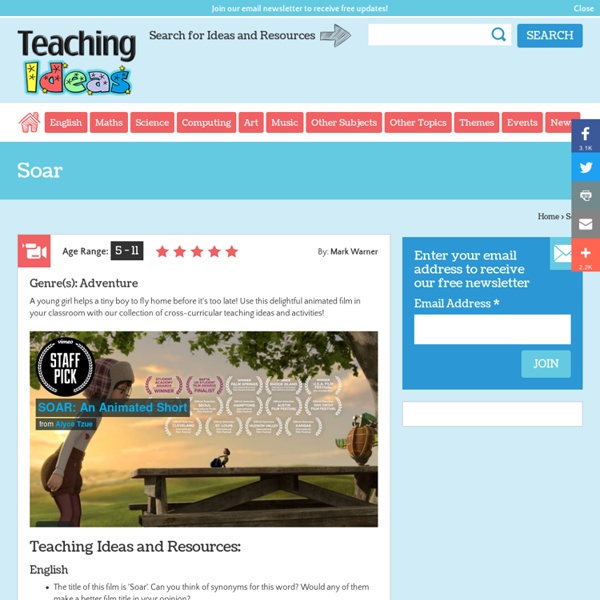
The Seven Best Short Films for ELT Students - Kieran Donaghy I’ve been writing lesson plans designed around short films for my website Film English for six years. Teachers often ask me how I find the short films I use in my lesson plans. The answer is quite simple: I’ve watched literally thousands of short films and developed an instinct for the type of engaging and simple short films which will work in the ELT classroom. The Mirror The Mirror is a short film by Ramon and Pedro which tells the story of a boy’s journey from childhood to old age. The Notebook The notebook is a moving short film by Greg Gray and is wonderful for introducing the theme of empathy. The Present The Present is a gripping short film with a wonderful twist by Jacob Frey which deals with the themes of empathy, teenagers and disability. Soar Soar is a delightful short film by Alyce Tzue which can be used to get students to predict and write a narrative. I Forgot My Phone i-Diots Fear of Flying I hope you like the short films and find the lesson plans useful.
“On The Same Page”: A Video-Based Lesson In “On The Same Page” (Alli Norman and Carla Lutz, 2015), an introverted journalist for the local news section “has nothing to write about until he is whirled away into a colourful journey with his neighbour from the comic section.” Similarly, the students in this video-based lesson are asked to become active learners and have lots to say by making predictions at various stages in the story, raising questions about what they have have just watched, or sharing their personal reactions in the hope of enhancing their critical thinking skills while practising the language. The goal here is to set up a dialogue that is student-driven and through which the students will both demonstrate comprehension and engage in meaningful conversations with the visual text. What is more, this provides a flexible framework which allows for each student to work at their own performance level. Write a question. Such an approach demands that a variety of sharing strategies be used throughout the activity. 1.
10 Creative Ways to Use Popular Movies in Fun ESL Lessons Bored of book work? Tired of teacher-talking? Want something exciting for your students? Then watch a movie! Now, I know what some of you might be thinking: Isn’t watching a movie a cop-out? It’s tempting to think that putting on a movie is simply a great excuse for the teacher to sit at the back of the room, dim the lights and fall asleep clutching the remote. Creating a lesson around a popular movie is a sure-fire way to have fun, engage your English learners and gain some much coveted popularity! How Does Watching a Movie Help ESL Students? There are countless ways in which movies can support your lesson. For example, they can be used to: Reinforce a grammar pointListen for gistPractice vocabularyDiscuss and debateRole play Movies are a brilliant way for students to hear up-to-date authentic speech and be exposed to various accents. To help your ESL students improve their English using any movie or short film, try out the following activities! 5 Great ESL Movie Comprehension Activities 1. 2.
Lingorank: English listening exercises and tests with selected talks tubequizard British Council | Episode 01 - They meet Julia: Hey! You! Watch out!Sammy: I'm sorry.Julia: This is a bike path.Sammy: I'm sorry! Julia and Sammy: Taxi! Sammy: Are you going to Tom's party? Song | All at C Take an occasionally controversial singer out of a short, self-imposed retirement, give her a Keane song to cover, add a bear, a hare and a beautifully crafted Christmas cartoon, mix with some activities focussing on listening, speaking and vocabulary development, and you have our Christmas lesson plan for this year. Click here for the Teacher’s Notes. For our second tea-themed post this month, we have another break-up, but this time all is well as there’s a cuppa at hand for the spurned lover. It’s a catchy song from a very funny ad that was filmed in just one take. Watch out for the zombie ending… Click here for the Teacher’s Notes. Our first post of the autumn term is based on an advert containing an assortment of food and cooking vocabulary, ranging from the familiar to the almost certainly unknown, unless students have spent hours in front of the TV watching Masterchef in English. Click here for the Teacher’s Notes Could this be the best marriage proposal ever? Horace by Rob Stringer