

American Presidents On Education: 20 Quotes from the White House 4Tests.com American Presidents have long been held in high regard for the influence — whether real or imagined — that they have brought to the nation throughout its 237-year history. On everything from economics to education, a President seeks to leave his mark and hopefully improve on what was there going in to the term. While they haven’t always been successful, these gentlemen — still waiting on a female for the top boss — have had some things to say about learning and education. Here are some top education quotes from American Presidents that stand out. 1. Ronald Reagan, 40th President Reagan’s words ring true today more than ever before. 2. Jimmy Carter, 39th President Nature’s ultimate gift in our opinion is the gift of thought. 3. Herbert Hoover, 31st President Hoover’s quote implies there is more to a school than a simple building, and he’s right. 4. George Washington, 1st President 5. Lyndon Johnson 36th President 6. George H. George H.W. 7. Barack Obama, 44th President 8. Franklin D. 9. 10.
Hackable High Schools COVID-19 as a catalyst for educational change Many areas of schooling in educational institutions can be and should be rethought. Roughly speaking, all education has to do with three areas of learning: what, how, and where. Learning from whom and when learning should take place are also important, but they can be discussed with the other three areas. What? The “what” of learning has always been the curriculum prescribed by government agencies or bodies of authoritative individuals. The practice of applying the same content for all students has been challenged for a long time, for two main reasons. Instead of continuing to force all students to study the same content, schools can invite their teachers to ask new questions. How? Except for the more progressive and innovative schools, the how of learning has typically been directed by the teacher. This traditional way of learning has been challenged and criticized. COVID-19 provides the right opportunity for all schools to try to change the how of learning. Where?
Quotes About Liberal Arts Education: top 34 Liberal Arts Education quotes from famous authors Enjoy reading and share 34 famous quotes about Liberal Arts Education with everyone. “This is what the real, no-shit value of your liberal arts education is supposed to be about: How to keep from going through your comfortable, prosperous, respectable adult life dead, unconscious, a slave to your head and to your natural default setting of being uniquely, completely, imperially alone, day in and day out. That may sound like hyperbole, or abstract nonsense.” — David Foster Wallace “I wasn't using college as a stepping stone to law school or some other career. — Charlie Trotter “When I finished high school, I was 16, and in Argentina you have to choose a career right after high school. — Cesar Pelli “For some students, especially in the sciences, the knowledge gained in college may be directly relevant to graduate study. — Derek Bok “The ability to recognize opportunities and move in new - and sometimes unexpected - directions will benefit you no matter your interests or aspirations.
From Andragogy to Heutagogy Author: Stewart Hase and Chris Kenyon (2001) Southern Cross University Keywords: Southern Cross University, pedagogy, andragogy, heutagogy, higher education, vocational education, self-determined learning. Article style and source: Peer Reviewed. Original ultiBASE publication. Original URL: Contents Abstract In something of a landmark for education Knowles (1970) suggested an important change in the way in which educational experiences for adults should be designed. Heutagogy Education has traditionally been seen as a pedagogic relationship between the teacher and the learner. The distinction Knowles (1970) made between how adults and children learn was an important landmark in teaching and learning practices in vocational education and training, and in higher education. This revolution recognises the changed world in which we live. Beyond pedagogy and andragogy Knowles (1970, p7) defined self-directed learning as: Conclusion References
How to Design for Learning: Four Approaches to Nonlinear Curriculum | GOA Is school designed for the way humans learn? In many ways, the traditional, time-based system of school isn’t compatible with learning, especially the linear design of what we’ve come to understand as a “course.” As Dan Cristiani of The Nueva School argues in this post, we organize academic programs into courses for practical reasons, like scheduling and grading and teacher load, yet our efforts to be efficient and organized can run counter to our missions to give every student the chance to learn deeply. Based on research in cognitive science, we know the learning process is nonlinear: different students need different amounts of time, support, and modalities in order to learn. Along the same lines, the idea that there is a “correct” sequence to curriculum is under increasing scrutiny. What does nonlinear curriculum look like? 1. 2. Questions for Teachers: How would you break down units or core concepts in your course into discrete skill trees, each with its own set of levels? 3. 4.
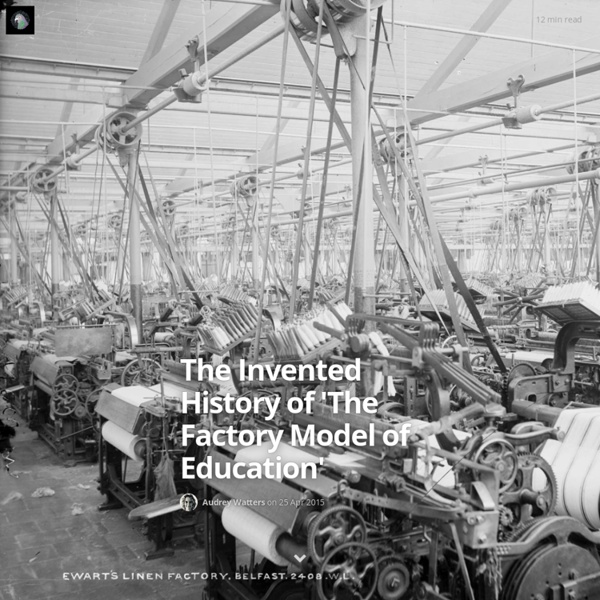
Universal education was first promoted by industrialists who wanted docile factory workers The education system as we know it is only about 200 years old. Before that, formal education was mostly reserved for the elite. But as industrialization changed the way we work, it created the need for universal schooling. Factory owners required a docile, agreeable workers who would show up on time and do what their managers told them. Sitting in a classroom all day with a teacher was good training for that. Early industrialists were instrumental, then, in creating and promoting universal education. “Factory schools,” as they are now called, originated in early 19th-century Prussia. As Northwestern University economist Joel Mokyr explains it (pdf): Much of this education, however, was not technical in nature but social and moral. The industrial revolution created jobs that had ever existed before. The transition to factory work was unpleasant, to put it mildly. In a post-industrial world, education may require an equally bold rethink.
Rethinking Thinking - Does Bloom's Taxonomy Align with Brain Science? Dr. Spencer Kagan To cite this article: Kagan, S. Rethinking Thinking – Does Bloom's Taxonomy Align with Brain Science? Thoughtful educators know that their students' success in the 21st Century depends on thinking skills. The second, related trend is the change rate. For half a century, thinking about thinking among educators has been dominated by a hierarchical model. Bloom's Taxonomy In Bloom's Taxonomy, six types of thinking are arranged from simple to complex; the taxonomy is built on the assumption that the more complex or higher-level thinking skills are built on the simpler or lower-level thinking skills. Table 1: Bloom's Taxonomy Among many educators this hierarchal notion of thinking has led to an unquestioned acceptance of the idea that there are "high" and "low" levels of thinking: Knowledge and Comprehension are presumed to be less complex cognitively than are Application, Analysis, Synthesis, and Evaluation. IQ without Recall. Evaluation without Thinking.
Moodle When groups of high schoolers arrive at Carnegie Mellon University’s Entertainment Technology Center (ETC), they’re greeted by a life-sized statue of the Incredible Hulk. These students have come to begin a semester-long project working alongside brilliant people using cutting-edge technology in an environment that’s more like a magical museum than a classroom. But any intimidation they might feel is soon washed away by a surprisingly approachable message: We don’t have all the answers. We experiment and “play test” ideas. Sometimes we fail spectacularly, and that’s a really good thing. John Balash, the department’s educational network coordinator, echoes the ETC‘s co-founder Randy Pausch, author of “The Last Lecture,” when he tells the students that “failing forward” is what real-world creating is all about. These student-guided projects at CMU are just one example of the collaboration that can happen in the Pittsburgh region through the ever-growing Remake Learning network.
Announcing 2020-21 Alternative Textbook Incentive Winners | University of Houston Libraries University of Houston Libraries, in collaboration with the UH Office of the Provost, is pleased to announce the 2020-21 recipient cohort of the UH Alternative Textbook Incentive Program (ATIP). UH instructors applied for an award ranging from $500 to $2500 that would go toward implementation of an open or alternative textbook in a summer 2020, fall 2020, or spring 2021 course. Awards were granted based on projected cost savings for students; the type of project; and feasibility of the successful implementation of the proposal. 2020 – 2021 ATIP winners are: Tres Bodet, PSYC 3341: Physiological Psychology Justin Burris, Carrie Cutler, and Shea Culpepper, ELED 4315: Mathematics in the Elementary School II Carrie Cutler, Justin Burris, and Shea Culpepper, ELED 4314: Mathematics in the Elementary School I Agnes DeFranco and Arlene Ramirez, HRMA 4343: Financial Administration for the Hospitality Industry Shelley Gonzales and Ginger Lucas, SOCW 6306: Social Work Practice Skills Rachelle A.C. Luis D.
Gagne’s Conditions of Learning Theory | International Centre for Educators' Learning Styles Robert Gagné’s seminal work is his conditions of learning theory. It includes five categories of learning outcomes and the nine events of instruction. Together, these two themes of Gagné’s learning theory provide a framework for learning conditions. Gagné’s work (1985) focuses on intentional or purposeful learning, which is the type of learning that occurs in school or specific training programs. For example, a learner who is participating in a situation where the right conditions for learning are invoked, then he or she will experience the five categories of learning outcomes that include the human capabilities of intellectual skills, verbal information, cognitive strategies, motor skills, and attitudes. Gagné also relates learning outcomes to the events of instruction. Description of Gagné’s Conditions of Learning Theory Gagné’s conditions of learning theory draws upon general concepts from various learning theories in order to define what learning is. Conditions of Learning Motor Skills
Not Taking Bad Advice: a Pedagogical Model The text for my flipped keynote at Digital Pedagogy Lab 2020. I’ve never created a model for online, digital, or hybrid pedagogies. As long as I’ve been teaching, and as long as I’ve been teaching teachers, I’ve encountered, been flummoxed by, or have cast off models. I have yet to see a single pedagogical model worth its salt. Some of the more insidious models are fashioned as needlessly complex in order to create a mystique of intellectual rigor. At the first teacher training I attended, I was introduced to Bloom’s taxonomy, which has since been burned into my brain through several dozen iterations. Dull verbs aside, my biggest issue with Bloom’s taxonomy is that it’s hierarchical. I have tracked an anti-pedagogical bent in higher education (and education more generally) since I started teaching in 1999 and teaching teachers in 2003. From the front page of the Quality Matters Web site: “With online learning, everyone has a goal.