
Lucid dream. A lucid dream is any dream in which one is aware that one is dreaming.
In relation to this phenomenon, Greek philosopher Aristotle observed: "often when one is asleep, there is something in consciousness which declares that what then presents itself is but a dream".[1] One of the earliest references to personal experiences with lucid dreaming was by Marie-Jean-Léon, Marquis d'Hervey de Saint Denys.[2] Skeptics of the phenomenon suggest that it is not a state of sleep, but of brief wakefulness.[15][16] Others point out that there is no way to prove the truth of lucid dreaming other than to ask the dreamer.[17] Lucid dreaming has been researched scientifically, with participants performing pre-determined physical responses while experiencing a lucid dream.[18][19] Scientific history[edit] Philosopher Norman Malcolm's 1959 text Dreaming[22] had argued against the possibility of checking the accuracy of dream reports.
Hearne's results were not widely distributed. Initiation[edit] REM sleep. Holonomic brain theory. The holonomic brain theory, developed by neuroscientist Karl Pribram initially in collaboration with physicist David Bohm, is a model of human cognition that describes the brain as a holographic storage network.[1][2] Pribram suggests these processes involve electric oscillations in the brain's fine-fibered dendritic webs, which are different than the more commonly known action potentials involving axons and synapses.[3][4][5] These oscillations are waves and create wave interference patterns in which memory is encoded naturally, in a way that can be described with Fourier Transformation equations.[3][4][5][6][7] Gabor, Pribram and others noted the similarities between these brain processes and the storage of information in a hologram, which also uses Fourier Transformations.[1][8] In a hologram, any part of the hologram with sufficient size contains the whole of the stored information.
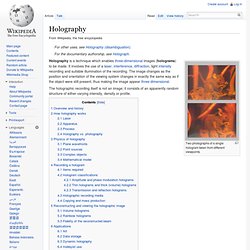
Origins and development[edit] Holography. Two photographs of a single hologram taken from different viewpoints The holographic recording itself is not an image; it consists of an apparently random structure of either varying intensity, density or profile.
Overview and history[edit] The Hungarian-British physicist Dennis Gabor (in Hungarian: Gábor Dénes),[1][2] was awarded the Nobel Prize in Physics in 1971 "for his invention and development of the holographic method".[3] His work, done in the late 1940s, built on pioneering work in the field of X-ray microscopy by other scientists including Mieczysław Wolfke in 1920 and WL Bragg in 1939.[4] The discovery was an unexpected result of research into improving electron microscopes at the British Thomson-Houston (BTH) Company in Rugby, England, and the company filed a patent in December 1947 (patent GB685286).
Several types of holograms can be made. Holograms can also be used to store, retrieve, and process information optically.[18] How holography works[edit] Recording a hologram. Karl H. Pribram. Karl H.
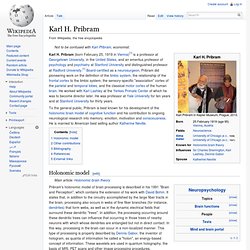
Pribram (born February 25, 1919 in Vienna)[1] is a professor at Georgetown University, in the United States, and an emeritus professor of psychology and psychiatry at Stanford University and distinguished professor at Radford University.[1] Board-certified as a neurosurgeon, Pribram did pioneering work on the definition of the limbic system, the relationship of the frontal cortex to the limbic system, the sensory-specific "association" cortex of the parietal and temporal lobes, and the classical motor cortex of the human brain. He worked with Karl Lashley at the Yerkes Primate Center of which he was to become director later. He was professor at Yale University for ten years and at Stanford University for thirty years. Holonomic model[edit] Pribram's holonomic model of brain processing is described in his 1991 "Brain and Perception", which contains the extension of his work with David Bohm.
Other contributions[edit] Comparison between Karl Pribram's "Holographic Brain Theory" and ore conventional models of neuronal computation. One of the problems facing neural science is how to explain evidence that local lesions in the brain do not selectively impair one or another memory trace.
Note that in a hologram, restrictive damage does not disrupt the stored information because it has become distributed. The information has become blurred over the entire extent of the holographic film, but in a precise fashion that it can be deblurred by performing the inverse procedure. This paper will discuss in detail the concept of a holograph and the evidence Karl Pribram uses to support the idea that the brain implements holonomic transformations that distribute episodic information over regions of the brain (and later "refocuses" them into a form in which we re-member). Particular emphasis will be placed on the visual system since its the best characterized in the neurosciences. 1. 2.
Chapter 2 will outline the basic concept of a hologram and start to introduce Pribram's holonomic brain theory. What is holography?