
Huge MIT Study of ‘Fake News’: Falsehoods Win on Twitter. Ultimately, they found about 126,000 tweets, which, together, had been retweeted more than 4.5 million times.
Some linked to “fake” stories hosted on other websites. Some started rumors themselves, either in the text of a tweet or in an attached image. (The team used a special program that could search for words contained within static tweet images.) And some contained true information or linked to it elsewhere. How journalists could be more constructive – and boost audiences. Rob Wijnberg, founder of De Correspondent, recently asked me to imagine my marriage was like the relationship between a news anchor and one of their viewers.
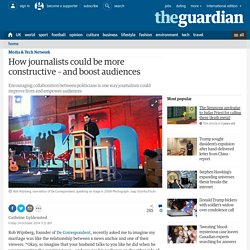
“Okay, so imagine that your husband talks to you like he did when he was presenting the evening news – and you are his audience on the other side of the screen.” They can write to him, post on his Facebook page, tweet him, Instagram him – but even that would not guarantee that he’s read what they have to say. If they are lucky someone else will spot their message and tape it to the front of his screen.
Counterarguments Are Critical to Debunking Misinformation – Association for Psychological Science. It’s no use simply telling people they have their facts wrong.
To be more effective at correcting misinformation in news accounts and intentionally misleading “fake news,” you need to provide a detailed counter-message with new information – and get your audience to help develop a new narrative. Those are some takeaways from an extensive new meta-analysis of debunking studies published in the journal Psychological Science, a journal of the Association for Psychological Science. Media bias is real, finds UCLA political scientist. While the editorial page of The Wall Street Journal is conservative, the newspaper's news pages are liberal, even more liberal than the New York Times.
The Drudge Report may have a right-wing reputation, but it leans left. Coverage by public television and radio is conservative compared to the rest of the mainstream media. Meanwhile, almost all major media outlets tilt to the left. These are just a few of the surprising findings from a UCLA-led study, which is believed to be the first successful attempt at objectively quantifying bias in a range of media outlets and ranking them accordingly. "I suspected that many media outlets would tilt to the left because surveys have shown that reporters tend to vote more Democrat than Republican," said Tim Groseclose, a UCLA political scientist and the study's lead author.
Skeptical Questions Everyone Should Ask. Because I am an activist skeptic I am often asked specific questions about how to be a better skeptic.
This is obviously a complex question, and I view skepticism (like all knowledge) as a journey not a destination. I am still trying to work out how to be a better skeptic. One recent question, however, took a great approach to the issue of practical skepticism – what questions should a skeptic ask themselves when confronted with a news item? The Conspiracy Theory Detector. This past September 23 a Canadian 9/11 "truther" confronted me after a talk I gave at the University of Lethbridge.
He turned out to be a professor there who had one of his students filming the “confrontation.” By early the next morning the video was online, complete with music, graphics, cutaways and edits apparently intended to make me appear deceptive (search YouTube for “Michael Shermer, Anthony J. Hall”). “You, sir, are not skeptical on that subject—you are gullible,” Hall raged. "We can see that the official conspiracy theory is discredited....It is very clear that the official story is a disgrace, and people who go along with it like you and who mix it in with this whole Martian/alien thing is discrediting and a shame and a disgrace to the economy and to the university. " 'Blacklisting' of Right-Wing Stories More Proof that Facebook 'Rules the News'
Revelations that Facebook may have regularly "blacklisted" conservative stories from the platform's "trending" news section was met with outrage on Monday from journalists across the political spectrum who found the company's alleged abuse of power "disturbing" and potentially dangerous.
After speaking with several former "news curators," Gizmodo technology editor Michael Nunez reported Monday that the social media platform routinely censored stories "about the right-wing CPAC gathering, Mitt Romney, Rand Paul, and other conservative topics from appearing in the highly-influential section, even though they were organically trending among the site’s users. " The contracted employees also said they were "instructed to artificially 'inject' selected stories into the trending news module, even if they weren’t popular enough to warrant inclusion—or in some cases weren’t trending at all," and were specifically asked to exclude "news about Facebook itself in the trending module. " He continued: Most of the information we spread online is quantifiably “bullshit”
In his well-known essay On Bullshit, Harry Frankfurt defines bullshit as speech that is designed to impress but lacks a direct concern for the truth.
Under such a definition, a large portion of what we read online today is likely to be bullshit. Some types of bullshit are political in nature, such as the misleading claim that only 16 mass shootings took place under President Bush’s tenure, compared to a whopping 162 under President Obama. Such claims are valued for their persuasiveness in making a point, rather than for their connection to reality. Other bullshit, such as clickbait, is motivated by the commercial mandates of the digital age, in which companies endlessly chase more page views, likes, followers, subscribers and customers.
The_world_is_not_falling_apart_the_trend_lines_reveal_an_increasingly_peaceful. Photo by Gokhan Sahin/Getty Images It’s a good time to be a pessimist.
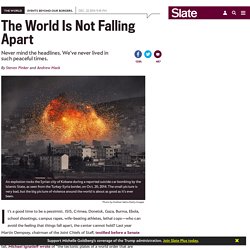
ISIS, Crimea, Donetsk, Gaza, Burma, Ebola, school shootings, campus rapes, wife-beating athletes, lethal cops—who can avoid the feeling that things fall apart, the center cannot hold? Last year Martin Dempsey, chairman of the Joint Chiefs of Staff, testified before a Senate committee that the world is “more dangerous than it has ever been.” This past fall, Michael Ignatieff wrote of “the tectonic plates of a world order that are being pushed apart by the volcanic upward pressure of violence and hatred.” Two months ago, the New York Times columnist Roger Cohen lamented, “Many people I talk to, and not only over dinner, have never previously felt so uneasy about the state of the world. … The search is on for someone to dispel foreboding and embody, again, the hope of the world.”
Top Think Tanks Cited by the U.S. Media Changes: A Shifting Bias? According to the progressive media watchdog, Fairness and Accuracy in Reporting (FAIR), there is a distinct bias in the U.S. media.
More right-wing think tanks are cited than left-wing think tanks. More recently however, centrist organizations with little or no political bias have been referenced more than either the right or the left. What factors contribute to this trend and what does it say about American media and society? Liberal or Conservative Bias? The Swarm Of The Right: Myth Of The Liberal Media. Echoing a common conservative claim, CBS correspondent Bernard Goldberg wrote a 1996 Wall Street Journal column arguing that mainstream news media are biased against right-wing sources.
His evidence of a liberal bias: Network colleague Eric Engberg once labeled the Heritage Foundation as "conservative" but failed to identify another Washington-based think tank, the Brookings Institution, as "liberal. " Goldberg's allegation inspired a series of studies about how the media use think tanks. Pew Finds Extreme Conservative Bias In Media. A study by the Pew Research Center’s Project for Excellence in Journalism finds that, in the past five months, the American main stream media has given Pres. Obama the most unremittingly negative press of any of the presidential candidates by a wide margin, while giving Republican candidates extremely positive press coverage. Liberal Media Bias -- You’ve probably heard it used to describe the American main stream media hundreds, if not thousands of times. Former fellows at conservative think tanks issued flawed UCLA-led study on media's "liberal bias. News outlets including CNN cited a study of several major media outlets by a UCLA political scientist and a University of Missouri-Columbia economist purporting to "show a strong liberal bias.
" But the study employed a measure of "bias" so problematic that its findings are next to useless, and the authors -- both former fellows at conservative think tanks cited in the study to illustrate liberal bias -- seem unaware of the substantial scholarly work that exists on the topic. In recent days, news outlets including CNN cited a study of several major media outlets, "A Measure of Media Bias" (pdf) by political scientist Timothy J. A Measure of Media Bias. How to Detect Bias in the News. 5 Ways to Spot a B.S. Political Story in Under 10 Seconds.
An election year is a shit blizzard. Every place you go for news online -- whether it's portal sites like Reddit, or aggregators like Google News or Yahoo! News or RealClearPolitics, or goddamned clips from late night talk shows -- they're all about to get buried under a brown storm of bullshit inflammatory headlines desperate for your click. Taking conspiracy theories seriously. Study: Belief in Free-Market Economics Linked to Distrust of Science. April 22, 2013 | Like this article? Data Mining Reveals How Conspiracy Theories Emerge on Facebook. How People Consume Conspiracy Theories on Facebook. 10 Search Engines to Explore the Invisible Web. Not everything on the web will show up in a list of search results on Google or Bing; there are lots of places that their web crawlers cannot access.
To explore the invisible web, you need to use specialist search engines. Find In-Depth Articles on Google with a URL Trick. B.S. Detection for Digital Content. How to Conduct Scientific Research On the Internet (Without Getting Duped) For scientific information. Chomsky warns of media distortion. Trust Me, I'm Lying: Confessions of a Media Manipulator. Nick Davies: Our media have become mass producers of distortion. Gingrich and Santorum: The Boys Who Cried Fox. Just last week, Newt Gingrich delighted observers on both the right and the left when he slammed Fox News for “bias” and “distortion.”
Gingrich claimed that the conservative news channel slanted its coverage to favor the less conservative establishment candidate, Mitt Romney. Seymour Hersh on Obama, NSA and the 'pathetic' American media. Glenn Greenwald and NY Times' Bill Keller Do Battle Over the Hidden Bias in Corporate News. Editor's Note: Former New York Times reporter David Cay Johnston interviewed Greenwald for Newsweek in an interview filled with powerful quotes and insights about the future of media in a digital era.
"Glenn Greenwald, the lawyer-turned-journalist-turned-global headline for his reporting on leaked NSA documents, says there is about to be a revolution that will radically change how news organizations cover governments and other big institutions. " Six Corporations That Control Almost Everything We Watch, Hear And Read. These 6 Corporations Control 90% Of The Media In America. Facts On Media In America: Did You Know? Congress Can No Longer Ignore Corporate Control of the Media.
Occupy Movement Media Success: Staying on Frame. Media Get Bored With Occupy—and Inequality. The Corporate Media's Attempt to Kill the Occupy Movement. Rebecca Solnit, Why the Media Loves the Violence of Protesters and Not of Banks. Center for Media and Democracy. Poll Finds Fox News Is Worse Than No News at All - News. Fox Shut Out of Canada Because of a Law Against Lying During Newscasts « Say It Ain't So Already. What are newspapers for? - The Plum Line. Glenn Beck Tries To Vilify Wall Street Protests, Fails To Disclose His Coordination With Bank Lobbyists And Oil Barons.