
Physics and Astronomy Links - PhysLink.com. WMAP Big Bang Theory. The Big Bang Model is a broadly accepted theory for the origin and evolution of our universe.

It postulates that 12 to 14 billion years ago, the portion of the universe we can see today was only a few millimeters across. It has since expanded from this hot dense state into the vast and much cooler cosmos we currently inhabit. We can see remnants of this hot dense matter as the now very cold cosmic microwave background radiation which still pervades the universe and is visible to microwave detectors as a uniform glow across the entire sky. Foundations of the Big Bang Model The Big Bang Model rests on two theoretical pillars: General Relativity Albert Einstein at the Chalkboard- source unknown The first key idea dates to 1916 when Einstein developed his General Theory of Relativity which he proposed as a new theory of gravity. The Cosmological Principle APM Galaxy Survey Further Reading Peebles, P.J.E., Schramm, D.N., Turner, E.L.
& R.G. Science news and science jobs from New Scientist. A Handpicked Collection of the Ultimate Space Pictures. Saturn’s Rings from the Other Side Credit: Cassini Imaging Team, SSI, JPL, ESA, NASA We normally see Saturn’s rings the side from which the sun shines on them. This picture was taken from the other side by the robot Cassini spacecraft. I think it’s still spectacular. An Antarctic Total Solar Eclipse Credit and Copyright:Fred Bruenjes (moonglow.net) From the location of Antarctica, this mind boggling picture was taken of the Sun’s total eclipse behind the Moon.
The Fox Fur Nebula Credit & Copyright: Jean-Charles Cuillandre (CFHT) & Giovanni Anselmi (Coelum Astronomia), Hawaiian Starlight Simply put, this is a load of dust and gas. If you lean your head towards the right, the left of this picture looks like the head and neck of a grizzly bear and not a fox (from my interpretation anyway). Phobos: Doomed Moon of Mars Credit: HiRISE, MRO, LPL (U. Mars, the red planet in our magnificent solar system, has two moons – Phobos and Deimos. Cat’s Eye Hubble Remix Hole in the Sun Lunation. Large Hadron Collider. The Large Hadron Collider (LHC) is the world's largest and most powerful particle collider, most complex experimental facility ever built, and the largest single machine in the world.[1] It was built by the European Organization for Nuclear Research (CERN) between 1998 and 2008 in collaboration with over 10,000 scientists and engineers from over 100 countries, as well as hundreds of universities and laboratories.[2] It lies in a tunnel 27 kilometres (17 mi) in circumference, as deep as 175 metres (574 ft) beneath the France–Switzerland border near Geneva, Switzerland.
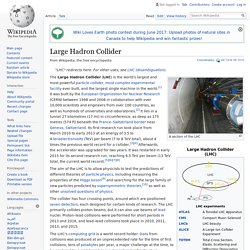
Its first research run took place from March 2010 to early 2013 at an energy of 3.5 to 4 teraelectronvolts (TeV) per beam (7 to 8 TeV total), about 4 times the previous world record for a collider,[3][4] Afterwards, the accelerator was upgraded for two years. It was restarted in early 2015 for its second research run, reaching 6.5 TeV per beam (13 TeV total, the current world record).[5][6][7][8] Background[edit] Cost[edit] WIKISKY.ORG.