
BTGuard - Anonymous BitTorrent Services. HowTo: IRC anonymously with TOR. Microsoft and Skype set to allow backdoor eavesdropping. Skype and Microsoft have managed to leapfrog common sense and build a backdoor into your favourite VOIP application.

It is called Lawful Interception and is part of a new patent which Microsoft filed back in 2009, but is now preparing to unleash itself into our world due to its recent approval. Lawful Interception means that government agencies can, without your permission, begin tracking your Skype conversations. CSO Online - Security and Risk. CSO's Ultimate Guide to Social Engineering. Social engineering attacks security at its weakest link: People.
Preying on employees' best intentions, social engineers gain unauthorized access to systems and information. So how do you secure people against these tactics? Storytelling, education, processes, and other methods all come into play. CSO's Ultimate Guide to Social Engineering, gathered from CSO's popular interviews with social engineering experts, provides a complete look at common techniques in both attack and defense. Hushmail – Free Email with Privacy. US shuts down Canadian gambling site with Verisign's help. High performance access to file storage The Department of Homeland Security has seized a domain name registered outside of the US, by individuals who are not American citizens, and who registered with a Canadian registrar.

What is unique about this case is that the American authorities did not get the domain's registrar - a Canadian company - to pull the domain. Instead they went to Verisign, which operates the entirety of .com, and had them pull the glue records, the warrant states. Anonymous Cowards, Deanonymized. Six Tips to Protect Your Search Privacy. By Peter Eckersley, Seth Schoen, Kevin Bankston, and Derek Slater.
Google, MSN Search, Yahoo! , AOL, and most other search engines collect and store records of your search queries. If these records are revealed to others, they can be embarrassing or even cause great harm. Would you want strangers to see searches that reference your online reading habits, medical history, finances, sexual orientation, or political affiliation?
Recent events highlight the danger that search logs pose. 5 free Android security apps: Keep your smartphone safe. Review By Eric Geier February 21, 2012 06:00 AM ET Computerworld - There's been much controversy over mobile OS security, especially where Android is concerned.
With 47% of the smartphone market in Q4 of 2011, according to ABI Research, it's no wonder that Android is getting attention. Its openness fuels adoption by smartphone manufacturers and wireless carriers, aids in mobile innovation, and helps bring more free apps. Android malware growth. Security Tool HijackThis Goes Open Source. Secret GPS tracker terrifies Ontario man - Canada.
An Ontario man says he's angry and frightened after discovering someone hid a GPS tracking device under his vehicle, apparently to secretly monitor his movements.
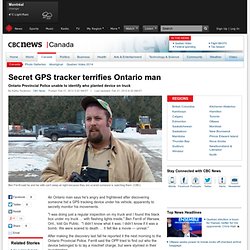
"I was doing just a regular inspection on my truck and I found this black box under my truck … with flashing lights inside," Ben Ferrill of Warsaw, Ont., told Go Public. "I didn’t know what it was. I didn’t know if it was a bomb. We were scared to death … It felt like a movie — unreal. " After making the discovery last fall he reported it the next morning to the Ontario Provincial Police. Why Deep Packet Inspection Is(n’t) Being Talked About.
Stuxnet: Anatomy of a Computer Virus. Is the Government Scaring Web Businesses Out of the US? UK Student Jailed For Facebook Hack Despite 'Ethical Hacking' Defense. FOIA Request Shows Which Printer Companies Cooperated With US Government. Unauthorized iOS Apps Leak Private Data Less Than Approved Ones. Magid: Latest iPhone and Android app privacy violations deeply troubling. By Larry Magid for the Mercury News Posted: 02/19/2012 02:41:00 PM PST0 Comments|Updated: 2 years ago The recent revelations that some iPhone and Android apps are uploading and storing users' phone address books without permission is very troubling.
It not only violates the privacy of the person using the phone but, potentially, everyone in that person's address book. What bothers me is that we need to worry not only about big companies like Apple (AAPL) being careful with our data but also about the app developers on its platforms. When you add them up, there are already probably more than a million iOS, Android and Facebook apps from a countless number of developers that could access personal information, so there is plenty of reason to worry about both deliberate misuse of our data as well as accidental disclosure. Tor Operations Security. 13 December 2011 Tor Operations Security Date: Tue, 13 Dec 2011 18:39:22 -0500 From: wakeupneo555[at]Safe-mail.net To: tor-talk[at]lists.torproject.org Subject: [tor-talk] Tor OPSEC - Operational Security - Great Resource of Information!

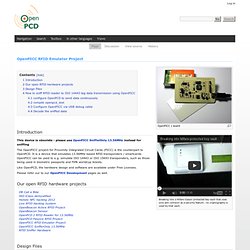
What began as a simple reply to a Tor user on the subject of downloading PDF files through Tor, turned into a wealth of information on Tor OPSEC. I am adding this post to the list because others might find it as useful as I have. Cheers. OpenPICC RFID Emulator and Sniffer Project - OpenPCD. From OpenPCD OpenPICC 1 board Breaking into a Mifare Classic protected key vault that uses only anti collision as a security feature - no cryptography is used by that vault.
Introduction This device is obsolete - please use OpenPICC SnifferOnly 13.56MHz instead for sniffing The OpenPICC project for Proximity Integrated Circuit Cards (PICC) is the counterpart to OpenPCD. Like OpenPCD, the hardware design and software are available under Free Licenses. Make a Faraday Cage Wallet. HTTPS Everywhere. Online viewer for PDF, PostScript and Word.