
List of concept- and mind-mapping software. Concept-mapping and mind-mapping software are used to create diagrams of relationships between concepts, ideas or other pieces of information.
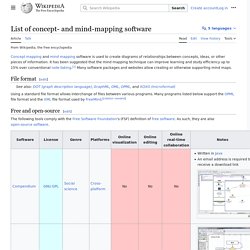
It has been suggested that the mind mapping technique can improve learning/study efficiency up to 15% over conventional note taking.[1] There are a number of software packages and websites that allow the creation of, or otherwise support mind maps. File format[edit] Using a standard file format allows interchange of files between various programs. Many of the programs listed below support the mm format used by FreeMind. The mm format is an XML text format consisting of tagged objects. Free Software[edit] The following tools are free as defined by the Free Software Foundation.
Freeware[edit] The following is a list of notable concept mapping and mind mapping applications which are freeware (they are available at no cost). Paid software[edit] The table below lists pieces of paid commercial software that allow the creation of mind maps and concept maps. Twitter integration comes to the world of mind mapping software via MindTweet. Twitter intergration has finally come to the world of mind mapping software, thanks to CS Odessa’s new MindTweet plug-in for ConceptDraw MINDMAP 7.

This new tool enables you to brainstorm, organize and send Twitter messages from within the program. MindTweet is available from the ConceptDraw Solution Park; it’s a free download. The app installs a new Twitter icon in the program’s main toolbar. Before you can use MindTweet, you must login to your Twitter account and authorize the app to communicate with it.
Once that’s done, all you have to do is select a topic in your mind map, click on the Twitter icon and a dialog box pops up, containing the text of your tweet. This app is the ultimate in simplicity. If your job involves managing social media for your organization, it’s a godsend. I’ve been using Twitter for several years now. A few shortcomings There are three main features that I wish MindTweet offered, but I have to remember that this is a version 1.0 product: DropMind makes impressive debut on the iPad. Seavus, the developers of DropMind mind mapping software and a corresponding web application, recently expanded its family of mind mapping applications with the launch of a DropMind app for the Apple iPad.
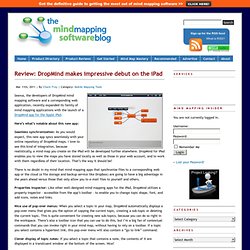
Here’s what’s notable about this new app: Seamless synchronization: As you would expect, this new app syncs seamlessly with your online repository of DropMind maps. I love to see this kind of integration, because realistically, a mind map you create on the iPad will be developed further elsewhere. DropMind for iPad enables you to view the maps you have stored locally as well as those in your web account, and to work with them regardless of their location. That’s the way it should be! There is no doubt in my mind that mind mapping apps that synchronize files to a corresponding web app or the cloud (a file storage and backup service like Dropbox) are going to have a big advantage in the years ahead versus those that only allow you to e-mail files to yourself and others.
Conclusion. Internet Mind Maps on Biggerplate.