
Computer Networks and ISDN Systems - The anatomy of a large-scale hypertextual Web search engine. Volume 30, Issues 1–7, April 1998, Pages 107–117 Proceedings of the Seventh International World Wide Web Conference Abstract In this paper, we present Google, a prototype of a large-scale search engine which makes heavy use of the structure present in hypertext.

Google is designed to crawl and index the Web efficiently and produce much more satisfying search results than existing systems. The prototype with a full text and hyperlink database of at least 24 million pages is available at To engineer a search engine is a challenging task. Apart from the problems of scaling traditional search techniques to data of this magnitude, there are new technical challenges involved with using the additional information present in hypertext to produce better search results. Keywords. Norvig Web Data Science Award. Open data. An introductory overview of Linked Open Data in the context of cultural institutions.
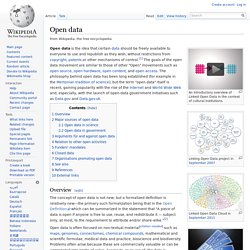
Clear labeling of the licensing terms is a key component of Open data, and icons like the one pictured here are being used for that purpose. Overview[edit] The concept of open data is not new; but a formalized definition is relatively new—the primary such formalization being that in the Open Definition which can be summarized in the statement that "A piece of data is open if anyone is free to use, reuse, and redistribute it — subject only, at most, to the requirement to attribute and/or share-alike.
Metacrap. 0.1.
Version History Version 1.3, August 26 2001. Fixed typos. First published version. Version 1.2, May 23 2001. HTML Microdata. Abstract This specification defines the HTML microdata mechanism.
This mechanism allows machine-readable data to be embedded in HTML documents in an easy-to-write manner, with an unambiguous parsing model. It is compatible with numerous other data formats including RDF and JSON. Schema Creator. HairSalon. RDFa Lite 1.1. Status of This Document This section describes the status of this document at the time of its publication.
Other documents may supersede this document. A list of current W3C publications and the latest revision of this technical report can be found in the W3C technical reports index at This is an Editorial Revision of the Recommendation published on the 7th of June, 2012. See the separate section for the changes.
W3C is expected to address errata in a future Edited Recommendation of RDFa 1.1 Lite. This document is the culmination of a series of discussions between the World Wide Web Consortium, including the RDFa Working Group, the Vocabularies Community Group, the HTML Working Group, and the sponsors of the schema.org initiative, including Google, Yahoo! This document was published by the RDFa Working Group as a Recommendation. Please see the Working Group's implementation report.
This document was produced by a group operating under the 5 February 2004 W3C Patent Policy. About Microformats. Designed for humans first and machines second, microformats are a set of simple, open data formats built upon existing and widely adopted standards.

Instead of throwing away what works today, microformats intend to solve simpler problems first by adapting to current behaviors and usage patterns (e.g. XHTML, blogging). Microformats are: A way of thinking about dataDesign principles for formatsAdapted to current behaviors and usage patterns (“Pave the cow paths.”)Highly correlated with semantic XHTML, AKA the real world semantics, AKA lowercase semantic web, AKA lossless XHTMLA set of simple open data format standards that many are actively developing and implementing for more/better structured blogging and web microcontent publishing in general. “An evolutionary revolution”All the above. Microformats are not: The microformats principles See the wiki for more detail. Rich snippets (microdata, microformats, RDFa en Gegevens markeren) - Webmasterhulpprogramma's Help. Rich snippets (microdata, microformats, RDFa en Data Highlighter) Rich snippets (de paar regels tekst die worden weergegeven onder elk zoekresultaat) zijn bedoeld om gebruikers een idee te geven van wat er op de pagina staat en waarom de pagina relevant is voor hun zoekopdracht.

Als Google de inhoud op uw pagina's begrijpt, kunnen we rich snippets maken. Dit zijn fragmenten met gedetailleerde informatie die zijn bedoeld om gebruikers met specifieke zoekopdrachten te helpen. Mythical Differences: RDFa Lite vs. Microdata. What’s Best: Microformats, RDFa, or Micro Data? In a recent post by Mike Blumenthal about Google’s announcement of supporting Microformats for local search, Andy Kuiper asked in the comments whether it would be best to go with Microdata versus RDFa or Microformat for marking up local business information.
As the number of flavors of semantic markup have grown, I think Andy’s not the only one to wonder which markup protocol might be ideal. Here’s my opinion. When you’re asking “which is better?” , it’s important to know what we’re speaking-of, since there are a number of different goals that people could be pursuing. For some, this is a question of which is better from an elegance-of-coding perspective (if you’re interested in this, you might read Evan Prodromou’s great article, RDFa vs microformats). It’s this last orientation of the question that I’m focusing upon — which semantic protocol is going to work best for Search Engine Optimization (“SEO”)? The Open Graph protocol.