
Timeline of ancient Greece. Athena. In Greek religion and mythology, Athena or Athene (/əˈθiːnə/ or /əˈθiːniː/; Attic: Ἀθηνᾶ, Athēnā or Ἀθηναία, Athēnaia; Epic: Ἀθηναίη, Athēnaiē; Ionic: Ἀθήνη, Athēnē; Doric: Ἀθάνα, Athānā), also referred to as Pallas Athena/Athene (/ˈpæləs/; Παλλὰς Ἀθηνᾶ; Παλλὰς Ἀθήνη), is the goddess of wisdom, courage, inspiration, civilization, law and justice, just warfare, mathematics, strength, strategy, the arts, crafts, and skill.
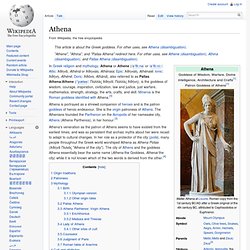
Minerva is the Roman goddess identified with Athena.[3] Athena is portrayed as a shrewd companion of heroes and is the patron goddess of heroic endeavour. She is the virgin patroness of Athens. The Athenians founded the Parthenon on the Acropolis of her namesake city, Athens (Athena Parthenos), in her honour.[3] Ares. Ares (Ancient Greek: Ἄρης [árɛːs], Modern Greek: Άρης [ˈaris]) is the Greek god of war.
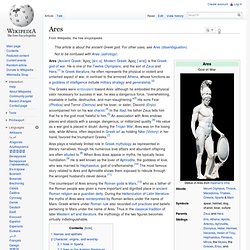
He is one of the Twelve Olympians, and the son of Zeus and Hera.[1] In Greek literature, he often represents the physical or violent and untamed aspect of war, in contrast to the armored Athena, whose functions as a goddess of intelligence include military strategy and generalship.[2] Ares plays a relatively limited role in Greek mythology as represented in literary narratives, though his numerous love affairs and abundant offspring are often alluded to.[8] When Ares does appear in myths, he typically faces humiliation.[9] He is well known as the lover of Aphrodite, the goddess of love, who was married to Hephaestus, god of craftsmanship.[10] The most famous story related to Ares and Aphrodite shows them exposed to ridicule through the wronged husband's clever device.[11] Names and epithets[edit]