
12 Ways to Use Social Media for Education. Social Media in Higher Education: 8 Essential Tips. Social media in higher education has become an essential chapter in almost every institution’s playbook.

According to our research, 98% of schools use social media across campus. Why? There’s a lot of value for schools to unlock on social media. Social media in adult learning: benefits and uses. EPALE Thematic Coordinator Andrew McCoshan surveys the social media landscape to see what it can offer adult learning.

Four reasons for using social media Social media are rapidly becoming part of everyday life. Usage varies from country to country, but the spread of smart phones seems set to make them ubiquitous. So what are the advantages of using them in adult learning? 1. Social media platforms are open 24/7. 2. Social media platforms are built for interaction so it is no surprise that they can be ideal for collaboration in learning. 3. TechIntegration2. Seven Elements of Digital Literacy for Adult Learners - EdTech Center @ World Education. By Jamie Harris, Adult Education Program Specialist at the Maryland Department of Labor There are terms we often hear, buzzwords, that are used everywhere, and we know those words are of importance.
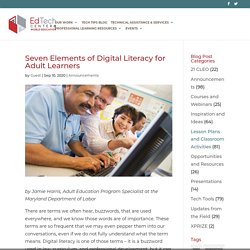
These terms are so frequent that we may even pepper them into our conversations, even if we do not fully understand what the term means. Digital literacy is one of those terms – it is a buzzword used in law, curriculum, and professional development, but it can be evasive in meaning. Does it only mean one’s ability to work with all things digital at a basic level? Does it only mean focusing on a user’s proficiency in using digital applications such as word processors and spreadsheets? Digital literacy is defined by the International Museum and Library Services Act of 2010 as, “the ability to use information and communication technologies to find, evaluate, create, and communicate information, requiring both cognitive and technical skills” [1]. Technical Civic Communicative Collaborative. Harnessing the Power of Social Media for Adult Education. Connecting a Classroom: Reflections on Using Social Media With My Students.
—Image via Brianna Crowley By Brianna Crowley Last fall, I took a leap by connecting my classroom. Through Twitter, Instagram, Skype, Flickr, and blogging, my students published their projects and writing to an audience beyond their peers and me. Along the way, we reflected on what social media added to our classroom as well as what it required of us. I want to share some reflections as I enter a second year facilitating a connected high school classroom. Why Connect? Connected classrooms can reach beyond physical barriers to create conversations with people from other classrooms, cultures, and communities.
When I asked my students mid-year what they thought social media added to our classroom, they offered the following responses: “Social media can expand our thoughts and ideas and connect us to what is going on in the rest of the world. Overwhelmingly, students agreed they liked expanding learning through social media platforms. What is your purpose for connecting your classroom? Web Only. The Role of Social Media in Education. Social media has gained credibility over the years as a trusted source of information and platform where organisations can interact with audiences.

We are seeing education institutions adapting these developments into their systems and relying on group resources and mechanisms to improve the student life. The use of social media in education provides students with the ability to get more useful information, to connect with learning groups and other educational systems that make education convenient. Social network tools afford students and institutions with multiple opportunities to improve learning methods. Through these networks, you can incorporate social media plugins that enable sharing and interaction. Students can benefit from online tutorials and resources that are shared through social networks and LMS’s. There is valuable knowledge to be gained through social media such as analytics and insights on various topics or issues for study purposes.
It helps in Research process. Using social media to boost student employability. Universities have a responsibility to equip students to navigate around these channels which are used by employers in the recruitment process.
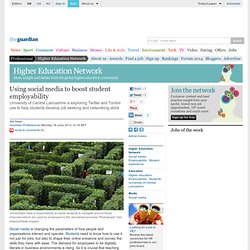
Photograph: Dan Kitwood/Getty Images Social media is changing the parameters of how people and organisations interact and operate. Students need to know how to use it not just for jobs, but also to shape their online presence and convey the skills they have with ease. The demand for employees to be digitally literate in business environments is rising. Using Social Media to Teach Adult Learners. The use of media: newspapers, computers, the Internet, television, movies, music, and magazine articles, can be a powerful way to enhance learning.

It can help build vocabulary, increase reading speed and fluency, and develop conversational skills. Using media also is a great way to tie-in real-world events and news into the classroom. This helps make learning a second language relevant to the learners’ lives. Social media and the Internet are excellent tools to help adult learners stay connected in this fast-paced, ever-changing world. Sites such as Facebook, Pinterest, Twitter, and others are wonderful platforms to help build visual literacy skills! When should you introduce media? Credit; Google images Carleton College has this to say: Before learning the concept. These tips are couldn’t have been written any better. Facebook isn’t just for kids anymore!