
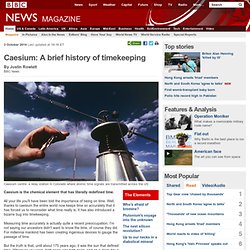
Caesium: A brief history of timekeeping. 3 October 2014Last updated at 19:16 ET By Justin Rowlatt BBC News Caesium centre: a relay station in Colorado where atomic time signals are transmitted across the US Caesium is the chemical element that has literally redefined time.
All your life you'll have been told the importance of being on time. Well, thanks to caesium the entire world now keeps time so accurately that it has forced us to reconsider what time really is. It has also introduced a bizarre bug into timekeeping. Measuring time accurately is actually quite a recent preoccupation. But the truth is that, until about 175 years ago, it was the sun that defined time. That all began to change with the world's first railways, here in the UK. Then the fact that midday in London was 10 minutes before midday in Bristol - because that was how long it took the sun to figuratively sail west across the sky - became an issue, and a very serious one.
It wasn't just that passengers would miss their trains. Horology - The Index. Timeanddate.com. Atomic Clocks. Launches a New U.S. Time Standard: NIST-F2 Atomic Clock. NIST-F2 Atomic Clock News Briefing: See backgrounder on clock operation and accompanying animation of NIST-F2.
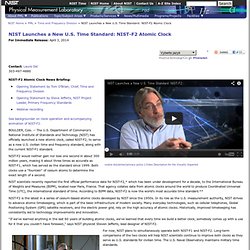
BOULDER, Colo. -- The U.S. Department of Commerce's National Institute of Standards and Technology (NIST) has officially launched a new atomic clock, called NIST-F2, to serve as a new U.S. civilian time and frequency standard, along with the current NIST-F1 standard. NIST-F2 would neither gain nor lose one second in about 300 million years, making it about three times as accurate as NIST-F1, which has served as the standard since 1999.
Both clocks use a "fountain" of cesium atoms to determine the exact length of a second. NIST scientists recently reported the first official performance data for NIST-F2,* which has been under development for a decade, to the International Bureau of Weights and Measures (BIPM), located near Paris, France. Atomic Clock Ensemble in Space (ACES) / Human Spaceflight Research / Human Spaceflight. Atomic Clock Ensemble in Space (ACES) Atomic Clock Ensemble in Space (ACES) is a fascinating new ESA mission developed in cooperation with the French Space Agency (CNES) that will expand the range of research on the International Space Station (ISS).
The ACES clocks will be installed on the external payload facility of the Columbus module. The frequency reference generated on-board the ISS will be used by a worldwide network of ground terminals to perform comparisons with the best available atomic clocks on the ground. PHARAO atomic clock agreement signed by ESA and CNES / Technology. PHARAO atomic clock agreement signed by ESA and CNES 15 December 2009.
Images of Pharao. PHARAO. Frequency combs, optical ruler, mode-locked laser, metrology, self-referencing, f-2f, noise, Hall, Hänsch, Nobel Prize. Ask RP Photonics for advice on various aspects of frequency combs, e.g. their generation, their use in frequency metrology, measurement or simulations of their noise properties, comparison of different frequency comb sources, etc.
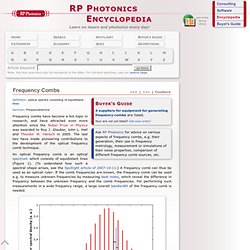
Definition: optical spectra consisting of equidistant lines German: Frequenzkämme Frequency combs have become a hot topic in research, and have attracted even more attention since the Nobel Prize in Physics was awarded to Roy J. Glauber, John L. Hall and Theodor W. An optical frequency comb is an optical spectrum which consists of equidistant lines (Figure 1). Figure 1: Frequency comb (in red) of a mode-locked laser, with an exaggerated mode spacing of 25 THz (more realistic would be e.g. 1 GHz). Early attempts to produce broadband frequency combs were based on strongly driven electro-optic modulators, which can impose dozens of sidebands on a single-frequency input beam from a single-frequency continuous-wave laser.
. − The Carrier–Envelope Offset − Bibliography. USNO Master Clock Time. Redefining the Second: A New Generation of Atomic Clocks. In late November, Alan Madej, a clockmaker of sorts, was testing a new timepiece in his workshop. At the heart of the clock, which occupies two rooms, is a single ion of strontium—a pliable metal known for its ruby incandescence in fireworks, and number thirty-eight on the periodic table. The ion is trapped by lasers and held perfectly centered in a small vacuum, where it is shielded from magnetic fields and cooled to a fraction of a degree above absolute zero. “The ion itself must remain as isolated as possible from the external universe,” Madej, a senior research officer at Canada’s National Research Council, explained. How the U.S. Built the World’s Most Ridiculously Accurate Atomic Clock. Introduction - 10,000 Year Clock. The full scale 10,000 Year Clock is now under construction.
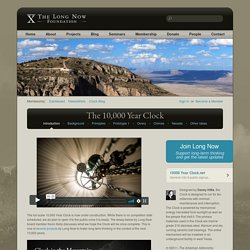
While there is no completion date scheduled, we do plan to open it to the public once it is ready. The essay below by Long Now board member Kevin Kelly discusses what we hope the Clock will be once complete. This is one of several projects by Long Now to foster long-term thinking in the context of the next 10,000 years. by Kevin Kelly.