
Latest College Trend: Wanting to Be Wealthy - U.S. Business News. Rising student debt and high unemployment may be causing part of the shift toward financial reward. Courtney Loo, a Cornell freshman, told the Cornell Daily Sun that "I think so many people in my class ... value being financially well-off because they are looking to live a comfortable life without having to worry about debt. " She added that, during the crisis, "They saw how difficult it was for their parents to deal with financial issues. " We don't know, of course, whether the students have a more or less negative view of the wealthy given the current class wars. Just because they want more wealth for themselves doesn't mean they want to be like the wealthy. Still, the survey shows that rather than shunning material comforts and financial gain, today's students are embracing it.
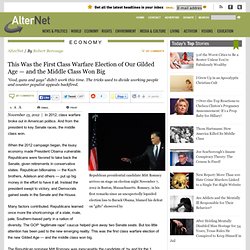
Some might say that today's top students are simply becoming more practical than idealistic. Is the American Dream in Danger? This Was the First Class Warfare Election of Our Gilded Age — and the Middle Class Won Big. Republican presidential candidate Mitt Romney arrives on stage on election night November 7, 2012 in Boston, Massachusetts. Romney, in his first remarks since an unexpectedly lopsided election loss to Barack Obama, blamed his defeat on "gifts" showered by November 15, 2012 | Like this article? Join our email list: Stay up to date with the latest headlines via email. In 2012, class warfare broke out in American politics. When the 2012 campaign began, the lousy economy made President Obama vulnerable. Many factors contributed. The Republican nominee Mitt Romney was inescapably the candidate of, by and for the 1 percent.
The class war, ironically, broke out in the Republican primaries. Needless to say, Obama is neither by temperament nor predilection a populist class warrior. Obama came back by deciding to stop seeking back-room compromises with people intent on destroying him and to start making his case. In the run-up to the election, the president’s campaign employed two basic strategies. Corporate Wealth Share Rises for Top-Income Americans. The billionaires next door. This is an excerpt from Plutocrats: The Rise of the New Global Super-Rich and the Fall of Everyone Else, published this week by Penguin Press. Pittsburgh was one of the smelters of America’s Gilded Age.
As the industrial revolution took hold there, Andrew Carnegie was struck by the contrast between “the palace of the millionaire and the cottage of the laborer.” Human beings had never before lived in such strikingly different material circumstances, he believed, and the result was “rigid castes” living in “mutual ignorance” and “mutual distrust” of one another. The twenty-seven-story Mumbai mansion of the Ambani family, rumored to have cost a billion dollars, is just seven miles away from Dharavi, one of the world’s most famous slums, and the gap between these two ways of life is even wider than anything Carnegie could find in the Golden Triangle.
Even so, the correct etiquette in today’s plutocracy, particularly among its most admired tribe, the technorati of the U.S. Recession-and-older-americans.pdf (application/pdf Object) Race for President Leaves Income Slump in Shadows. They are the issues that have dominated the political debate in recent years and have played a prominent role in this presidential campaign. But in many ways they have obscured what is arguably the nation’s biggest challenge: breaking out of a decade of income stagnation that has afflicted the middle class and the poor and exacerbated inequality. Many of the bedrock assumptions of American culture — about work, progress, fairness and optimism — are being shaken as successive generations worry about the prospect of declining living standards. No question, perhaps, is more central to the country’s global standing than whether the economy will perform better on that score in the future than it has in the recent past.
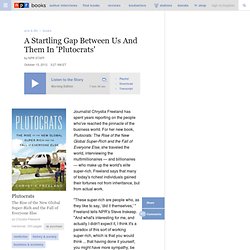
The question has helped create a volatile period in American politics, with Democrats gaining large victories in 2006 and 2008, only to have Republicans return the favor in 2010. But economists and other analysts also point to the scale of the problem. Interview: Chrystia Freeland, Author Of 'Plutocrats' Journalist Chrystia Freeland has spent years reporting on the people who've reached the pinnacle of the business world. For her new book, Plutocrats: The Rise of the New Global Super-Rich and the Fall of Everyone Else, she traveled the world, interviewing the multimillionaires — and billionaires — who make up the world's elite super-rich. Freeland says that many of today's richest individuals gained their fortunes not from inheritance, but from actual work.
"These super-rich are people who, as they like to say, 'did it themselves,' " Freeland tells NPR's Steve Inskeep. "And what's interesting for me, and actually I didn't expect it, I think it's a paradox of this sort of working super-rich, which is that you would think ... that having done it yourself, you might have more sympathy, be closer to the 99 percent. " But, she says, that's often not the case. "In many ways, that personal history of really feeling like, 'I did this! By myself! ' Brian Ferraro. Chicago Booth Blog: Fault Lines by Raghuram Rajan - Fault Lines by Raghuram Rajan.
This was published in the Financial Times. Democracy and free enterprise usually are found together – it is hard to think of any flourishing democracy that is not a market economy. Moreover, while a number of autocratic economies have embraced free enterprise (or “socialism with Chinese characteristics,” as the Chinese Communist Party would say), it seems to be only a matter of time before they are forced to become more democratic.
Yet it is not clear a priori why democracy and free enterprise should be mutually supportive. After all, democracy treats individuals as equal, with every adult getting an equal vote, whereas free enterprise empowers individuals based on how much economic value they create and how much property they own. What then prevents the median voter in a democracy from voting to dispossess the rich and successful? And why do the latter not try to erode the political rights of the former. When such aspirations seem plausible, the system gains added democratic support. The Role of Politics in Wealth Distribution. If Mr. Romney’s points were to be reformulated in a more defensible direction, the outline might look something like this: OF MAKING AND TAKING The correct distinction is not “makers versus takers.”
The problem is that taking, rather than making wealth, appears to be growing in relative influence. Most of us are actually both makers and takers. Consider farmers who produce food and favor agricultural subsidies. It isn’t easy to measure whether politics is less public-spirited these days, and we should resist the tendency to idealize the past. FOLLOW THE MONEY Seven of the 10 most affluent counties in the nation are near Washington, D.C. As Matthew Yglesias, a columnist for the online magazine Slate, has pointed out, there is also a subtler point about those wealthy Virginia and Maryland counties. UNEQUAL INFLUENCE Politics based on lobbying stacks the deck against lower-income groups, who are often outmaneuvered. It is therefore correct to reject Mr. Chrystia Freeland | Analysis & Opinion.
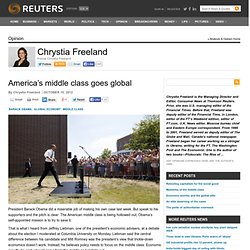
President Barack Obama did a miserable job of making his own case last week. But speak to his supporters and the pitch is clear: The American middle class is being hollowed out; Obama’s self-appointed mission is to try to save it. That is what I heard from Jeffrey Liebman, one of the president’s economic advisers, at a debate about the election I moderated at Columbia University on Monday. Liebman said the central difference between his candidate and Mitt Romney was the president’s view that trickle-down economics doesn’t work. Instead, he believes policy needs to focus on the middle class. Economic growth, he said, should come from the middle and radiate out. In a separate interview, Mark Gallogly, co-founder of the private equity and credit investment firm Centerbridge Partners and one of Obama’s earliest supporters on Wall Street, likewise emphasized the middle class. You may be tempted to say that focusing on the middle class is about as distinctive as supporting motherhood.
Laura D'Andrea Tyson and Owen Zidar: Tax Cuts for Job Creators. Laura D’Andrea Tyson is a professor at the Haas School of Business at the University of California, Berkeley, and served as chairwoman of the Council of Economic Advisers under President Clinton. Owen Zidar, a doctoral student in economics at the University of California, Berkeley, was previously a staff economist at the Council of Economic Advisers and, in 2008-9, an analyst at Bain Capital Ventures. The centerpiece of Mitt Romney’s tax plan is an across-the-board 20 percent cut in marginal tax rates. This cut, along with a few other tax changes Mr. Romney has endorsed – such as repeal of the estate tax and the alternative minimum tax – would reduce federal tax revenue from personal income and payroll taxes by an estimated $3.6 trillion to $3.8 trillion over 10 years. The total is closer to $5 trillion when Mr. Extending the Bush tax cuts for high-income earners, as Mr. Mr. What do we actually see after combing through a half-century of economic data?
What about the long run? How Propagandists for the 1% Are Manipulating Christian Teachings to Rob the Middle Class October 17, 2012 | Like this article? Join our email list: Stay up to date with the latest headlines via email. In the endless swirl of headlines about the current global financial crisis, the dominant narrative, which is also driving the 2012 US presidential election, is that crippling amounts of public debt run up by profligate government spending have brought us to the brink of financial ruin and must be offset by deep cuts in social services and "entitlements. " It is a false narrative that masks the largest ongoing financial swindle in human history, a swindle being carried out at public expense by a small class of elite financial speculators.
This speculative class has been unleashed over the past three decades by a Utopian neoliberal political project now embodied in its most virulent form in the Republican presidential ticket of Mitt Romney and Paul Ryan. Let's start with the depth and size of the underlying financial crisis, which is almost in the realm of hyper-reality. Plutocrat Bosses to American Employees: Vote for Romney – Or Else. Photo Credit: Shutterstock.com October 16, 2012 | Like this article? Join our email list: Stay up to date with the latest headlines via email.
It’s quickly becoming the story of the election season. Most recently, we’ve learned that Arthur Allen, CEO of ASG Software Solutions, sent an email to workers with the following subject line: “Will the US Presidential election directly impact your future jobs at ASG? David Siegel, the billionaire founder of Westgate Resorts, has been playing the worker intimidation game. On a June conference call to the National Federation of Independent Businesses, Mitt Romney himself enthusiastically pushed the tactic: “I hope you make it very clear to your employees what you believe is in the best interest of your enterprise and therefore their job and their future in the upcoming elections.” At a time of rampant job insecurity, workers across the country are fearful of doing anything to jeopardize their paychecks. Which is what the plutocrats are worried about. Why the Obscenely Wealthy Whine When They Have It So Good. October 9, 2012 | Like this article? Join our email list: Stay up to date with the latest headlines via email.
So, Mitt Romney now tells Sean Hannity he was “completely wrong” about the 47%. On the surface that looks like a typical etch-a-sketch campaign pivot. My theory is that after careful research and analysis, the smartest guys at 1% World Headquarters reached a disturbing conclusion. How? First, the setting. Yes, they really do believe there is something wrong with the people. The roots of this mindset run very deep. That legacy is very much with us They still don’t want anyone to think there is anything wrong with the system. For one thing, it matters greatly to their own sense of self-worth that they be seen as deserving of their riches and power.
And even if they are genuinely “self-made,” in the Horatio Alger myth sense, their “achievements” occur within a system. That aside, it’s even more important that we-the-people believe that the rich are “deserving” too. The Role of Politics in Wealth Distribution. The Self-Destruction of the 1 Percent. The High Inequality of U.S. Metro Areas Compared to Countries - Jobs & Economy.
Income inequality in America has reached levels not seen since the Gilded Age. As Joseph Stiglitz, the Nobel Prize-winning economist, noted in June, “America has the highest level of inequality of any of the advanced countries — and its gap with the rest has been widening.” This already-high national level of inequality is even worse in certain American cities and metro regions.
This is not surprising, given the large-scale demographic and economic sorting of Americans by education and skill over the past couple of decades. But it’s still shocking to realize that some American cities and metros face levels of inequality comparable to those in the poorest nations of Africa and other less-developed parts of the world. The Martin Prosperity Institute's Zara Matheson mapped data for 362 metros (based on an analysis by the institute's Charlotta Mellander). Map by MPI's Zara Matheson The Gini coefficient for the United States as a whole is .450, about the same as Iran and the Philippines. Pathways to the Middle Class: Balancing Personal and Public Responsibilities. Debate focusing on the American Dream has been ubiquitous of late, with some arguing that effort and talent are the primary causes of success and others arguing that government can help open greater opportunities for those with modest beginnings. But who actually achieves the dream and joins the middle class?
How much are children's chances of achieving success affected by the circumstances of their birth, by race and gender, and by how well they do at each life stage from birth to age 40? And how can we help more children navigate the path to a successful adulthood? On September 20, the Social Genome Project at Brookings presented new research on how many of today's children are likely to succeed, who they are, how success at one stage affects success in subsequent stages of life, and what might help keep more children on track.
Pathways_middle_class_presentation (application/pdf Object) Five Myths About the 47 Percent. 1. Forty-seven percent of Americans don’t pay taxes. The most pernicious misconception about people who don’t pay federal income taxes is that they don’t pay any taxes. That oft-heard claim ignores all the other taxes Americans encounter in their daily lives. Almost two-thirds of the 47 percent work, for example, and their payroll taxes help finance Social Security and Medicare. Accounting for this, the share of households paying no net federal taxes falls to 28 percent. And those aren’t the only other taxes they bear. 2. Politicians and commentators often talk about those who don’t pay income taxes as though they’re in a special club with lifetime membership. When they first join the workforce, for example, young people may not earn enough to pay federal income taxes.
The reverse is true for many senior citizens: They may pay no federal income tax in retirement, but most did during their working years. 3. 4. 5. But there is another way. The 10-year decline in wages for most college graduates. Classic Koch: How California's Prop. 32 Could Enrich Two Billionaires. Wealth losses by race and ethnicity. Inequality, exhibit A: Walmart and the wealth of American families. Confirming the further redistribution of wealth upward. The ‘democratization of the stock market’ that never happened. Rich Got Richer and Poor Poorer in N.Y.C., 2011 Data Shows. What You Need to Know About a Worldwide Corporate Power Grab of Enormous Proportions. Casey B. Mulligan: Changes in Inequality the 21st Century.
American Experience . The Richest Man in the World: Andrew Carnegie. Empathy. Infographic: How The Poor Spend Their Money Vs. The Middle Class. Middle-Class Areas Shrink as Income Gap Grows, New Report Finds. Review: Voice of the New Global Elite. Yes, The Rich are Different & Pew Research. Revolt of the Rich. World's richest woman advises poor to stop socializing. Who Killed American Unions? - Derek Thompson. Older, Jobless and Forced Onto Social Security. Millionaires are not the new middle class. What do Americans think of the rich? Yes, the Rich Are Different.