
Anders Breivik’s Inexplicable Crime. Norway is a small country.

It is also relatively homogeneous and egalitarian. This means that the distance from top to bottom is short, and that great disasters affect the entire populace. For example, every Norwegian knows someone who knows someone who died when the Alexander Kielland drilling rig capsized, in 1980—I recall that my brother had a schoolmate whose father died in the disaster—or when, a decade later, a ferry, the Scandinavian Star, burned and a hundred and fifty-eight of the passengers died.
There is also something deeply sincere, almost innocent, about Norwegian culture. Practically every time something about Norway or one of its people appears in the foreign press, the Norwegian media mention this with pride. He wanted to save Norway. The Manifesto. RearmamentThese grand and fatal movements toward death: the grandeur of the mass Makes pity a fool, the tearing pity For the atoms of the mass, the persons, the victims, makes it seem monstrous To admire the tragic beauty they build.

Living the Compassionate Life. His Holiness the Dalai Lama, by Alison Wright This teaching by the Dalai Lama explains how the Buddhist teachings of mindfulness and compassion lead inevitably to feelings of self-confidence and kindness.

As human beings we all have the potential to be happy and compassionate people, and we also have the potential to be miserable and harmful to others. The potential for all these things is present within each of us. If we want to be happy, then the important thing is to try to promote the positive and useful aspects in each of us and to try to reduce the negative. Doing negative things, such as stealing and lying, may occasionally seem to bring some short-term satisfaction, but in the long term they will always bring us misery. This is what I call the promotion of human value. Rebel Without a Cause. Stanley-kubrick-meaning-of-life-quote.jpg (980×8114) The Cure - Killing An Arab. Albert Camus’ “The Stranger” Inspires The Cure’s “Killing an Arab” When the Cure released the album “Boys Don’t Cry” in 1980 the English band always dealt with having to explaining a song that was deemed racist by many at the time.

The cries to censor the rock band’s first single “Killing an Arab” came from the American-Arab Anti-Discrimination Committee, a civil-rights organization, when a radio deejay confused the song with an anti-Arab anthem. A 1946 first-edition cover to “The Stranger” by Albert Camus. With incendiary lyrics “I’m alive…I’m dead…I’m a stranger…Killing an Arab,” a lot of music fans overlooked the fact that the tune simply retold a scene in the short novel “The Stranger” by French writer Albert Camus. “If there’s one thing I would change, it’s the title,” lyricist Robert Smith told Chart Attack, a Canadian music online publication, in 2001. “I wrote it when I was still in school and I had no idea that anyone would ever listen to it other than my immediate school friends.” ‘I withdraw’: A talk with climate defeatist Paul Kingsnorth.
A longer version of this interview appeared at ThoreauFarm.org.
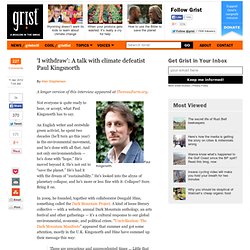
Paul Kingsnorth. Not everyone is quite ready to hear, or accept, what Paul Kingsnorth has to say. An English writer and erstwhile green activist, he spent two decades (he’ll turn 40 this year) in the environmental movement, and he’s done with all that. And not only environmentalism — he’s done with “hope.” He’s moved beyond it. Hope in the Age of Collapse. An exchange with Paul Kingsnorth, founder of the Dark Mountain Project Research now demonstrates that the continued functioning of the Earth system as it has supported the well-being of human civilization in recent centuries is at risk.

Without urgent action, we could face threats to water, food, biodiversity and other critical resources: these threats risk intensifying economic, ecological and social crises, creating the potential for a humanitarian emergency on a global scale. - “State of the Planet Declaration,” London, March 29, 2012 That’s the warning issued last week by a high-level group of scientists, business leaders and government officials at the Planet Under Pressure conference in London. It’s certainly an arresting video. And many might see in those images a call to action, however belated. Not Paul Kingsnorth. It’s the End of the World as We Know It . . . and He Feels Fine. Photo Late one night last August, on the chalk downlands of southern England, Paul Kingsnorth stood in a field beside an old-growth forest, two yurts and a composting toilet.

Kingsnorth is 41, tall, slim and energetic, with sweeping brown hair and a sparse beard. He wears rimless glasses and a silver stud in his ear, and he talks with great ardor, often apologizing for having said too much or for having said it too strongly. On this occasion, Kingsnorth was silent. Paul Kingsnorth. Searching for truth in a post-green world Paul Kingsnorth Take the only tree that’s left, Stuff it up the hole in your culture.

—Leonard Cohen Retreat to the desert, and fight. —D. Confessions of a Recovering Environmentalist. By Paul Kingsnorth Scenes from a younger life # 1: I am twelve years old. I am alone, I am scared, I am cold, and I am crying my eyes out. I can’t see more than six feet in either direction. The Sopranos and existentialism. The Sopranos: 2x07 D-Girl - Livia speaks to AJ about life and death (HD 1080p) Watch Seinfeld, The Phone Message, Season 2, Episode 7 Online Free. Charlie Todd: The shared experience of absurdity.
Absurdism. Absurdism is very closely related to existentialism and nihilism and has its origins in the 19th century Danish philosopher Søren Kierkegaard, who chose to confront the crisis humans faced with the Absurd by developing existentialist philosophy.[3] Absurdism as a belief system was born of the European existentialist movement that ensued, specifically when the French Algerian philosopher and writer Albert Camus rejected certain aspects from that philosophical line of thought[4] and published his essay The Myth of Sisyphus.

The aftermath of World War II provided the social environment that stimulated absurdist views and allowed for their popular development, especially in the devastated country of France. Overview[edit] "... in spite of or in defiance of the whole of existence he wills to be himself with it, to take it along, almost defying his torment. Relationship with existentialism and nihilism[edit] Related works by Søren Kierkegaard[edit] New York man charged in boy's killing placed under suicide watch. Suspect in boy's brutal death in court NEW: The defense attorneys say Levi Aron hears voices and hallucinatesNEW: They ask that Aron be put on suicide watch as he awaits a mental examNEW: Assemblyman: "People ... can't believe what happened"Leiby Kletzky, 8, went missing Monday and police believe they've found his remains New York (CNN) -- Levi Aron, arraigned in a New York court Thursday on charges of murder and kidnapping in the first degree in the killing of an 8-year-old boy, was remanded under suicide watch until a mental evaluation is completed.
Aron, 35, showed no emotion as he entered the court handcuffed and did not enter a plea. He said earlier in a statement that he was sorry for the trouble he has caused, said New York Police Commissioner Ray Kelly. Defense attorneys Pierre Bazile and Gerard Marrone told the court that Aron has said he hears voices and hallucinates. "I have sincerest concerns about the defendant's mental state and his cognitive abilities," Bazile said. Ted Kaczynski. Selected journalism by Stephen J.

Dubner < BACK "I Don't Want To Live Long. I Would Rather Get The Death Penalty Than Spend The Rest Of My Life In Prison" Ted Kaczynski talks about life in jail, his appeal plans and his brother David, who still struggles over the decision to turn in the Unabomber By STEPHEN J. DUBNER October 18, 1999 There is probably never a good time to ask the question--Tell me, do you consider yourself insane? He is sitting on a concrete stool in a concrete booth with windows made of reinforced glass. His voice is nasal and singsongy, full of flat Chicago vowels. When he was arrested, Kaczynski was widely assumed to be insane. Camus, Albert Albert Camus was a French-Algerian existentialist. Albert Camus. 1. The Paradoxes of Camus's Absurdist Philosophy There are various paradoxical elements in Camus's approach to philosophy. Albert Camus - The Madness of Sincerity. Albert Camus Society Blog: Meursault and Kruschen Salts, humour in The Stranger.
Albert Camus' The Stranger is not often read for its comedy value however Meursault the hero and narrator likes a joke. He tells us that Salamano's dog manages to wriggle out of his collar and escape while his owner was watching "the Escape king" [41] and he tells us of Raymond's silly hat that makes Marie laugh [50]. Marie's laughter is in fact what attracts Meursault to her and he makes 18 separate references to her laughing or smiling. Patrice Mersault, hero of A Happy Death (a kind of pre-run for The Stranger) is very attracted to mouths, 'lips' are mentioned several times in a sexual context but this is the subject for a future post.
A Man Said to the Universe by Stephen Crane.