
Souffiya.
Blog de aladdji - Wallaye - Skyrock.com. Frithjof Schuon. IX. Anthropomorphism And Theomorphism In Al-Mishkat. Sacred Texts Islam Index Previous Next The doctrine of mukhâlafa--that the divine essence and characteristics wholly and entirely "differ from" the human-appears to be [1.
Tah., p. 60. Quoted in the writer's article in Der Islâm, see pp. 134-6, 151, 152, where parts of the subject are gone into in greater detail.] {p. 51} assorted, as this treatise's last word, in its most extreme and intransigent form. Nevertheless, the Mishkât itself seems to be one long attempt to modify or even negate this its own bankrupt conclusion. Sufismpage2 History. Islamic mysticism had several stages of growth, including (1) the appearance of early asceticism, (2) the development of a classical mysticism of divine love, and (3) the rise and proliferation of fraternal orders of mystics.
Despite these general stages, however, the history of Islamic mysticism is largely a history of individual mystic experience. The first stage of Sufism appeared in pious circles as a reaction against the worldliness of the early Umayyad period (AD 661-749). From their practice of constantly meditating on the Qur'anic words about Doomsday, the ascetics became known as "those who always weep" and those who considered this world "a hut of sorrows.
" They were distinguished by their scrupulous fulfillment of the injunctions of the Qur'an and tradition, by many acts of piety, and especially by a predilection for night prayers. Classical mysticism Sufi thought was in these early centuries transmitted in small circles. Herbert Mason: "Reflections on Louis Massignon and His Legacy of. One of my realizations over the years has been of the truth that I am not an expert on Louis Massignon.
And on this the thirtieth anniversary of his death, the realization hasn't diminished. When I first met him person to person, in 1959, I knew very little about him and virtually nothing about his scholarly subject of Islamic Studies1. Following our subsequent association and correspondence and my ensuing work of translating his Passion d'al-Hallaj and others of his shorter essays2, I moved, as he would've wished, from him to Hallaj and other Islamic persons, subjects, and my own present-day friendships.
By his opening a door — I hadn't expected to find let alone pass through — he had shown his real approach, the technique if you will, of his "dialogue with other cultures. " Content 4. Religion et spiritualité en citations et en images. Que faire donc pour maintenir la paix dans ce processus de globalisation ?

Ecoutons, les sages : Deux voies semblent donc amener à la paix. Isa The Light And The Fragrance Of God. Copyright © 1996 by M.
Anderson. All rights reserved. by M. Anderson. Biographical Encyclopaedia of Sufis : Central Asia and Middle Ea. Contents: Preface. 1.
‘Abd Ahmad, Shah Muhammad b. (1584-1661). 2. ‘Abd Allah Wali, Shah Ni’mat Allah Nur al-Din b. (1330/31-). 3. Abi ‘I-Khayr, Abu Sa’id Fadl Allah B. (967-1049). 4. Maitres musulmans. "Couvre-toi la poitrine avec le vide, et passe sur ta tête la robe de non-existence".
Attar Une présentation plus détaillée vous est proposée en cliquant sur le maître "désiré"... Poète et philosophe perse, Hallaj est sans doute l'un des plus célèbres mystiques de tous les temps pour le monde islamique, bien qu'il soit presque totalement inconnu en Occident. Né à Tur (Iran) en 857, il est exécuté par décapitation en 922, à Baghdad. Sufi Wisdom: Mansur al-Hallaj - Winds of Change.NET. The Mystical Core of Organized Religion. Brother David Steindl-Rast, O.S.B., is a monk of Mount Savior Monastery in the Finger Lake Region of New York State and a member of the board of the Council on Spiritual Practices.
He holds a Ph.D. from the Psychological Institute at the University of Vienna and has practiced Zen with Buddhist masters. He is author of Gratefulness, The Heart of Prayer and Music of Silence: A Sacred Journey Through the Hours of the Day. Copyright © 1989 by David Steindl-Rast. Used by the Council on Spiritual Practices with permission. First appeared in ReVision, Summer 1989 12(1):11-14. Mysticism has been democratized in our day. Fils d'Untel - HISNOULMUSLIM. DOCTRINE OF IMAM MANSUR AL-HALLAJ. Doctrine of from the.
The Ismaili da'wa Outside the Fatimid dawla. The Institute of Ismaili Studies - Hamid al-Din al-Kirmani: Isma. ESCHATOLOGIE ET EXEGESE MYSTIQUE : Pierre Lory: Soufisme et pens. Le but de cet étude n’est pas de découvrir un sens « originel » des versets eschatologiques du Coran tels qu’il furent diffusé du vivant du prophète Muhammad.
Ce travail consiste simplement à rendre compte d’une foi se développant selon sa dynamique propre. Ici, je me sépare de certains maîtres en Sorbonne, comme Régis Blachère, qui travailla sur sa traduction du Coran sans trop référer aux ouvrages de tafsîr, comme pour éviter la « contamination » de sa traduction par le dogme. Mon travail d’universitaire correspond, pour l’essentiel, à exposer et analyser pour le public francophone les voies historiques de la compréhension du texte sacré par les différentes tendances musulmanes. Partant de là, un fait s’impose. Pour les musulmans, le texte sacré qu’est le Coran vise à transmettre des vérités surnaturelles, dans un langage permettant une foi sans équivoque.
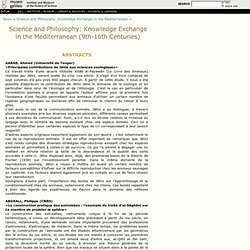
On pourrait beaucoup épiloguer sur la portée de l’exégèse mystique du Coran appliquée aux thèmes eschatologiques. Bibliographie. Soufisme. Abstracts - Science and Philosophy: Knowledge Exchange in the Me. News > Science and Philosophy: Knowledge Exchange in the Mediterranean > AARAB, Ahmed (Université de Tanger) «Principales contributions de Jāhiz aux sciences zoologiques» Ce travail traite d’une œuvre intitulée Kitāb al-hayawān (Le Livre des Animaux) réalisée par Jāhiz, savant arabe du viiie -ixe siècle.
Concept of Martyrdom with special reference to the Sahidi of Gur. Concept of Martyrdom with special reference to the Sahidi of Guru Tegh Bahadur Dr. Harnam Singh Shan. Martyrdom is a Semitic concept. Its doctrine goes back to old Oriental and Hellenistic ideas. The literal and primary meaning of the word uaprus in Greek, martyr in English and shahid in Arabic is ‘witness’,. Semitic Origin: The word ‘martyr’ acquired its modern connotation during the conflict between Paganism and Christianity when Christians ‘testified to the truth of their convictions" by sacrificing their own lives.2 A similar development of its Arabic synonym, Shahid, took place under Christian influence, and it also began to be used for one who dies in witness of his faith or who seals his belief with his death while fighting against infidels.3 Sikhism adopted the concept, alongwith its current form and usage, from Islam, extending it by introducing a new dimension and a universal outlook.
But all religious traditions are not endowed with this great and proud privilege. SAINTETE ET MARTYRE EN ISLAM : Pierre Lory: Soufisme et pensée i. Soufisme : Tariqa Qadiriyya Boutchichiyya Maroc. Spiritualite soufie.COM en construction › Se connecter. Forum Tariqa Avignon (pour l'instant) - Index. Religionswissenschaft Marburg: Links to the wider world. Confréries soufies. Un article de Wikipédia, l'encyclopédie libre. Soufisme - Le Journal Soufi - Accueil. Confréries soufies - Wikipédia. Spiritualité soufie : Conférences, rencontres, concerts, contes,