
CSEFEL: Center on the Social and Emotional Foundations for Early Learning. Promoting Social and Emotional Competence: These modules were designed based on input gathered during focus groups with program administrators, T/TA providers, early educators, and family members about the types and content of training that would be most useful in addressing the social-emotional needs of young children.
The content of the modules is consistent with evidence-based practices identified through a thorough review of the literature. Preschool Modules (English and Spanish Versions) Infant Toddler Modules (click here for Spanish versions) Modules last updated: May 2006 View Module Archive for Modules from 2003. SLP Video Intervention Programs – Video Therapy Tools for SLPs. The Lavi Institute – Pioneer in video based assessments. AFIRM Modules. AFIRM Modules Our funding has ended. Find out how to continue to support AFIRM and keep it accessible to all. AFIRM Modules are designed to help you learn the step-by-step process of planning for, using, and monitoring an EBP with learners with ASD from birth to 22 years of age. Supplemental materials and handouts are available for download. Provincial Outreach Program for Autism and Related Disorders (POPARD) Make Social Learning Stick! - Home. Color My Conversation: Social Skills Curriculum. Teach the language skills needed for face-to-face conversations!
The Color My Conversation program (CMC) is an engaging, multi-sensory teaching approach to help guide children through the conversation flow. Children will learn to navigate through a conversation starting at a basic greeting and working toward the most complex conversation that the child is capable of having. Whole Body Listening Trailer. Lesson 12: Good & Weird Thoughts. Upload Miss Deborah Cherry Loading...
Working... ► Play all.
Social Thinking Books. Friendship. Idioms. Social Thinking Videos. My Smarts. Parent Resources. Social Thinking Jeopardy Game Jeopardy Template. Video Clips for Social Thinking on Pinterest. Teaching General Safety Rules to Children - Parenting Tips & Advice. Photograph by Cherry-Merry - Fotolia At school, children learn the infamous “Stop, Drop and Roll” and the basics of stranger danger, but as parents, it’s important to teach general safety rules to children at home, too.
“My advice to parents is to work hard on your communication with your child,” says Kim Estes, certified prevention educator and founder of Savvy Parents, Safe Kids, in Redmond, Washington. “Keep a consistent conversation going about your values around safety.” Make learning about safety a family affair with games, lists and open communication, so your children are prepared. Teaching General Safety Rules to Children - Parenting Tips & Advice.
Do You Know How to Be Street Smart? Listen Do you know how to be street smart?
Being street smart means knowing how to keep yourself safe from strangers when you're alone or with other kids. Whether you're walking to school or to the bus, hanging out on the playground, or riding your bike in your neighborhood, being street smart helps you stay safe. Tools_getting_along_introduction.pdf. Evidence-Based Practices for Effective Communication and Social Intervention. Contributed by Kristie Brown Lofland, MS, CCC-A Differences in communication are the hallmark for individuals on the Autism Spectrum (ASD).
These differences in communication and language development include absence or delay in spoken language, impairment in conversational abilities, stereotyped and repetitive language, inappropriate use of pronouns, and difficulties with play and imitation. Some students with ASD will have a specific language impairment. Others may have limited comprehension in verbal and gestural forms of communication. In addition, some individuals will exhibit difficulty in generalization. 22 Social Scenarios for Speech Therapy Practice. TeachTown. Social Skills Training: Taking Turns Speaking. "I'm interested but nervous" - Body language: 23 must-know moves - Pictures. Social Skills Resources. (Click on book for link to website for more information) The Superflex Curriculum is a great tool for teaching younger kids social skills.
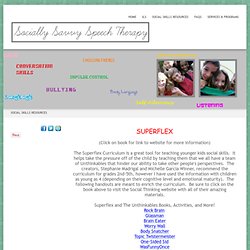
It helps take the pressure off of the child by teaching them that we all have a team of Unthinkables that hinder our ability to take other people's perspectives. The creators, Stephanie Madrigal and Michelle Garcia Winner, recommend the curriculum for grades 2nd-5th, however I have used the information with children as young as 4 (depending on their cognitive level and emotional maturity). Jill Kuzma's SLP Social & Emotional Skill Sharing Site. The Incredible Flexible You. Cindy L. Meester's Blog- Speech Therapy with a Twist. Webonauts Internet Academy.