
Piekļuve tekstiem par biovaru un Mišelu Fuko. On the Genealogy of Modernity : Foucault's Social Philosophy - Nythamar de Oliveira. Nythamar Fernandes de Oliveira Publisher: Nova Science Publishers, Inc.; ISBN: 1590336224; (January 2003) Click here to order it from Amazon Books Table of Contents Preface Introduction 1. 2. 3.
Foucault and His Panopticon - power, knowledge, Jeremy Bentham, surveillance, smart mobs, protests, cooperation, philosopher. Michel Foucault Above all else, Michel Foucault believed in the freedom of people.
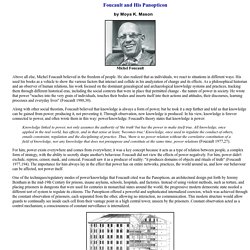
He also realized that as individuals, we react to situations in different ways. His used his books as a vehicle to show the various factors that interact and collide in his analyzation of change and its effects. As a philosophical historian and an observer of human relations, his work focused on the dominant genealogical and archaeological knowledge systems and practices, tracking them through different historical eras, including the social contexts that were in place that permitted change - the nature of power in society. Mišels Fuko. This page offers brief definitions of some of the key concepts in Foucault's work.
For a more complete list which also includes extensive details of where these concepts can be found in Foucault's work please see my book Michel Foucault (London: Sage, 2005). The list here places more emphasis on definitions, whereas the list in the book provides a detailed structure of references for users of Foucault's work. © Clare O'Farrell 2007 apparatus (dispositif) Foucault generally uses this term to indicate the various institutional, physical and administrative mechanisms and knowledge structures, which enhance and maintain the exercise of power within the social body.
Archaeology 'Archaeology' is the term Foucault used during the 1960s to describe his approach to writing history. Archaeology versus genealogy Foucault's remarks on the difference between archaeology and genealogy are generally rather vague and confusing. Archive This is a technical term Foucault uses in The Archaeology of Knowledge. Michel Foucault. Michel Foucault Theorist Web Project Scott McGaha Michel Foucault, the French philosopher, was one of the most influential thinkers of the 20 th Century.
Discipline and Punish , written in 1975, gave people a new way to view the prison system. In this book, Foucault describes the history of prisons. History. A journal of critical philosophy. Texte_ArcheologieSavoir.pdf (Objet application/pdf) Le biopouvoir chez Foucault et Agamben. - Methodos. 1 L’hypothèse du bio-pouvoir est formulée par Foucault à un tournant de ses recherches, notamment da (...) 2 Giorgio Agamben, Homo sacer, Le pouvoir souverain et la vie nue, traduction par Marilène Raiola, L (...) 1L’hypothèse d’un bio-pouvoir, c’est-à-dire d’un certain rapport entre le pouvoir et la vie, a été initialement formulée par Foucault dans La volonté de savoir et dans les cours contemporains donnés au Collège de France (Il faut défendre la société1).
Foucault propose ainsi une nouvelle approche du pouvoir en identifiant un mode spécifique d’exercice du pouvoir lorsque la vie entre dans ses préoccupations. Il étudie les technologies de pouvoir qui, à partir du XVIIIe siècle, investissent spécifiquement la vie, c’est-à-dire les corps individuels, objets d’une « anatomo-politique ». Il s’inscrit en cela dans la continuité de ses analyses sur les disciplines. 3 VS, p.188. 4 HS, p.202. 1.1. 5 VS, p.179. 6 IFDS, p.216. 7 IFDS, p.216. 8 IFDS, p.219. Foucault, Historien du présent, Gilles Deleuze: Foucault, Historien du présent. Origine.
Portail Michel Foucault. D’après Foucault. Gestes, luttes, programmes. Protevi plāns - Drošība, teritorija, iedzīvotāji. Fuko studijas - par drošību, teritoriju.. Pēc 11/9 septembra - drošība, teritorija, iedzīvotāji. AfterFoucault. Social Control and the Theory of Communicative Action (by Mathieu Deflem) The Situationist International Text Library/The Revolution of Everyday Life. The Situationist International Text Library. Speculum criticum traditionis. Who was Gilles Deleuze? (part 1) - The Philosopher's Zone - ABC Radio National.
Alan Saunders: At the age of seventy, Gilles Deleuze, the French philosopher, took his own life, on November 4th, 1995.
He'd been a heavy smoker and suffered from a debilitating pulmonary ailment throughout the last 25 years of his life. He'd had a lung removed, undergone a tracheotomy, lost the power of speech and considered himself 'chained like a dog' to an oxygen machine. By the last years of his life, even handwriting required laborious effort. Hello, this is The Philosopher's Zone, and I'm Alan Saunders, welcoming you to the first of two programs examining the work of one of the most influential and prolific French philosophers of the second half of the 20th century. To guide us around the deep and complex subject of Deleuze's thought, we're joined by Robert Sinnerbrink who teaches philosophy at Macquarie University and is chair of the Australasian Society for Continental Philosophy. Robert Sinnerbrink: Thanks for having me. Robert Sinnerbrink: That's a very good question.
Gilles%20Deleuze%20(Routledge%20Critical%20Thinkers)%20-%20Claire%20Colebrook. Thermal, vibration, and optical level switches are area devices established to solve specific level detection problems.
Typically, they are used in uses that either cannot be held by the more communal float and probe-type devices, or when ultrasonic, nuclear, radar or microwave designs would be too refined, costly, or otherwise unqualified for the task. The OLS-11 solves all three problems. The OLS-11 can be used to distinguish liquid levels or boundaries amongst liquids. The optical level switch is also suitable for identifying high froth levels, if it is spray washed after each occasion. A Deleuze Society? Society of Control by Gilles Deleuze. K. A. Taipale: The Surveillance Society (Omniveillance) FOUCAULT AVEC DELEUZE. 14401_deleuze_control. Society: Philosophy: Philosophers: D: Deleuze, Gilles. Mille Deleuze 1/5 : Deleuze va au cinéma - Idées. Gilles Deleuze and Félix Guattari. Francois Dosse; Translated by Deborah Glassman Paper, 672 pages, 29 illus.
ISBN: 978-0-231-14561-9 $27.00 / £18.50 July, 2010 Cloth, 672 pages, 29 illus. ISBN: 978-0-231-14560-2 $45.00 / £30.95 Copyright information Introduction: Betwixt or Between Four-handed. In 1968, Gilles Deleuze and Félix Guattari inhabited very different worlds, and there was little chance that they would ever meet. In the late 1950s, Jean-Pierre Muyard was a medical student in Lyon and a militant member of the left wing of the National French Students’ Union (UNEF), which vigorously protested the war in Algeria. "I remember the impression that I had, I’d describe it as something physiological, the impression that Guattari immediately made on me felt like a startling vibration, a process of connection.
In 1966, Nicole Guillet asked Muyard to move into the clinic at La Borde, as the influx of long-term patients required more doctors. The text is important. Meeting Guattari revitalized Deleuze. Rhizomes: Cultural Studies in Emerging Knowledge. Brighenti2010CrowdsPacks. Deleuze&Guattari. Deleuze and Guattari. Political-normativity-deleuze. Gilles Deleuze and Felix Guattari. Gilles Deleuze and Felix Guattari QUESTION: When you describe capitalism, you say: 'There isn't the slightest operation, the slightest industrial or financial mechanism that does not reveal the dementia of the capitalist machine and the pathological character of its rationality (not at all a false rationality, but a true rationality of *this* pathology, of *this madness*, for the machine does work, be sure of it).
There is no danger of this machine going mad, it has been mad from the beginning and that's where its rationality comes from. Mille Deleuze 2/5 : lecteur de Bergson - Idées. Interview with Elizabeth Grosz.