
Google+: 9 surprising facts about the GROWING social network. Brands, don’t abandon that Google+ account yet.

A new study of the top brands on Google’s social network found that their presence is greatly expanding—and so is engagement among users (dubbed “circlers,” because “circle” is the Google+ equivalent to a “like” or follow). Simply Measured, which compiles and presents social data, evaluated the Google+ presence of companies from the Interbrand 100 list. The study found that 64 percent of these brands have an active Google+ page, and 22 percent have pages with more than 100,000 circlers. This graph shows the steady increase in the number of circles for these brand pages: Facebook and Twitter Postings Cost CFO His Job. CSR Asia - Corporate Social Responsibility in Asia. It was World Consumer Rights Day on March 15 th . You may not have noticed it, but in China it’s a television event.
Every year, on the eve on WCRD, China’s Central Television (CCTV) broadcasts a special programme on this topic. This year, CCTV exposed a company called Roadway D&B for selling the personal information of 150 million Chinese consumers. Roadway D&B is a subsidiary of the US business information provider Dun & Bradstreet. According to a Wall Street Journal report (20 March), Dun & Bradstreet have since suspended Roadway D&B’s operations and reported the case to the US Department of Justice and the Securities and Exchange Commission. Globally, companies illegally selling personal information will normally be subject to criminal charges. Could Facebook ID Cards Replace State-Issued Ones? What's the Latest Development?

A new project out of Berlin is issuing Facebook identity cards that, in principle, would work like a government-issued ID. Called the FB Bureau, the group makes ID cards with your photo, Facebook name (or moniker) plus a QR code. To verify your identity, retailers or authorities could scan the code with a mobile device or computer. When signing up for a new service on the Internet, many people are already accustomed to using Facebook Connect to establish their identity on the new site, so perhaps Facebook will be trusted in real life as well. What's the Big Idea? With 800 million users, Facebook is already the dominant identity system on the Web. Photo credit: FB Bureau. Google and Facebook mean that we don’t know what we’re missing.
Charles Chao: Weibo Looking to Boost Business Accounts. At a conference last night in Taipei, Sina (NASDAQ:SINA) CEO and Chairman Charles Chao spoke about the importance of Sina Weibo as a channel for marketing.

To that end, Chao says, Sina is hoping to boost enterprise weibo accounts from the 100,000 or so it has currently to 1 million over the next year. The Evolution of Online Travel. The Social Travel Series is supported by join.me, the easiest way to have an online meeting. join.me lets you instantly share your screen with anyone, for free.
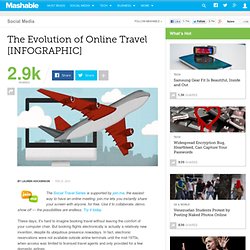
Use it to collaborate, demo, show off — the possibilities are endless. Try it today. These days, it's hard to imagine booking travel without leaving the comfort of your computer chair. But booking flights electronically is actually a relatively new invention, despite its ubiquitous presence nowadays. China’s Digital Advertising Market in 2012 [Slideshare] AdChina (易传媒), one of China’s top advertising platforms, has put together an overview of China’s digital advertising market.
![China’s Digital Advertising Market in 2012 [Slideshare]](http://cdn.pearltrees.com/s/pic/th/advertising-slideshare-23762880)
AdChina itself is a company to watch, a real Chinese IPO candidate that, unlike many others, rarely trumpets its own horn. Zhihu (知乎) – China’s Quora Clone. Quora, a social question and answer site, has absolutely exploded over the past few months.

One Quora questioner asks, “What would happen if a website based in China copied everything from Quora?” The answer: it’s called Zhihu (知乎) and we’ll soon find out. I was recently sent a couple screenshots of Zhihu, a Chinese Q&A site that copies 99% of the Quora user interface (but it’s blue, not red!). Zhihu (知乎) means “know everything” in Chinese. Groupon in China, Part I: why it could succeed where others have failed. *published in tandem on VentureBeat.

Pinterest Clones Explore China’s “Interest Graph” The Pinterest sharing model is the latest trend in China’s startup scene, with no less than 20 Pinterest clones in existence.

Some of them are following the classic cloning route, changing the UI only thinly, while the more intelligent clones are leveraging the Pinterest interface design for more outright commercial practices (like social shopping). The entire concept focuses on building users based on interests rather than social networks, and it’s opened up new doors for China’s social startups. The Ups and Downs of Lite Blogs Early in 2011, a popular trend was cloning Tumblr, which also builds an audience around shared user interests.
QQ Users in China Pay For a Fake 'Sent From My iPhone' Hack. Forget real time: 'next time' is far more disruptive. This is a guest post by Tom Gray, a Senior Creative Strategist at Imagination in London.

He blogs on imagination.com/labs and can be found at @tomoppad. If you're looking for the roots of our obsession with real-time information, you could do worse than look to the London Stock Exchange around the time of the Napoleonic wars. Legend has it financier Nathan Rothschild developed such a fearsome network of spies and couriers that he knew the Battle of Waterloo's result many hours before even the British Government. Being a smart man (and not being on Twitter), he kept the information to himself.
【投资界学堂】初创企业融资推介十要点_投资界学堂. What the media can learn from Facebook. Facebook sees content as an abundant resource to learn from, value and exploit, says Jeff Jarvis.

Photograph: Justin Sullivan/Getty Images. 4 Unique Approaches for Measuring Social Media ROI. Krista Neher | February 15, 2012 | 2 Comments inShare103 A look at the creative ways to measure (or at least validate) your social media efforts. Calculating ROI in social media is a hot topic. As companies have rushed into the elusive social media marketing gold mine, many are left trying to figure out if all the time and effort is paying off. Internet companies: Attack of the clones. 5 Essential Spreadsheets for Social Media Analytics. Ann Smarty is a search marketer and full-time web entrepreneur. Ann blogs on search and social media tools. Her newest project, My Blog Guest, is a free platform for guest bloggers and blog owners.
Follow Ann on Twitter @seosmarty. Katie Goodman: Facebook Blocked Me From Friending: That is Soooo 7th Grade... A male friend of mine said his worst middle school memory is when he called a girl to ask her out and her mom grabbed the phone and said to stop calling her. That's what happened to me on Facebook this week. I swear I was trying to friend real live people I know -- people I met at Occupy Wall Street and in New York at my comedy show who don't have any friends in common with me on Facebook but who I had actual human exchanges with that involved the use of mouths, vocal chords, brain synapses, and shared political camaraderie, a borrowing of pens, signs, witticisms, hand warmers, and probably a sharing of beers though I don't remember due to the sheer enthusiasm of being present with real live people!
But Facebook deemed me a stalker and cut me off from friending anyone for seven days. ComScore: Social Universe Still Quickly Expanding [STUDY] Zachary Rodgers | February 9, 2012 | 0 Comments. 5 Paradoxes Shaping the Future of Mobile Commerce. Igor Faletski is the CEO of Mobify, a web platform that optimizes ecommerce and publishing sites for mobile and powers more than 20,000 sites. Remember when it took 23 clicks to find movie showtimes on your mobile phone? How Target Figured Out A Teen Girl Was Pregnant Before Her Father Did. Target has got you in its aim. How Companies Learn Your Secrets.