
Oreo the geep rams genetic barrier. Sheep-goat hybrid Oreo and his mum at a NSW children's daycare centre.

Picture: Gary Graham Source: The Daily Telegraph HALF sheep, half goat? You've got to be kidding. That is what farmer Terry Crompton thought when he discovered his ewe had just given birth to a hybrid. While it sounds bizarre, the genetic fluke is officially known as a "geep". "One of the boys told me the lamb had arrived," Mr Crompton said. "It was dark, and I went into the paddock looking for her mother and she had this little black and white bundle. "We don't get black and white lambs, and as soon as I felt it I knew it didn't have wool, it had hair.
"I said its father must be a goat. " Proving to be more than just the black sheep of the family, the geep, named Oreo, was born to a sheep but is a genetic throwback from its father - a ram with goat genes. Fertility landmark as scientists make sperm from stem cells - Science, News. It is believed to the the first time that sperm cells made in the laboratory with stem-cell techniques have been used to generate offspring free of any obvious physical or genetic defects that have grown up and reproduced normally, the researchers said.
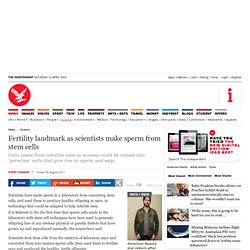
Scientists took stem cells from the embryos of laboratory mice and converted them into mature sperm cells, then used them to fertilise eggs and produced the healthy, fertile offspring. The technology may one day form the basis of a new approach to treating infertile women incapable of making their own egg cells, the scientists said. One possibility is that skin cells taken from infertile men or women could be turned into stem cells and then converted into the "germline" cells that give rise to sperm and eggs. These sperm and egg cells could then be used in standard IVF procedures. "This is the first study to create health and fertile offspring from germline cells generated from embryonic stem cells. Giant Rat Kills Predators with Poisonous Hair.
By utilizing the same plants that African tribesmen use to poison their arrows, the furry fury known as the African crested rat can incapacitate and even kill predators many times its size, researchers have found.

"This is the first mammal that is borrowing a deadly poison from a plant and slathering it on itself without dying," said study researcher Jonathan Kingdon, of Oxford University in England. "This is an extraordinary thing to have evolved. " Growing up in Africa, Kingdon was frequently exposed to these rats, even keeping one (very cautiously) as a pet. Man who could hear his own eyeballs roll cured. "Eventually I could hear my heart beating and my eyes moving in their sockets.

It was really distracting. " Mr Mabbutt was referred to Martin Burton, a surgeon from the Oxford Radcliffe Hospital who helped establish the Cochrane Ear, Nose and Throat Disorders Group. South Korean scientists seem to have produced a glowing dog. South Korean scientists said on Wednesday they have created a glowing dog using a cloning technique that could help find cures for human diseases such as Alzheimer’s and Parkinson’s, Yonhap news agency reported.

A research team from Seoul National University (SNU) said the genetically modified female beagle, named Tegon and born in 2009, has been found to glow fluorescent green under ultraviolet light if given a doxycycline antibiotic, the report said. Embryotic Similarities. 10 Horrible Deep Sea Creatures - Oddee.com (sea monsters, sea animals...) 10 Most Incredible Hairy People. Yu Zhenhuan The Hairy Chinese Kid (Yu Zhenhuan) was first mentioned on 12 October 2002 during Karl's first ever edition of Educating Ricky. Karl revealed the child was indeed quite hairy and apparently had trouble hearing due to a build up of hair in his ears. Yu was born in the city of Anshan in the Chinese province of Anshan in 1979 and began growing hair at the age of two that eventually covered approximately 96% of his body. As well as being incredibly hairy, The Hairy Chinese Kid is also an aspiring rock star and has used his unusual looks to launch something of a music career.
Two-Headed, Five-Legged Tortoise Predicts Hockey Championship. Two-Headed Turtle Found In Backyard. Scientists: Stinky Sock Smell Helps Fight Malaria. NAIROBI, Kenya (AP) -- What do mosquitoes like more than clean, human skin? Stinky socks. Scientists think the musky odor of human feet can be used to attract and kill mosquitoes that carry deadly malaria. The Gates Foundation announced on Wednesday that it will help fund one such pungent project in Tanzania. If they can be cheaply mass-produced, the traps could provide the first practical way of controlling malaria infections outside. The increased use of bed nets and indoor spraying has already helped bring down transmissions inside homes.
Dutch scientist Dr. Rare Two-Headed Albino Snake Shocks Zoo. Wrinkled When Wet: Accidental or Adaptive? Fingers wrinkled after an afternoon snorkeling.

Photo by notanyron via Flickr Creative Commons. BBC Nature - Tiny snails survive digestion by birds. 11 July 2011Last updated at 04:25 By Ella Davies Reporter, BBC Nature Excreted snails can survive Snails are able to survive intact after being eaten by birds, according to scientists.
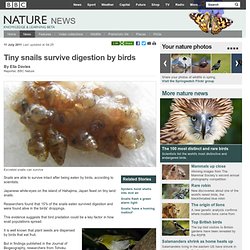
Japanese white-eyes on the island of Hahajima, Japan feast on tiny land snails. Zoologger: The first non-human meat farmers - life - 30 June 2011. Species: Melissotarsus insularis and three other Melissotarsus species Habitat: Down on the farm under the bark of African trees, particularly in Madagascar.
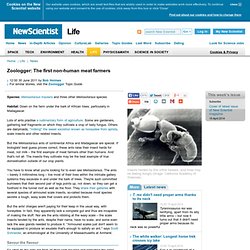
Lots of ants practise a rudimentary form of agriculture. Some are gardeners, gathering leaf fragments on which they cultivate a crop of tasty fungus. Others are dairymaids, "milking" the sweet excretion known as honeydew from aphids, scale insects and other related insects. But the Melissotarsus ants of continental Africa and Madagascar are special. Blind snake rediscovered after 100 years - Technology & science - Science - LiveScience. A rare blind snake has been rediscovered in Madagascar a century after its last sighting.
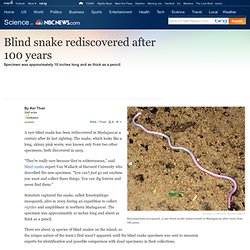
The snake, which looks like a long, skinny pink worm, was known only from two other specimens, both discovered in 1905. “They’re really rare because they’re subterranean,” said blind-snake expert Van Wallach of Harvard University who described the new specimen. “You can’t just go out anytime you want and collect these things. You can dig forever and never find them.” Scientists captured the snake, called Xenotyphlops mocquardi, alive in 2005 during an expedition to collect reptiles and amphibians in northern Madagascar. There are about 15 species of blind snakes on the island, so the unique nature of the team’s find wasn’t apparent until the blind snake specimen was sent to museum experts for identification and possible comparison with dead specimens in their collections. God instructs stoner grandfather to become smelly: He avoids bathing for 37 years. Some say cleanliness is next to godliness, but not Guru Kailash Singh who quit bathing 37 years ago, because he believe he’d be rewarded for his sacrifice.Kailash, 65, a farmer from India, stopped using soap and water in 1974, after his wedding.

He also hasn’t cut his dreadlocks, according to the news agency Barcroft.It wasn’t because he no longer needed to attract the ladies that he let himself go. Kailash reportedly abandoned washing because a priest told him it would help him produce a son.With seven daughters born since then, he’s still waiting for a male heir.Each evening, Kailash winds down the day with a “fire bath” ritual of smoking marijuana, praying to the Hindu god Shiva and dancing around a campfire.There was one failed attempt by his family to force him into a stream. ‘He fought us off and ran away,’ his wife Kalavati Devi, 60, told Barcroft. Strange Exits: Woman dies of heart attack caused by shock of waking up at her OWN funeral. Woman dies of heart attack caused by shock of waking up at her OWN funeral. Started screaming as mourners gathered around coffin saying prayers for her soul 'Her eyes fluttered but she only lived for another 12 minutes before she died again, this time for good' By Daily Mail Reporter Updated: 13:14 GMT, 24 June 2011.
Human eye protein senses Earth's magnetism. 21 June 2011Last updated at 16:35 By Jason Palmer Science and technology reporter, BBC News The cryptochrome protein comes in more than one type - and the human one can perform as the fly's A light-sensitive protein in the human eye has been shown to act as a "compass" in a magnetic field, when it is present in flies' eyes. The study in Nature Communications showed that without their natural "magnetoreception" protein, the flies did not respond to a magnetic field - but replacing the protein with the human version restored the ability.
Despite much controversy, no conclusive evidence exists that humans can sense the Earth's magnetic field, and the find may revive interest in the idea. DARPA Wants Artificial Lifeforms. Yesterday morning, at the Fifth International Meeting on Synthetic Biology at Stanford University, a representative from the DARPA announced a new program called Living Foundries that will invest in and develop synthetic biology projects. The goal, according to the agency’s program manager Alicia Jackson, is to revolutionize materials science, and to foster projects that will enable the creation and manufacture of materials that are not possible to make today, such as more efficient solar and electronic materials.
Blow from taxi restores boy's sight: News24: South Africa: News. Pigs could grow human organs in stem cell breakthrough. POOP BURGER: Japanese Researchers Create Artificial Meat From Human Feces. Scientists Find 'Werewolf' Gene - FoxNews.com. Eating dirt can be good for the belly, researchers find. Public release date: 2-Jun-2011 [ Print | E-mail Share ] [ Close Window ] Contact: Kevin Staceykstacey@press.uchicago.edu 773-834-0386University of Chicago Press Journals. ‘Devil Worm’ Takes Animal Life to New Depths. A 49-million-year-old spider face — in 3-D - Technology & science - Science - LiveScience. Why a mobile phone ring may make bees buzz off: Insects infuriated by handset signals. By David Derbyshire Updated: 13:45 GMT, 13 May 2011 Signals from mobile phones could be partly to blame for the mysterious deaths of honeybees, new research shows.
In the first experiment of its kind, a bee expert placed a mobile phone underneath a hive and then carefully monitored the reaction of the workers. Giant Squid Killed by Sound? Uh-Oh: Cows Genetically Modified With People DNA To Produce More Human-like Milk. BBC - Earth News - Plant lives inside animal: algae invade amphibian cells. Researchers have discovered a unique and rather weird example of a plant living inside an animal. A team from Dalhousie University in Halifax, Canada, discovered that a green alga invades tiny developing salamander embryos. Colloidal Silver: Blue Skin » iFitandHealthy.com. Continued from Colloidal Silver Make You Look Dumb. So why has Paul Karason’s skin permanently changed to a dark blue color?