
Lost City Revealed Under Centuries of Jungle Growth. Though it's long been known to locals that something—something big—is buried in this patch of Guatemalan rain forest, it's only now that archaeologists are able to begin teasing out what exactly Head of Stone was.
Using GPS and electronic distance-measurement technology last year, the researchers plotted the locations and elevations of a seven-story-tall pyramid, an astronomical observatory, a ritual ball court, several stone residences, and other structures. (See pictures of excavated Maya cities .) Some of the stone houses, said study leader Brigitte Kovacevich , may have doubled as burial chambers for the city's early kings. "Oftentimes archaeologists are looking at the biggest pyramids or temples to find the tombs of early kings, but during this Late-Middle Preclassic period"—roughly 600 B.C. to 300 B.C. Lost city of Ubar - revealed from outer space. It wasn't quite "Can I hitch a ride on your spaceship?
' But it was one of the strangest phone calls that the NASA space agency had received … A hesitant voice on the end of the line said: "I would like to talk to someone about using the Space Shuttle to look for a lost city. " With these few words, began one of the most extraordinary quests of the 2Oth century. CSI: Egypt. King Tut is in the news again--not regarding his supposed "curse," but as the subject of high-tech analyses that debunked his supposed "murder" and provided a more realistic representation of the youthful king's features.
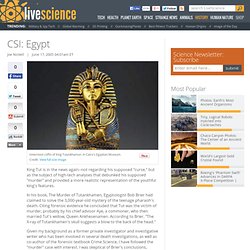
In his book, The Murder of Tutankhamen, Egyptologist Bob Brier had claimed to solve the 3,000-year-old mystery of the teenage pharaoh's death. Citing forensic evidence he concluded that Tut was the victim of murder, probably by his chief advisor Aye, a commoner, who then married Tut's widow, Queen Ankhesenamen. According to Brier, "The X-ray of Tutankhamen's skull suggests a blow to the back of the head. " Given my background as a former private investigator and investigative writer who has been involved in several death investigations, as well as co-author of the forensic textbook Crime Science, I have followed the "murder" case with interest.
Britain's Oldest Brain Found. Archaeologists have found what they say is the oldest brain ever discovered in Britain, or at least the shriveled remnant of one, in a decapitated skull that dates back more than 2,000 years.
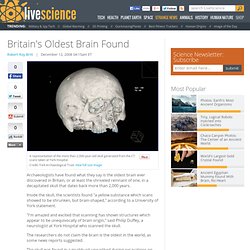
Inside the skull, the scientists found "a yellow substance which scans showed to be shrunken, but brain-shaped," according to a University of York statement. "I'm amazed and excited that scanning has shown structures which appear to be unequivocally of brain origin," said Philip Duffey, a neurologist at York Hospital who scanned the skull. Mummified Iceman's Ancient Job Determined. Before his body froze and mummified, a now-famous Neolithic guy dubbed the Iceman took his last steps while donned in a coat and leggings made of sheep's fur and moccasins made of cattle leather.
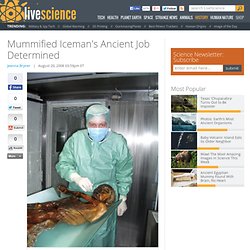
That was more than 5,000 years ago. The 45-year-old man apparently trekked up the Schnalstal glacier in the Italian Alps before dying, and a new study reveals more about how he lived. The body of the Iceman (also called Ötzi, Frozen Fritz and Similaun Man) was discovered in 1991 by accident by German tourists and made headlines around the world. Iceman Mummy Leaves Few Relatives. The Neolithic mummy dubbed the Iceman likely has no relatives alive today on his mom's side of the family, finds a new study of the ancient guy's genes.
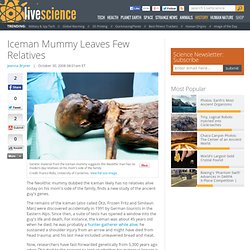
The remains of the Iceman (also called Ötzi, Frozen Fritz and Similaun Man) were discovered accidentally in 1991 by German tourists in the Eastern Alps. Since then, a suite of tests has opened a window into the guy's life and death. For instance, the Iceman was about 45 years old when he died; he was probably a hunter-gatherer while alive; he sustained a shoulder injury from an arrow and might have died from head trauma; and his last meal included unleavened bread and meat.
Now, researchers have fast-forwarded genetically from 5,300 years ago when Ötzi died to the present to look at whether his maternal lineage is alive and kicking. It's probably not. Mom's genes. Iceman Mummy Had Moss in His Tummy. A new study of the well-known "Iceman" mummy finds that he ate moss, though perhaps not on purpose.
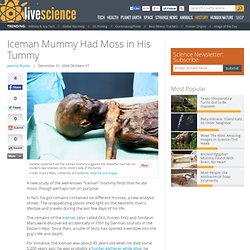
In fact, his gut remains contained six different mosses, a new analysis shows. The unappetizing plants shed light on the Neolithic man's lifestyle and travels during the last few days of his life. The remains of the Iceman (also called Ötzi, Frozen Fritz and Similaun Man) were discovered accidentally in 1991 by German tourists in the Eastern Alps. Since then, a suite of tests has opened a window into the guy's life and death. For instance, the Iceman was about 45 years old when he died some 5,200 years ago; he was probably a hunter-gatherer while alive; he sustained a shoulder injury from an arrow and might have died from head trauma; and his last meal included unleavened bread and meat. Apparently, he also ate and drank some mosses. Out of Asia: New Origin Proposed for Humans, Monkeys, Apes. The ancestors of monkeys, apes and humans were thought primarily to have originated in Africa, but now what may be the oldest examples of such fossils discovered yet on the continent suggest these primates might have originally arisen in Asia, researchers suggest.
The dating of the newfound fossils is controversial, however. The origin of anthropoids — the simians, or "higher primates" — has been hotly debated for decades among scientists. Although a series of fossils unearthed in Egypt have long suggested that Africa was the cradle for anthropoids, other bones revealed in the last 15 years or so raised the possibility that Asia may be their birthplace. Now paleontologists have revealed the earliest known African anthropoids found to date — three previously unknown kinds of the primates from Dur At-Talah in central Libya that apparently date back 38 million to 39 million years ago.
Genes: The Instruction Manuals for Life. A gene is a how-to book for making one product—a protein.
Proteins perform most life functions, and make up almost all cellular structures. Genes control everything from hair color to blood sugar by telling cells which proteins to make, how much, when, and where. Genes exist in most cells. Inside a cell is a long strand of the chemical DNA (deoxyribonucleic acid). A DNA sequence is a specific lineup of chemical base pairs along its strand. Inside genes. Top 10 Missing Links. The Many Mysteries of Neanderthals. Editor's Note: This is Part 6 in a 10-part LiveScience series on the origin, evolution and future of the human species and the mysteries that remain to be solved.
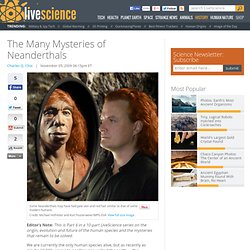
We are currently the only human species alive, but as recently as maybe 24,000 years ago another one walked the earth — the Neanderthals. These extinct humans were the closest relatives we had, and tantalizing new hints from researchers suggest that we might have been intimately close indeed. The mystery of whether Neanderthals and us had sex might possibly get solved if the entire Neanderthal genome is reported soon as expected. Some Neanderthals Were Redheads. Like bringing to life a naked mannequin, scientists are using genetic and physical evidence found in fossils to clothe the skeletal remains of our closest hominid relatives, the Neanderthals. More and more, they seem familiar.
Bones from two Neanderthals yielded valuable genetic information that adds red hair, light skin and perhaps some freckling to our extinct relatives. Scientist: Humans Strange, Neanderthals Normal. Neanderthals are often thought of as the stray branch in the human family tree, but research now suggests the modern human is likely the odd man out. "What people tend to do is draw a line from our ancestors straight to ourselves, and any group that doesn't seem to fit on that line is divergent, distinct, unusual, strange," researcher Erik Trinkaus, an anthropologist at Washington University in St. Louis, told LiveScience today. Scientists Build 'Frankenstein' Neanderthal Skeleton.
Anthropologists have built a "Frankenstein" Neanderthal skeleton, the first and only full-body reconstruction of the species. The result, announced today, is a shape no one expected. "It's almost like making my own fossil discovery," said Gary Sawyer, one of the skeleton's architects. Sawyer, an anthropologist at the American Natural History Museum in New York, and his colleague Blaine Maley of Washington University, pieced together the skeleton using bones mostly from an individual known as La Ferrassie 1. La Ferrassie 1 was missing its rib cage, pelvis, and a few other parts, so Sawyer and Maley had to scrounge around to find some parts. "The missing parts had to come from another classic Neanderthal that was similar, if not identical, in size to the La Ferrassie man," Sawyer told LiveScience in a phone interview.
The Many Mysteries of Neanderthals. Humans and Neanderthals Might Have Interbred. As modern humans spread across Europe tens of thousands of years ago, they may have interbred with Neanderthals, creating hybrids, according to a new study of ancient human bones from Romania. Anthropologists have long wondered what happened when the two species met as modern humans spread from Africa into Neanderthal territory in Eurasia: did the populations interbreed or did modern humans simply replace their cousins? The specimens examined and dated for the first time in this study show that “at least in Europe, the populations blended,” said study author Erik Trinkaus of Washington University.
The study compared the fragments, including a skull [image] and jaw [image], to bones of Neanderthals, early modern humans in Africa before they spread, and in Europe afterward. Trinkaus said that he and his colleagues found certain features that could have only come from Neanderthals, because early modern humans lost them before they spread from Africa. Neanderthal: 99.5 Percent Human. Humans and their close Neanderthal relatives began diverging from a common ancestor about 700,000 years ago, and the two groups split permanently some 300,000 years later, according to two of the most detailed analyses of Neanderthal DNA to date.
Using different techniques, two teams of scientists separately sequenced large chunks of DNA extracted from the femur of a 38,000-year-old Neanderthal specimen found in a cave [image] 26 years ago in Croatia. One team sequenced more than one million base pairs and the other 65,000 pairs of the genome. The achievements could help shed light on the evolution of our own species, and it paves the way for building a complete library of the Neanderthal genome, the scientists say. No evidence of interbreeding In popular imagination, Neanderthals are often portrayed as prehistoric brutes who became outsmarted by a more advanced species, humans, emerging from Africa. Ruling out contamination New advances Clues to our past. Neanderthal Brains Grew Like Ours. Score one more for Neanderthals. Chatty Cave Men? Me Neanderthal, Talk Good. Neanderthals might have spoken just like humans do now, new genetic findings suggest.
Neanderthals are humanity's closest extinct relatives. Neanderthals Were Cannibals, Study Confirms. Neanderthals suffered periods of starvation and may have supplemented their diet through cannibalism, according to a study of remains from northwest Spain. Paleobiologists studied samples from eight 43,000-year-old Neanderthal skeletons excavated from an underground cave in El Sidrón, Spain since 2000. Neanderthals and Humans: Perhaps They Never Met.
The number of years that modern humans are thought to have overlapped with Neanderthals in Europe is shrinking fast, and some scientists now say that figure could drop to zero. Neanderthals and Humans: Perhaps They Never Met. Neanderthals Fashioned Earliest Tool Made From Human Bone. Neanderthals Were High-Tech For Their Era. Neanderthal tools found in England suggest our early human relatives hunted with blades and spear tips that were pretty sophisticated, rivaling those made by modern humans, a new analysis suggests. Neanderthal 'Family' Possibly Victim of Cannibal Attack. Gnawed Bones Reveal Cannibal Cavemen. Prehistoric humans may have gnawed on each other's bones, researchers now suggest. Scientists have long seen evidence of prehistoric cannibalism, such as butcher marks on bones. To learn whether or not cavemen also chewed on human bones, researchers first had to get a good look at what such bite marks might look like.
Scientists had volunteers chew on bones — not human ones, but raw pork ribs and sheep legs as well as barbecued pork ribs and boiled mutton. The bone-gnawers included both Europeans and Koi people from Namibia. Human and Chimp Ancestors Might Have Interbred. The earliest known ancestors of modern humans might have reproduced with early chimpanzees to create a hybrid species, a new genetic analysis suggests. Based on the study of human and chimp genomes, the scientists believe the split between the human and chimpanzee lines occurred much more recently than previously thought—no more than 6.3 million years ago and perhaps as recently as 5.4 million years ago.
Human and chimpanzee ancestors began branching apart on the primate evolutionary tree some 9 million years ago, but there are significant gaps in the fossil record. The new analysis suggests that a full split, which scientists call speciation, wasn't achieved for nearly 4 million years and might have occurred twice. The study was published online today by the journal Nature. Going back in time. Brain Dead: Strange Find Analyzed.
Archaeology. History's Most Overlooked Mysteries. Archaeology on the Net. Forbidden Archeology - Michael A. Cremo. Archeology. Archeology. Archaeology Magazine.