
Uncertainty principle. Where ħ is the reduced Planck constant.
The original heuristic argument that such a limit should exist was given by Heisenberg, after whom it is sometimes named the Heisenberg principle. This ascribes the uncertainty in the measurable quantities to the jolt-like disturbance triggered by the act of observation. Though widely repeated in textbooks, this physical argument is now known to be fundamentally misleading.[4][5] While the act of measurement does lead to uncertainty, the loss of precision is less than that predicted by Heisenberg's argument; the formal mathematical result remains valid, however.
Since the uncertainty principle is such a basic result in quantum mechanics, typical experiments in quantum mechanics routinely observe aspects of it. Certain experiments, however, may deliberately test a particular form of the uncertainty principle as part of their main research program. Introduction[edit] Click to see animation. Wave mechanics interpretation[edit] . With yields. Level of consciousness (Esotericism) Consciousness is a loosely defined concept that addresses the human awareness of both internal and external stimuli.
This can refer to spiritual recognition, psychological understanding, medically altered states, or more modern-day concepts of life purpose, satisfaction, and self-actualization. Most theories map consciousness in a series of levels, some stages of which are more continuous or complex than others. Movement between stages is often bidirectional depending on internal and external conditions, with each mental ascension precipitating a change in reactivity. In the most basic sense, this alteration might lead to a reduced responsiveness as seen in anesthesiology; more abstract facets of tiered consciousness describe characteristics of profoundness, insight, perception, or understanding. Neural correlates of consciousness. Figure 1: The Neuronal Correlates of Consciousness (NCC) are the minimal set of neural events and structures – here synchronized action potentials in neocortical pyramidal neurons – sufficient for a specific conscious percept or a conscious (explicit) memory.
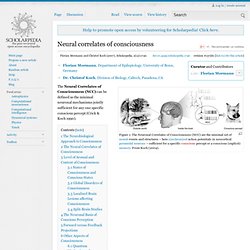
From Koch (2004). Our Conscious Mind Could Be An Electromagnetic Field. Are our thoughts made of the distributed kind of electromagnetic field that permeates space and carries the broadcast signal to the TV or radio.
Professor Johnjoe McFadden from the School of Biomedical and Life Sciences at the University of Surrey in the UK believes our conscious mind could be an electromagnetic field. “The theory solves many previously intractable problems of consciousness and could have profound implications for our concepts of mind, free will, spirituality, the design of artificial intelligence, and even life and death,” he said. Most people consider "mind" to be all the conscious things that we are aware of. But much, if not most, mental activity goes on without awareness. Actions such as walking, changing gear in your car or peddling a bicycle can become as automatic as breathing. Neural correlates of consciousness.
Measurement in quantum mechanics. A measurement always causes the system to jump into an eigenstate of the dynamical variable that is being measured, the eigenvalue of this eigenstate belongs to being equal to the result of the measurement— P.A.M.
Quantum entanglement. Quantum entanglement is a physical phenomenon that occurs when pairs or groups of particles are generated or interact in ways such that the quantum state of each particle cannot be described independently – instead, a quantum state may be given for the system as a whole.
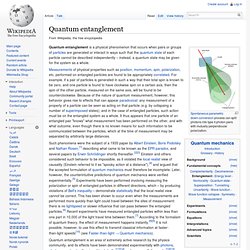
Such phenomena were the subject of a 1935 paper by Albert Einstein, Boris Podolsky and Nathan Rosen,[1] describing what came to be known as the EPR paradox, and several papers by Erwin Schrödinger shortly thereafter.[2][3] Einstein and others considered such behavior to be impossible, as it violated the local realist view of causality (Einstein referred to it as "spooky action at a distance"),[4] and argued that the accepted formulation of quantum mechanics must therefore be incomplete.
Fundamentals. Io9. We come from the future. Culture&science. Quantum physics explanation for smell gains traction. 24 March 2011Last updated at 13:58 By Jason Palmer Science and technology reporter, BBC News, Dallas The quantum details of a flower's chemicals may make the difference to our noses The theory that our sense of smell has its basis in quantum physics events is gaining traction, say researchers.
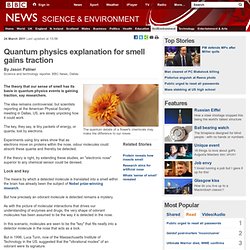
The idea remains controversial, but scientists reporting at the American Physical Society meeting in Dallas, US, are slowly unpicking how it could work. The key, they say, is tiny packets of energy, or quanta, lost by electrons. Experiments using tiny wires show that as electrons move on proteins within the nose, odour molecules could absorb these quanta and thereby be detected. If the theory is right, by extending these studies, an "electronic nose" superior to any chemical sensor could be devised. Lock and key The means by which a detected molecule is translated into a smell within the brain has already been the subject of Nobel prize-winning research.
Continue reading the main story. Physics Letters A : Quantum entanglement, indistinguishability, and the absent-minded driver's problem. The Age of Entanglement: When Quantum Physics Was Reborn - Louisa Gilder. A Quantum Communist Manifesto at Tomorrow Elephant. No Comment on Qubit - The Quantum Pontiff. A previous article on the meeting at Bell labs that I attended.
Notable: The National Institute of Standards and Technology and the super-secret National Security Agency are backing U.S. quantum projects.NSA spokesman Ken White declined to elaborate, “given the sensitivities about our work to understand the secret communications of our foreign adversaries while protecting our own communica tions, and given our desire to preserve our nation’s unique advan tages in these pursuits.” Ack. Quick, better shut down quant-ph! [IP] on crypto systems from CTO PGP. [ Date Prev ] | [ Thread Prev ] | [ Thread Next ] | [ Date Next ] -- [ Date Index ] | [ Thread Index ] | [ interesting-people Home ] Subject : [IP] on crypto systems from CTO PGP From : David Farber <dave@farber.net> To : ip@v2.listbox.com Date : Mon, 10 Jul 2006 06:04:17 -0400 Begin forwarded message: From: Jon Callas <jon@pgp.com> Date: July 9, 2006 5:56:15 PM EDT To: dave@farber.net Cc: Jon Callas <jon@pgp.com> Subject: Re: [IP] more on FBI plans new Net-tapping push Brian Randell said: Just because the government *claims* it can't break a given code ... :-) I realize that there was a smiley face at the end of this, and I might be showing humorlessness about this, but this concerns my profession in general, and my software in particular.
![[IP] on crypto systems from CTO PGP](http://cdn.pearltrees.com/s/pic/th/ip-crypto-systems-from-cto-pgp-11322781)
Modern cryptographic systems are essentially unbreakable, particularly if an adversary is restricted to intercepts. Breakthrough brings 'Star Trek' teleport a step closer - Science, News. A team of physicists has teleported data over a distance of 89 miles from the Canary Island of La Palma to the neighbouring island of Tenerife, which is 10 times further than the previous attempt at teleportation through free space.

The scientists did it by exploiting the "spooky" and virtually unfathomable field of quantum entanglement - when the state of matter rather than matter itself is sent from one place to another. Tiny packets or particles of light, photons, were used to teleport information between telescopes on the two islands. Quantum Entanglement - Solved (with pseudocode) Quantum pseudo-telepathy. Quantum pseudo-telepathy is a phenomenon in quantum game theory resulting in anomalously high success rates in coordination games between separated players. These high success rates would require communication between the players in a purely classical (non-quantum) world; however, the game is set up such that during the game, communication is physically impossible.
This means that for quantum pseudo-telepathy to occur, prior to the game the participants need to share a physical system in an entangled quantum state, and during the game have to execute measurements on this entangled state as part of their game strategy. Quantum Entanglement Questions. Quantum Weirdness. 'We must be clear that when it comes to atoms, language can be used only as in poetry.' — N. Bohr. What I most love of quantum mechanics is that it is nondeterministic, which means that it’s generally doesn’t predict the outcome of any measurement with certainty.
Instead, it just provides the probabilities of the outcomes, so that ‘measurements of a certain property done on two apparently identical systems can give different answers’ — to put it simply, the Truth is unfathomable. That’s how I’ve always perceived the universe and therefore life: governed by the uncertain definition inherent in its very core. This effect is now known as "non-local behavior" (aka "quantum weirdness" or as Einstein put it "spooky action at a distance"). 'Isolated material particles are abstractions, their properties being definable and observable only through their interaction with other systems.' N.
723-CCC05screen.pdf (application/pdf Object) Debunking and closing quantum entanglement 'loopholes' Quantum Entanglement. Quantum entanglement. Quantum Mechanics: Uncertainty Principle Used To Detect Entanglement Of Photon Shared Among Four Locations. Scientists at the California Institute of Technology (Caltech) have developed an efficient method to detect entanglement shared among multiple parts of an optical system. They show how entanglement, in the form of beams of light simultaneously propagating along four distinct paths, can be detected with a surprisingly small number of measurements. Entanglement is an essential resource in quantum information science, which is the study of advanced computation and communication based on the laws of quantum mechanics. In the May 8 issue of the journal Science, H. Jeff Kimble, the William L. QUANTUM GOD. Mi2g. Quantum Entanglement. Whatever happened to one particle would thus immediately affect the other particle, wherever in the universe it may be.
Einstein called this "Spooky action at a distance. " Amir D. Aczel, Entanglement, The Greatest Mystery In Physics. The Theory When a photon (usually polarized laser light) passes through matter, it will be absorbed by an electron. When the original photon splits into two photons, the resulting photon pair is considered entangled. Quantum networks advance with entanglement of photons, solid-state qubits.
A team of Harvard physicists led by Mikhail D. A Step Towards Quantum Computing: Entangling 10 Billion Particles. New painting - Quantum Entanglement. Quantum Entanglement Could Stretch Across Time. In the weird world of quantum physics, two linked particles can share a single fate, even when they’re miles apart. Now, two physicists have mathematically described how this spooky effect, called entanglement, could also bind particles across time. Quantum entanglement. Quantum entanglement. Quantum entanglement. Idealism Versus Materialism.
If you're new here, you may want to subscribe to my RSS feed. Thanks for visiting! Idealism Versus Materialism – What Do You Believe? From a philosophical point of view, there are two opposing concepts which describe our interaction with the world around us. These contradictive philosophies are materialism and idealism.