
The Next Digital Decade: Essays on the Future of the Internet. Michael Fullan. You can do anything - but not everything. Three Trends That Define the Future of Teaching and Learning. Culture Digital Tools Teaching Strategies This week, we feature the most popular posts of the year on MindShift.
In today’s dynamic classrooms, the teaching and learning process is becoming more nuanced, more seamless, and it flows back and forth from students to teachers. Here’s a look at current trends in teaching and learning, their implications, and changes to watch for. The Three Key Trends 1. If Web 2.0 has taught us anything, it’s to play nicely together. Lenny Gonzales Sharing information and connecting with others — whether we know them personally or not — has proven to be a powerful tool in education. They’re finding each other on their own kid-specific social networking sites, on their blogs, on schools’ sites, and of course on Facebook and Twitter. Educators Unite But social networking is not just for teens, as evidenced by the 500 million-plus Facebook users. 2. Flickr:Randy Pertiet Creating media is another noteworthy tech-driven initiative in education. 3.
60 Seconds - Things That Happen On Internet Every Sixty Seconds. World Wide Web is growing at rapid pace.

On average, more than a billion new pages are added to it every day. To give you an idea of how big world wide web is, our Infographic 60 Seconds will cover some really interesting facts about websites that we use on day-to-day basis. Please Check - Things That Happen Every Sixty Seconds Part 2 Infographic by- GO-Globe.com To Publish this Image on your Blog or Website . <a href=" alt="60 Seconds - Things That Happen On Internet Every Sixty Seconds" src=" width="580" /></a><br /><strong>Infographic by- <a href=" Did You Know That – In 60 SECONDS Search engine Google serves more that 694,445 queries 6,600+ pictures are uploaded on Flickr 600 videos are uploaded on YouTube videos, amounting to 25+ hours of content 695,000 status updates, 79,364 wall posts and 510,040 comments are published on Social Networking site Facebook.
Www.tpck.org. Australian Council for Educational Leaders: ACEL Home. Ed Tech Crew 196 - Australian Technologies Draft Curriculum. Educational Technology and Mobile Learning: The 21st century pedagogy teachers should be aware of. Interpersonal learning , personalized learning, second life learning , 3d learning, collaborative learning and virtual learning , these are just some of the few buzz words you would be be reading so often in today’s educational literature.

Things have changed , old methods and pedagogies are no longer relevant. The teacher-controlled learning where pre-constructed information is presented in a formal and standardized classroom settings becomes very obsolete. The urgent questions we should , as educators , ask ourselves are : what are the driving factors behind this huge transformation in learning ? New culture of learning. Docs/wheel.pdf. The Differentiator. Try Respondo!

→ ← Back to Byrdseed.com The Differentiator The Differentiator is based on Bloom's Taxonomy, Kaplan and Gould's Depth and Complexity, and David Chung's product menu. Try It In: French Dutch • Tweet It • Like Byrdseed • Pin It Students will judge the ethics of the [click to edit] using a textbook and create an essay in groups of three. Um-bloom-ra Bloom’s Taxonomy. Last week I blogged about my Bloomin’ Peacock, a new Bloom’s Taxonomy visual I made to share with teachers in a training.

Over the years, I have created a number of Bloom’s Taxonomy pictures to hang in my classroom for students to refer to. My Bloomin’ Peacock was such a hit with you all, I thought I would start sharing the others I’ve made. Today I revived one that I created for my classroom and added the digital version (again the digital tools displayed relate directly to the Treasures reading curriculum). Blooms Document. Bloom's, The 21st Century Version. So much have been written about Bloom’s taxonomy; one click in a search engine will flood your page with hundreds of articles all of which revolve around this taxonomy.
Only few are those who have tried to customize it to fit in the 21st century educational paradigm. Kathy Schrock's Guide to Everything - Bloomin' Apps. This page gathers all of the Bloomin' Apps projects in one place.Each image has clickable hotspots and includes suggestions for iPad, Android, Google and online tools and applications to support each of the levels of Bloom's Revised Taxonomy.I have created a page to allow you to share your favorite online tool, iOS, or Android app with others.
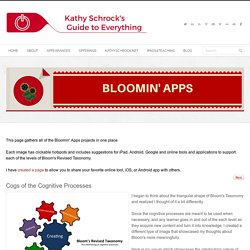
Cogs of the Cognitive Processes I began to think about the triangular shape of Bloom's Taxonomy and realized I thought of it a bit differently.Since the cognitive processes are meant to be used when necessary, and any learner goes in and out of the each level as they acquire new content and turn it into knowledge, I created a different type of image that showcased my thoughts about Bloom's more meaningfully.Here is my visual which showcases the interlocking nature of the cognitive processes or, simply, the "Cogs of the Cognitive Processes". Bloom’s Taxonomy and iPad Apps