
You Only Live Up to the Standards You Set. Defrag Your Brain With a Spark File. MemStash Helps You Remember Words, Quotes, Facts, or Anything Else with Timely Reminders. The Start to Finish Guide to a Perfect, Stress-Free Vacation. LSF. The Simply Business Productivity Series. In a productivity rut?

Cut your admin time with our new Productivity Series. Increasing productivity is a challenge – whether your primary objectives are to increase profitability, to grow and expand; or if you’re just trying to spend a little less time battling with your inbox! We’ve put together a tool box to help you fight back. A key part of the challenge is the sheer amount of information on productivity there is out there - blog posts, books, videos, tools and apps – who has the time to evaluate this stuff? Dual NBack Application. Improve Your Memory by Using Memory Foraging Strategies. Change a Habit in Three Steps with This Flowchart. I'm going to promote your comment by way of calling you out for being a bullshitter extraordinaire.
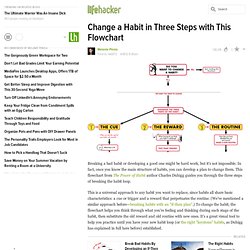
Nicotine is one of the most famously addictive substances known. There are many cases reported of people who were told they had cancer, were on drugs and treatment to help them fight cancer, and yet could not stop smoking tobacco. The BBC had a documentary about this phenomenon at least 15 years ago. Develop a Two-Minute Meditation Habit and Make It Stick. Talking to Yourself Makes You Smarter. Make Something Good Out of Rejection. There are a lot of books and how-to guides telling you how to deal with rejection.
Some suggest positive thinking, coping strategies and visualizing for a better tomorrow. Others tell you about the serial phases like “denial”, “bargaining”, “acceptance” you’ll inevitably go through when rejected. But these are just ideas; strategies packed together by well-meaning coaches. Rules - Rejection Therapy Rejection Therapy.
Consists of only one main rule… Please notice the wording of the rule.
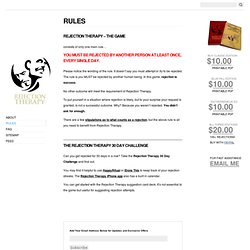
It doesn’t say you must attempt or try to be rejected. The rule is you MUST be rejected by another human being. In this game, rejection is success. 20 Common Grammar Mistakes That (Almost) Everyone Gets Wrong. I’ve edited a monthly magazine for more than six years, and it’s a job that’s come with more frustration than reward.
If there’s one thing I am grateful for — and it sure isn’t the pay — it’s that my work has allowed endless time to hone my craft to Louis Skolnick levels of grammar geekery. As someone who slings red ink for a living, let me tell you: grammar is an ultra-micro component in the larger picture; it lies somewhere in the final steps of the editing trail; and as such it’s an overrated quasi-irrelevancy in the creative process, perpetuated into importance primarily by bitter nerds who accumulate tweed jackets and crippling inferiority complexes. Ditch Hard Drive Clutter with an Organized, Automated Home Folder. Just wanted to share another tool that can replace and improve upon Belvedere (since it hasn't been updated in 2 years).
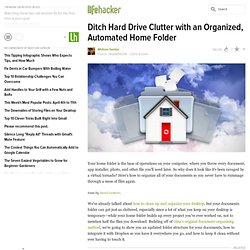
The program is called DropIT. Here is the description from their website: When you need to organize files, DropIt can eliminate much of the drudgery of searching and manually opening folders and moving files around. Drop a group of different files and folders on the floating DropIt image and it sorts them to defined destination folders, compresses or extracts them, opens them with associated programs or performs other defined actions.
You can define how to filter your files (by name, directory, size, date, properties, content, regular expressions) and associate one of the 18 available actions to perform (Move, Copy, Compress, Extract, Rename, Delete, Encrypt, Decrypt, Open With, Upload, Send by Mail, Create Gallery, Create List, Create Playlist, Create Shortcut, Copy to Clipboard, Change Properties and Ignore). 5 No-BS Ways to Become Awesome in 5 Minutes. You’re at college and working two jobs.

You have a date in 15 minutes. Myers-Briggs Type Indicator. Model of personality types A chart with descriptions of each Myers–Briggs personality type and the four dichotomies central to the theory The Myers–Briggs Type Indicator (MBTI) is an introspective self-report questionnaire indicating differing psychological preferences in how people perceive the world and make decisions.[1][2][3] The original versions of the MBTI were constructed by two Americans, Katharine Cook Briggs and her daughter Isabel Briggs Myers.[4] The MBTI is based on the conceptual theory proposed by Swiss psychiatrist Carl Jung,[5] who had speculated that people experience the world using four principal psychological functions – sensation, intuition, feeling, and thinking – and that one of these four functions is dominant for a person most of the time.[6] The four categories are Introversion/Extraversion, Sensing/Intuition, Thinking/Feeling, Judging/Perception.
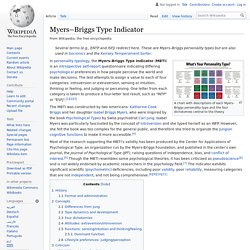
Each person is said to have one preferred quality from each category, producing 16 unique types. History[edit] How to hold that thought till morning. The Science Behind a Bad Mood and What You Can Do About It. How to Find More Time in Your Day by Putting Your Chores on Auto-Pilot. First I wanted to say this was a really good article with lots of content, and not just a quick summery and a link.

These are the types of articles I like to see on Lifehacker. As far as tips: Batching- I do this somewhat for food. Living alone I'll make several servings. I now have a few lunches/suppers cooked for the future. Make use of little spurts of energy. How to Re-program Your Memory to Become More Self-Reliant. How I Achieved Better Sleep with the Help of Technology. How to Make Waking Up Comfortable and Pleasurable (Instead of Punishing) Increase Your Dating Success with Statistics. I've admittedly been on OKCupid for awhile now.
When I first got on the site, I did exactly what you said and got maybe a 1/10 response back. But let me break down what's happened since. It usually ends up a few ways. 1) The girl has a dealbreaker for me. How to Overcome Your Fatal Flaw.