
Millennium Ecosystem Assessment. The Protests and the Metamovement - Umair Haque. By Umair Haque | 3:08 PM October 4, 2011 Across the globe, protests are rippling out like vectors in an epidemic.

I believe that we’re witnessing the rise of a global Metamovement. The Metamovement is a movement of movements. Not all these movements are similar, and no two are exactly like. Our Panarchic Future. A theory that explains the evolution of ecosystems may apply to civilizations as well-and it says we're approaching a critical phase.

[Editor's note: The following article is adapted from The Upside of Down: Catastrophe, Creativity, and the Renewal of Civilization, by Thomas Homer-Dixon (copyright © Resource & Conflict Analysis, Inc.) and printed by permission of Island Press, Washington, D.C. (www.islandpress.org).] Buzz Holling, one of the world's great ecologists, is a kind and gracious man, with a shock of white hair and a warm smile. Born in Toronto and educated at the University of Toronto and the University of British Columbia, he worked for many years as a research scientist for the government of Canada, where he pioneered the study of budworm infestations in the great spruce forests of New Brunswick.
Since the early 1970s, Holling's research has attracted attention in disciplines ranging from anthropology to economics. Dangerous Efficiency Nested Cycles Lessons from Rome... Prioritize... Hamilton: Panarchy - resilience cycle of living systems. 7- Open Gov & E Democracy. Anarchy as Order. * Book: Anarchy as Order: The History and Future of Civic Humanity.
Mohammed A. Bamyeh. Rowman & Littlefield Publishers, Inc. (May 16, 2010) Transformation from Carbon Valley to a Post-carbon Society in a climate-change hot spot: The coalfields of the Hunter Valley, New South Wales, Australia. Drawing a Better Panarchy Diagram. I am always on the lookout for good graphics and diagrams for my lectures on complexity and adaptive change.
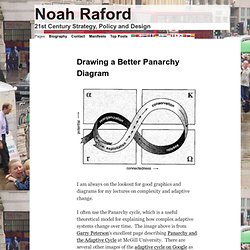
I often use the Panarchy cycle, which is a useful theoretical model for explaining how complex adaptive systems change over time. The image above is from Garry Peterson‘s excellent page describing Panarchy and the Adaptive Cycle at McGill University. There are several other images of the adaptive cycle on Google as well. I created my own, however, which are perfectly overlaid to animate in a PowerPoint or Keynote. Please feel free to use these images in your graphics or presentations, just as long as you credit Gunderson & Holling for their original insights. There are three versions of the slides below; one with full annotation, one with partial annotation, and one without any annotation.
I hope you find these useful. Version 1m with full annotation Version 2, with partial annotation Version 3, with no annotation. Resilience Alliance - Panarchy. No system can be understood or managed by focusing on it at a single scale.
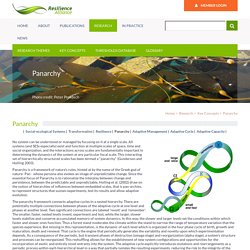
All systems (and SESs especially) exist and function at multiple scales of space, time and social organization, and the interactions across scales are fundamentally important in determining the dynamics of the system at any particular focal scale. This interacting set of hierarchically structured scales has been termed a "panarchy" (Gunderson and Holling 2003). Panarchy.org : Index. Category:Panarchy. The discussion of panarchy herein will be embryonic in nature.
I will begin with the complete shape, but only in the simplest of forms. As I add more material, the overall structure will become more developed and clarified, but all of the essentials will have been laid out in the beginning. Panarchy is a transdisciplinary investigation into the political and cultural philosophy of "network culture. " The primary fields of relevance for panarchy are world politics (international relations), political philosophy/theory, and information technology.
Panarchy also draws on insights from information/communications theory, economics, sociology, networks, and complex systems. Panarchy. Panarchy is a conceptual term first coined by the Belgian philosopher, economist, and botanist Paul Emile de Puydt in 1860, referring to a specific form of governance (-archy) that would encompass (pan-) all others.[1] The Oxford English Dictionary lists the noun as "chiefly poetic" with the meaning "a universal realm," citing an 1848 attestation by Philip James Bailey, "the starry panarchy of space".
The adjective panarchic "all-ruling" has earlier attestations.[2] In the twentieth century the term was re-coined separately by scholars in international relations to describe the notion of global governance and then by systems theorists to describe non-hierarchical organizing theories. Freely choosing government[edit] In his 1860 article "Panarchy" de Puydt, who also expressed support for laissez-faire economics, applied the concept to the individual's right to choose any form of government without being forced to move from their current locale. Le Grand E. Global Society[edit] James P. Panarchy. Handprints to panarchy: 20 more sustainability diagrams « Computing for Sustainability. Diverse lot to add to the collection this time – from the very simple (how did I miss the balance images so far?)
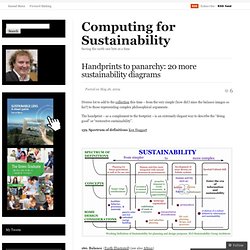
To those representing complex philosophical arguments. The handprint – as a complement to the footprint – is an extremely elegant way to describe the “doing good” or “restorative sustainability”. 159. Spectrum of definitions Ken Haggart 160. 161. 5 capitals (Sigma project) 162. 163.